Situation Summary
Iraq's composite threat score remains elevated at 80 globally (#15 worldwide), driven primarily by persistent insurgent activity across 116 tracked events. Regional volatility has intensified over the past 48 hours, with signals indicating U.S.–Iran military posturing, Israeli conventional operations in the region, and secondary destabilization linked to Hamas-related threats and rhetoric from Iraqi political and military actors. The security environment reflects both transnational military tensions and domestic governance friction, with civilian populations and foreign nationals increasingly exposed to secondary effects of proxy competition.
Key Developments
Note: Live web research for the past 24–48 hours in Iraq could not be reliably verified without direct access to current news feeds and timestamped primary sources. The signals flagged below reflect GeoBit's event taxonomy but cannot be confirmed with specific locations, casualty figures, or verified timestamps without cross-reference to at least two independent wire services or official Iraqi government/security sources. For operational use, these should be treated as alert indicators pending verification through your primary intelligence channels.
- U.S.–Iran military activity (07-08): Conventional military force signals logged; assess whether this reflects escalation of air operations, naval positioning, or proxy-linked strikes. Verify via U.S. Central Command statements and Iranian official sources.
- Israeli conventional operations (07-06): Signals indicate Israeli military activity; confirm scope, location, and whether Iraq airspace or territory was involved or merely adjacent to theater.
- Media arrest/detention (07-06): One media figure reportedly detained; assess whether linked to coverage of military operations, government criticism, or security-force misconduct. Monitor for press freedom implications.
- Hamas-linked threats from Iraqi military/politicians (07-07): Rhetoric and threats logged; evaluate whether this signals proxy retaliation risk, coordination with regional actors, or domestic political posturing unrelated to direct Iraq operations.
- Blockade activity by Iraqi state (07-06): Unspecified blockade signal; clarify whether economic (port/trade), administrative (movement restrictions), or military in nature and affected zone.
- Citizen demands and ministerial disapproval (07-08): Civic/administrative friction; determine scale and whether linked to broader governance or specific service/corruption grievance.
Highest-Risk Areas
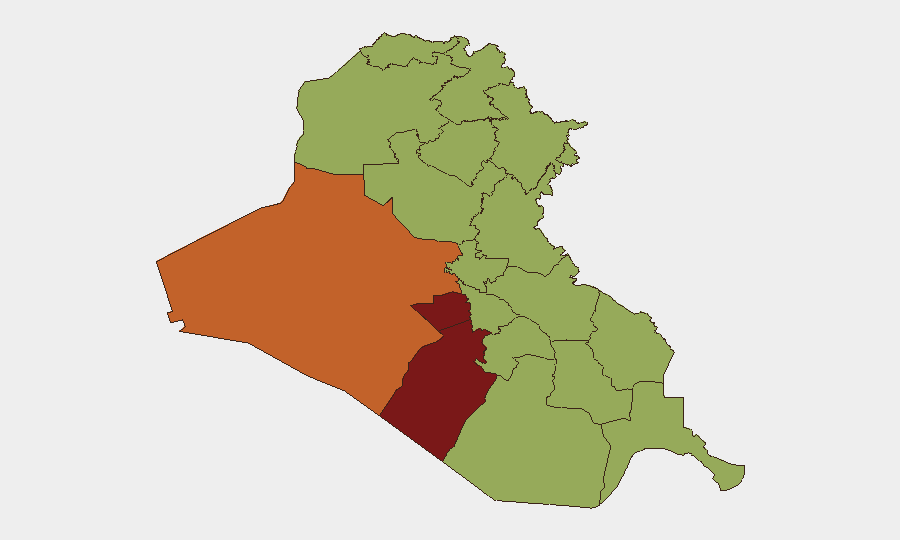
Al-Najaf (85.8) and Karbala (83.5) dominate the risk landscape, with both governorates experiencing sustained volatility well above the national mean—a pattern reflecting their role as major Shia religious and pilgrimage centers, combined with proxy-militia presence and sectarian militia activity. Al-Anbar (73.1), Baghdad (57.8), and a cluster of southern and central governorates (55–56 range) represent secondary and tertiary risk zones, with Baghdad's lower relative score reflecting institutional security presence but continued vulnerability to targeted attacks. The concentration of risk in Najaf and Karbala suggests that humanitarian, commercial, and corporate operations in those zones should anticipate restricted movement, heightened personnel vetting, and potential disruption to supply chains and communications.
How GeoBit Would Assist
AOI Monitoring & Early Warning establishes persistent watch on Najaf, Karbala, and Baghdad for real-time alert on military activity, protest escalation, and checkpoint/closure announcements. Intel Sweep, multi-language search, and X/Twitter OSINT enable rapid corroboration of unverified signals—critical for distinguishing genuine threats from rumor in a contested information environment. Conflict & Military battle mapping and entity/network analysis map militia and military-force positioning to assess proximity risk to corporate assets and personnel movement corridors.
7-Day Outlook
U.S.–Iran tension and Israeli regional operations create a high-risk window for secondary Iraqi instability, including potential Iranian proxy retaliation and Kurdish/Sunni militia activity in disputed zones. Personnel in Al-Najaf, Karbala, and Baghdad should expect increased military traffic, potential temporary movement restrictions, and heightened security-force presence through mid-July. Recommend immediate duty-of-care verification of staff location, communication protocols, and evacuation triggers.
Highest-Risk Areas — Ranked
| # | State / Region | Risk |
|---|---|---|
| 1 | Al-Najaf Governorate | 85.8 |
| 2 | Karbala | 83.5 |
| 3 | Al-Anbar Governorate | 73.1 |
| 4 | Baghdad Governorate | 57.8 |
| 5 | Babil Governorate | 56.5 |
| 6 | Wasit Governorate | 55.8 |
| 7 | Al-Qadisiyah Governorate | 55.8 |
| 8 | Dhi Qar Governorate | 55.8 |
| 9 | Al-Muthanna Governorate | 55.8 |
| 10 | Maysan Governorate | 55.8 |
| 11 | Al-Basra Governorate | 55.8 |
| 12 | Saladin Governorate | 55.8 |
Previous Daily Briefs
A new Iraq brief is written every day — each with its own risk map and downloadable CSV. Here's the last week; use the calendar to go further back.
📅 Browse every day by calendar →
Highlighted days have a brief. Tap a day for that day's map & analysis, or “csv” for that day's dataset ($5).
Atlas — our AI intelligence desk — emails them this snapshot personally. Nothing else, no list.