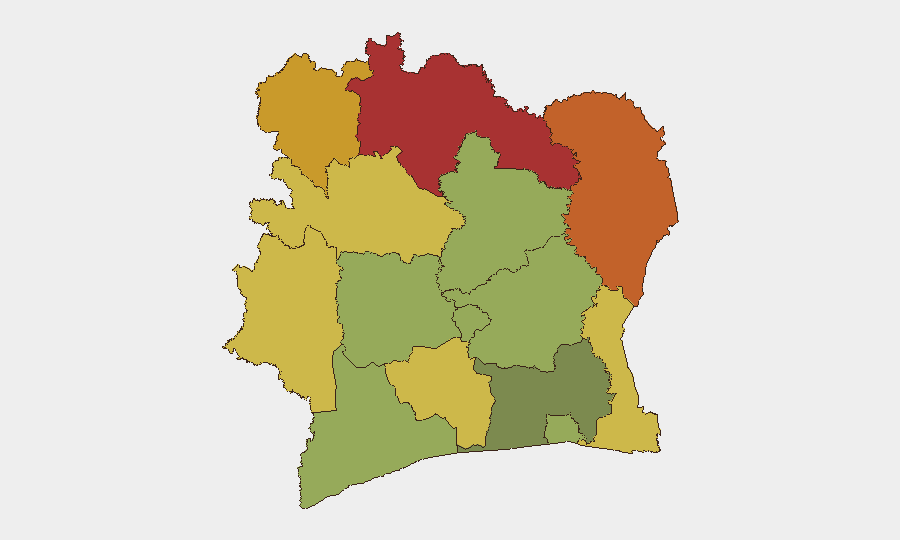
Situation Summary
Ivory Coast remains a moderate regional security concern (global rank #64), with insurgency and terrorism as primary drivers, though no major incidents were recorded in the past week. Security momentum reflects a dual focus: ongoing counterterrorism coordination with Mali amid jihadist pressure on the northern border, and domestic crime prevention through enhanced law enforcement operations and critical-infrastructure protection. The northern savanna districts (Savanes, Zanzan, Denguélé) continue to pose the highest risk profile, while Abidjan and southern zones remain relatively more stable.
Key Developments
- Abidjan, 12 October: Authorities inaugurated an Integrated Operations Centre for State Action at Sea with standardized maritime operating procedures, signaling enhanced capacity for maritime surveillance and threat response.
- Abidjan, 12 October: PPA-CI strategic council president Sébastien Dano Djédjé was charged with 17 offenses including alleged threats to state security and terrorism-related counts; he was placed under judicial supervision, indicating heightened domestic political sensitivity around extremism narratives.
- Bamako (Mali), 15–17 October: Ivorian intelligence chief Vassiriki Traoré conducted high-level security talks with Malian counterparts on counterterrorism and intelligence cooperation, reflecting bilateral concern over jihadist activity affecting the border region.
- Kani department, 15 October: Gendarmerie and Séguéla forces conducted coordinated late-night operations (after 22:00) in response to reported robberies and burglaries, suggesting a localized crime uptick warranting resource mobilization.
- Korhogo, 15 October: Police arrested a suspect linked to the theft of electrical cables and equipment from COOPEX-CI factory (burglary occurred 9–10 October). The arrest reflects ongoing petty-to-mid-level property crime affecting industrial sites.
- Abidjan, 13 October: A cybersecurity cooperation agreement expanded locally operated security-operations capabilities for public institutions and critical-infrastructure operators, indicating growing cyber-threat awareness among government stakeholders.
Highest-Risk Areas
The northern savanna belt—comprising Savanes (risk 78), Zanzan (75), and Denguélé (72) districts—dominates the risk profile, reflecting persistent jihadist infiltration, porous borders with Mali, and limited state security presence in remote areas. Comoé (70) and Montagnes (68) districts extend this arc eastward and southward, creating a high-risk northern crescent. By contrast, Abidjan (45) and southern coastal districts carry substantially lower composite scores, though Abidjan remains a hub for organized and transnational crime. The October intelligence visit to Mali underscores that border-region terrorism remains the primary driver of national-level threat elevation.
How GeoBit Would Assist
Security teams should deploy AOI Monitoring & Early Warning on northern border zones (Savanes, Zanzan, Denguélé) to detect militant movement and cross-border incursions. Network & Actor Analysis combined with multi-language OSINT (X/Twitter, Telegram, local radio SIGINT) will track jihadist recruitment, financing, and operational messaging. Routing & Network Analysis enables duty-of-care teams to identify safe transit corridors and contingency evacuation routes, especially for personnel traveling to or near the north.
7-Day Outlook
Expect continued incremental security-sector capacity-building (maritime, cyber, gendarmerie operations) as authorities address fragmented threats across crime, extremism, and infrastructure protection. Border-region jihadist activity will likely remain the primary strategic concern, though no major escalation is signaled for the coming week. Domestic political sensitivities (as reflected in the PPA-CI leadership charges) may amplify if opposition voices challenge counterterrorism rhetoric.
Highest-Risk Areas — Ranked
| # | State / Region | Risk |
|---|---|---|
| 1 | Savanes District | 78 |
| 2 | Zanzan District | 75 |
| 3 | Denguélé District | 72 |
| 4 | Comoé District | 70 |
| 5 | Montagnes District | 68 |
| 6 | Woroba District | 65 |
| 7 | Gôh-Djiboua District | 60 |
| 8 | Sassandra-Marahoué District | 58 |
| 9 | Vallée du Bandama District | 55 |
| 10 | Bas-Sassandra District | 52 |
| 11 | Lacs District | 48 |
| 12 | Abidjan | 45 |
Sources
Previous Weekly Briefs
A new Ivory Coast brief is written every Monday, covering the week — each with its own risk map and downloadable CSV. Use the calendar to go further back.
- October 12, 2026
- October 5, 2026
- September 28, 2026
- September 21, 2026
- September 14, 2026
- September 7, 2026
- September 2, 2026
📅 Browse past briefs by calendar →
Highlighted days have a brief. Tap a day for that day's map & analysis, or “csv” for that day's dataset ($5).
Atlas — our AI intelligence desk — emails them this snapshot personally. Nothing else, no list.