Situation Summary
Mexico remains at elevated security risk (rank #5 globally, composite score 100), driven principally by ongoing insurgency and organized-crime violence. The past 48 hours have seen concentrated incidents across multiple high-risk states—Sinaloa, Baja California, Tamaulipas, and Michoacán—involving armed clashes, police casualties, and mass detentions, with at least three high-profile violent events reported. The pattern suggests intensified enforcement operations and active cartel/criminal-group conflict, compounded by transparency gaps in some incidents that may complicate threat assessment.
Key Developments
- Sinaloa (Sanalona/Culiacán zone) – ~48 hours ago: A major confrontation in the ejido *El 12* (Sanalona area) resulted in 19 deaths; authorities have identified 12 of the deceased. A separate large security operation in Agua Verde–Chametla remains without official public report more than 48 hours post-incident, raising concern over operational transparency and civilian protection protocols in an active conflict zone.
- Baja California (state-wide) – last 48 hours: Two agents of the Fuerza Estatal de Seguridad Ciudadana (FESC) were killed within less than 48 hours following prior threats. Coordinated enforcement has resulted in 45 detentions linked to attacks on FESC personnel and 15 additional arrests over the same window; 12 more were detained in Mexicali Valley operations in the past 48 hours.
- Michoacán (Álvaro Obregón) – night of 11 July: An armed attack at a wake killed three persons and injured at least four; no immediate attribution reported.
- Michoacán (Morelia) – 11 July: The State Attorney General's Office opened an investigation after a police officer allegedly ran over and killed a civilian in the Misión del Valle neighborhood; incident remains under review.
- Tamaulipas (Matamoros) – 11 July: A security-force clash with alleged organized-crime actors resulted in two wounded detainees and seizure of a Barrett .50-caliber rifle, eight long guns, a high-end vehicle, and tactical gear.
- Guerrero (Huamuxtitlán) – last 48 hours: Civil society and local media report persistent violence and absence of effective state response; local actors describe conditions as "terror and abandonment" with limited official communication on recent incidents.
- Government-level signal – 13 July: A disapproval signal involving government entities was recorded, consistent with ongoing institutional friction over security responses and policy direction.
Highest-Risk Areas
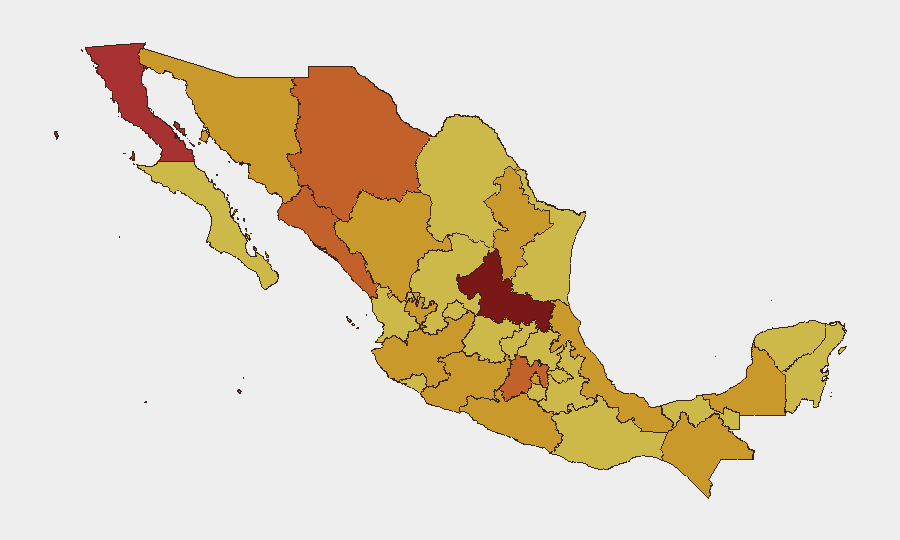
San Luis Potosí (risk 100) remains the single most elevated sub-national threat, followed closely by Baja California (76.7), Chihuahua (74.6), and State of Mexico (74.1). The immediate 48-hour activity pattern, however, shows acute risk concentration in *Sinaloa, Baja California, Michoacán, and Tamaulipas*—all in the top ten—where armed confrontations, police casualty events, and mass detentions signal either active cartel conflict or intensified state enforcement (or both). Baja California's two police killings and multi-jurisdiction arrests suggest either targeted attacks on state security forces or ongoing operational pressure on criminal networks; Sinaloa's mass-casualty event and reporting opacity point to active cartel-on-cartel or state-led tactical engagement.
How GeoBit Would Assist
Real-time AOI Monitoring & Early Warning on high-risk states would provide persistent alerting on force movements, incident clusters, and security-force deployments. Intel Sweep and OSINT fusion (X, Telegram, local media, radio SIGINT) would fill transparency gaps—particularly for incidents like the Agua Verde–Chametla operation—and corroborate casualty figures and detainee numbers. Network & Actor Analysis and conflict mapping would clarify whether observed arrests and clashes reflect cartel infighting, state counter-narcotics pressure, or organized attacks on security forces, enabling teams to adjust travel, facility security, and staffing protocols accordingly.
7-Day Outlook
Multi-state enforcement operations and cartel violence are likely to persist, with Baja California and Sinaloa remaining flashpoints. Transparency delays and institutional friction signals suggest policy or tactical repositioning; no immediate ceasefire or de-escalation indicators are evident. Organizations with personnel or assets in top-ten risk states should anticipate continued volatility and maintain heightened situational awareness.
Highest-Risk Areas — Ranked
| # | State / Region | Risk |
|---|---|---|
| 1 | San Luis Potosí | 100 |
| 2 | Baja California | 76.7 |
| 3 | Chihuahua | 74.6 |
| 4 | State of Mexico | 74.1 |
| 5 | Sinaloa | 73.8 |
| 6 | Veracruz | 72.9 |
| 7 | Durango | 72.5 |
| 8 | Jalisco | 72.2 |
| 9 | Sonora | 72.1 |
| 10 | Mexico City | 71.7 |
| 11 | Campeche | 71.6 |
| 12 | Chiapas | 71.6 |
Sources
Previous Daily Briefs
A new Mexico brief is written every day — each with its own risk map and downloadable CSV. Here's the last week; use the calendar to go further back.
📅 Browse every day by calendar →
Highlighted days have a brief. Tap a day for that day's map & analysis, or “csv” for that day's dataset ($5).
Atlas — our AI intelligence desk — emails them this snapshot personally. Nothing else, no list.