Situation Summary
The United Arab Emirates faces an elevated but contained security environment driven by sustained regional missile and drone threats originating outside its borders. Since mid-July 2026, Iran has conducted multiple attacks on neighboring states (Bahrain, Kuwait, Qatar, Jordan, Oman) following U.S. strikes on Iranian targets, prompting UAE authorities to activate air defenses and issue nationwide alerts. Although direct strikes on UAE territory have not occurred, the spillover risk and unpredictability of the regional escalation have compelled U.S. and UK diplomatic missions to restrict operations and issue heightened travel warnings. The threat trajectory remains volatile but currently stabilized at elevated alert status rather than acute crisis.
Key Developments
- Abu Dhabi & Dubai – U.S. consular suspension (July 13–15). The U.S. Embassy in Abu Dhabi and Consulate General in Dubai canceled all consular appointments and suspended routine visa services due to regional security concerns; non-emergency U.S. personnel have been relocated outside the UAE under ordered-departure status.
- UAE airspace – European aviation guidance issued (mid-July). European aviation authorities issued fresh operational guidance for airlines transiting Gulf airspace in response to ongoing missile and drone activity, signaling perceived overflight risk for routes through or near UAE airspace.
- UK Foreign Office travel-advisory update (July 13–15). The FCDO updated its UAE travel advice noting that despite a recent U.S.-Iran memorandum of understanding, Iran has carried out further attacks on the region since the MOU, with unpredictable escalation risk and renewed strike possibility at short notice.
- UAE air-defense activation (recent Sunday, early July). UAE authorities activated nationwide air defenses and issued alerts in response to missile and drone threats; later clarifications confirmed threats remained outside UAE territory while regional strikes impacted neighboring states.
- Gulf regional escalation (early-to-mid July). Reporting describes U.S. strikes on Iranian targets, followed by Iranian missile and drone attacks on Bahrain, Kuwait, Qatar, Jordan, and Oman; Iran declared the Strait of Hormuz closed "until further notice," directly driving UAE's defensive posture and consular restrictions.
- Consular services degradation across UAE (July 13–15). Limited consular assistance is available across U.S. missions in Dubai and Abu Dhabi; routine support for U.S. citizens and residents is materially reduced during the current security window.
Highest-Risk Areas
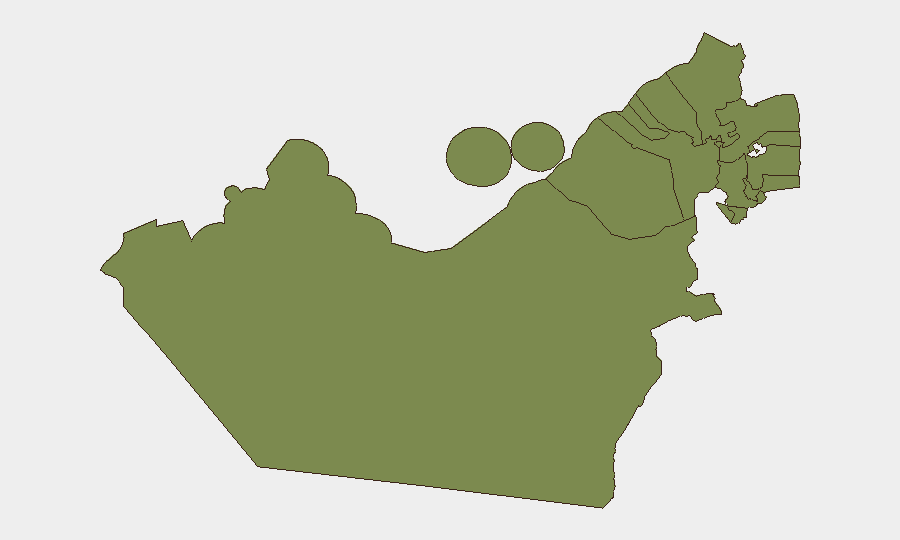
Dubai (risk 31.9) and Abu Dhabi Emirate (risk 31) account for the overwhelming majority of tracked security events and composite threat elevation, reflecting their status as regional economic hubs, diplomatic centers, and aviation/maritime chokepoints. Both emirates host significant expatriate populations, consular presence, and critical infrastructure; the concentration of events in these zones suggests clustering around U.S. and international facilities, transportation nodes, and government installations. The remaining five emirates (Ras al-Khaimah, Sharjah, Ajman, Fujairah, Umm al-Quwain) carry materially lower composite risk (1.9–2.2), indicating that spillover or secondary-impact risk is concentrated in the major urban and administrative centers.
How GeoBit Would Assist
Corporate security teams in the UAE should employ AOI Monitoring & Early Warning to track developments at U.S. and allied facilities in Dubai and Abu Dhabi, coupled with multi-language OSINT and Telegram/X monitoring to detect emerging warnings before official travel advisories. Maritime & Aviation tracking and Routing & Network Analysis capabilities enable real-time assessment of alternative transportation corridors and port operations in the event of further disruption to Strait of Hormuz transits or overflight restrictions.
7-Day Outlook
Regional tensions are likely to remain elevated over the next week, with continued risk of opportunistic strikes on neighboring states; the UAE is expected to maintain heightened air-defense posture and consular restrictions. The trajectory depends on diplomatic engagement and de-escalation; absent new Iranian or U.S. military action, the current alert status may gradually ease toward normalcy by late July, though reversals remain plausible given stated Iranian intent and regional volatility.
Highest-Risk Areas — Ranked
| # | State / Region | Risk |
|---|---|---|
| 1 | Dubai | 31.9 |
| 2 | Abu Dhabi Emirate | 31 |
| 3 | Ras al-Khaimah | 2.2 |
| 4 | Sharjah Emirate | 1.9 |
| 5 | Ajman Emirate | 1.9 |
| 6 | Fujairah Emirate | 1.9 |
| 7 | Umm al-Quwain | 1.9 |
Sources
Previous Daily Briefs
A new United Arab Emirates brief is written every day — each with its own risk map and downloadable CSV. Here's the last week; use the calendar to go further back.
📅 Browse every day by calendar →
Highlighted days have a brief. Tap a day for that day's map & analysis, or “csv” for that day's dataset ($5).
Atlas — our AI intelligence desk — emails them this snapshot personally. Nothing else, no list.