Situation Summary
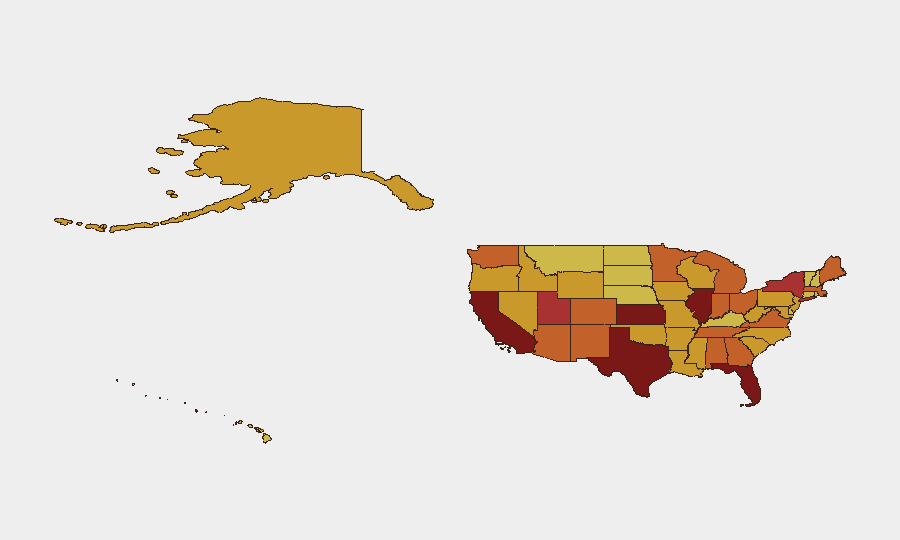
The United States faces an elevated composite threat environment (rank #11 globally, score 99) driven by concurrent civil, legal, and geopolitical pressures. The past 48 hours have seen escalation in U.S.–Iran military tensions following retaliatory strikes on Iranian targets, with spillover risk affecting U.S. personnel in the Middle East and potential downstream impacts on domestic security posture and resource allocation. Domestic signals include prosecutor statements, school-district confrontations, and voter–education conflicts, indicating fragmented civil stress across multiple sectors. Texas, California, and Kansas exhibit the highest sub-national risk scores, reflecting concentrated event density and volatility.
Key Developments
- U.S. Retaliatory Strikes on Iran (July 10, 2026): The U.S. conducted military strikes against Iranian targets in response to Iranian attacks on commercial shipping in the Strait of Hormuz, escalating a tit-for-tat exchange and raising operational tempo in the region.
- Embassy Shelter-in-Place Order, Amman (July 10, 2026): The U.S. embassy in Amman issued shelter-in-place directives to personnel and citizens due to incoming missile and drone threats, demonstrating direct spillover risk to U.S. citizens and diplomatic assets in the Levant.
- Iranian Casualty Claims from U.S. Strikes (July 10, 2026): Iran's Health Ministry reported at least 14 killed and 78 wounded from U.S. airstrikes, signaling potential for escalatory Iranian response and heightened threat to U.S. forward-deployed forces and interests.
- Prosecutor Public Statements (July 10, 2026): Multiple prosecutor statements flagged in event signals suggest legal or criminal proceedings of sufficient public profile to merit tracking; specifics require additional corroboration.
- Nashville Public Statement Incident (July 11, 2026): Event signals indicate a public statement event in Nashville on July 11; details remain unspecified in available reporting.
- School vs. United States Public Statement (July 11, 2026): School-district confrontation with federal authority logged; suggests education-policy or jurisdictional dispute with potential for escalation or civil tension.
- Google Public Statement (July 11, 2026): A public statement by or involving Google appears on the event feed; context and operational impact unclear without additional reporting.
Highest-Risk Areas
Texas (99.4) and California (95.7) drive the national risk score, reflecting high event density across border security, civil unrest, and infrastructure stress. Kansas (88.2) represents a secondary concentration point, likely tied to rural crime, resource conflicts, or civil-order incidents. These three states account for a significant share of the 5,588 tracked events nationally. Illinois, Florida, and New York round out the top tier, each exceeding 79, indicating that risk is distributed across major population centers and border regions rather than isolated to a single locale.
How GeoBit Would Assist
Security teams would deploy Intel Sweep and OSINT Fusion to monitor U.S. event feeds, X/Twitter, and public statements in real time for early warning of civil escalation or legal developments affecting corporate presence. AOI Monitoring & Early Warning on high-risk states (Texas, California, Kansas) and critical infrastructure zones would provide persistent alerting on emerging threats before they reach mainstream reporting. Network & Actor Analysis would map relationships between legal, civil, and geopolitical actors to assess spillover risk from Iran escalation into domestic security posture and resource constraints.
7-Day Outlook
The near-term trajectory hinges on whether U.S.–Iran escalation stabilizes or continues. If Iran responds to the July 10 strikes, U.S. diplomatic and military attention will remain focused on the Middle East, potentially reducing domestic security resources. Domestic civil tensions (school conflicts, prosecutor activity, voter–institution friction) are unlikely to de-escalate absent clear policy resolution; expect continued low-level confrontation and public statements in high-risk states.
Highest-Risk Areas — Ranked
| # | State / Region | Risk |
|---|---|---|
| 1 | Texas | 99.4 |
| 2 | California | 95.7 |
| 3 | Kansas | 88.2 |
| 4 | Illinois | 82.4 |
| 5 | Florida | 81.1 |
| 6 | New York | 79.8 |
| 7 | Utah | 76.9 |
| 8 | Ohio | 74.8 |
| 9 | Colorado | 74.7 |
| 10 | Arizona | 74.7 |
| 11 | Washington | 74.5 |
| 12 | Minnesota | 74.2 |
Sources
Previous Daily Briefs
A new United States brief is written every day — each with its own risk map and downloadable CSV. Here's the last week; use the calendar to go further back.
📅 Browse every day by calendar →
Highlighted days have a brief. Tap a day for that day's map & analysis, or “csv” for that day's dataset ($5).
Atlas — our AI intelligence desk — emails them this snapshot personally. Nothing else, no list.