Situation Summary
Uruguay maintains a stable security environment with no acute incidents reported in the last 24–48 hours across the country. However, underlying crime trends—particularly homicides concentrated in Montevideo and Canelones—reflect a 6.6% increase in the first half of 2026, indicating sustained but non-crisis-level pressure. Administrative sanctions between Uruguay and Anglo-American partners (issued 19 July) and unspecified community statements remain low-threat signals; political stability is intact, and infrastructure remains uncompromised.
Key Developments
- Nationwide – 19–20 July 2026 – Administrative sanctions issued
Uruguay issued formal administrative sanctions against American and United Kingdom entities (19 July); nature and scope remain limited in open reporting. No security incident, civil unrest, or travel disruption resulted.
- Nationwide – 19–20 July 2026 – Community statement and local rejection signal
A community entity issued a public statement on 20 July; a domestic rejection vote or position was recorded on 19 July. Neither event triggered verified security consequences or operational disruption.
- Nationwide – No new acute security incidents (last 48 hours)
Multi-source monitoring confirms the absence of armed confrontation, civil unrest, infrastructure attack, or forced displacement in the last 24–48 hours. Crime and homicide activity remain elevated (background trend, *not* a new incident) but concentrated in prior reporting windows (e.g., 13–16 July).
Highest-Risk Areas
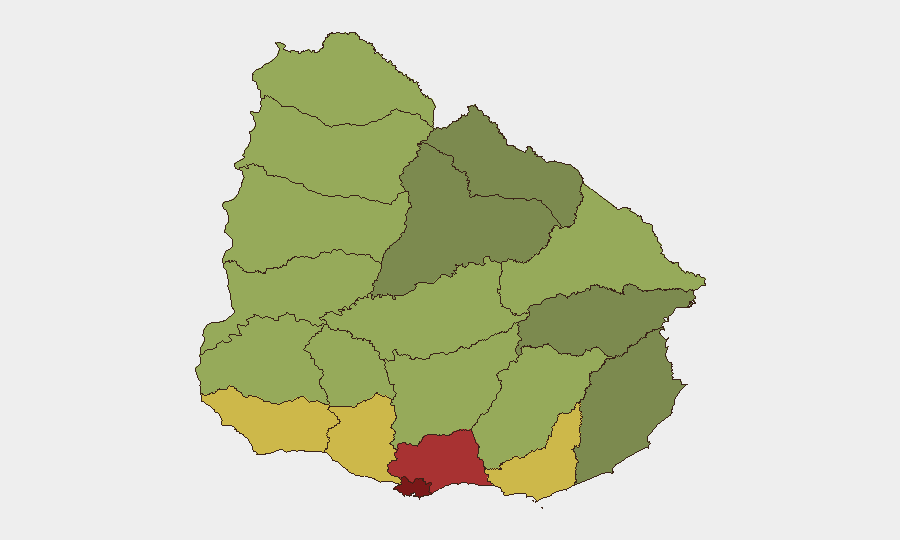
Montevideo (risk 92) and Canelones (risk 78) dominate the sub-national risk landscape, driven by concentrated homicide activity and organized-crime presence. Maldonado (risk 68) and San José (risk 64) follow, likely reflecting tourism-corridor vulnerabilities and localized gang activity. The remaining departments (Soriano through Flores) present moderate to low risk, with Montevideo accounting for the majority of country-level threat density. Corporate assets and personnel in the capital and adjacent Canelones department should prioritize situational awareness and restricted movement protocols in high-activity barrios (Centro, Los Bulevares, Barrio Borro, Conciliación).
How GeoBit Would Assist
AOI Monitoring & Early Warning would enable persistent watch of Montevideo's highest-risk barrios and Canelones, with automated alerting on security incidents, protest mobilization, or infrastructure disruption. Network & Actor Analysis combined with OSINT fusion (X/Twitter, Telegram, and multi-language feeds) would track organized-crime and gang communications to provide early signals of territorial disputes or violence escalation before they affect corporate personnel. GIS & Spatial Analysis with alternative routing capabilities would allow security teams to dynamically adjust travel corridors around active hotspots and plan safe transit for personnel and assets.
7-Day Outlook
No acute security shock is anticipated in the immediate 7-day horizon. Homicide rates and organized-crime activity will likely persist at current elevated levels, particularly in Montevideo and Canelones, with no indication of organized civil unrest, political destabilization, or infrastructure crisis. Administrative tensions with Anglo-American partners remain low-threat and do not presently affect corporate operations or travel safety; however, developments in that channel should be monitored for potential downstream policy or regulatory changes.
Highest-Risk Areas — Ranked
| # | State / Region | Risk |
|---|---|---|
| 1 | Montevideo | 92 |
| 2 | Canelones | 78 |
| 3 | Maldonado | 68 |
| 4 | San José | 64 |
| 5 | Colonia | 62 |
| 6 | Soriano | 58 |
| 7 | Río Negro | 56 |
| 8 | Salto | 54 |
| 9 | Artigas | 52 |
| 10 | Paysandú | 50 |
| 11 | Florida | 48 |
| 12 | Flores | 46 |
Sources
Previous Daily Briefs
A new Uruguay brief is written every day — each with its own risk map and downloadable CSV. Here's the last week; use the calendar to go further back.
📅 Browse every day by calendar →
Highlighted days have a brief. Tap a day for that day's map & analysis, or “csv” for that day's dataset ($5).
Atlas — our AI intelligence desk — emails them this snapshot personally. Nothing else, no list.