Situation Summary
Venezuela remains at composite threat rank #40 globally (score 38), with security conditions dominated by ongoing post-earthquake recovery operations rather than acute conflict or civil unrest. As of 21 July 2026, emergency deployments involving 62,000+ personnel continue across earthquake-affected regions, particularly in coastal and northern states, with persistent infrastructure damage, displacement camps housing ~24,000 people, and 1,388 recorded aftershocks creating a complex humanitarian-security environment. No major new armed clashes, large-scale protests, or documented crime incidents have been cross-confirmed in the last 48 hours, but the structural risk environment—including active armed militias, checkpoint operations, and seismic instability—remains elevated.
Key Developments
- Caracas, El Junquito parish (19–20 July): Acting President Delcy Rodríguez conducted reconstruction oversight visits in earthquake-damaged neighborhoods, indicating continued high-level government presence and active construction activity in affected urban zones with ongoing security escorts and possible localized movement restrictions.
- Nationwide emergency operations update (19 July statement): Government confirmed sustained deployment of 62,000+ personnel and volunteers in post-earthquake response, with medical care for ~40,000 patients and large-scale food/water distribution across affected regions—signal of major security force commitment to emergency logistics.
- Northern coastal belt aftershock activity (continuing): Venezuela's Institute of Seismology recorded 1,388 aftershocks since the 24 June main event; ongoing seismic instability increases risk of further structural damage to weakened buildings and may trigger localized evacuations or infrastructure cordons.
- Displacement camp status (mid-to-late July): Approximately 23,820 people remain in 107 temporary camps, with ~18,000 still without permanent housing; protracted displacement creates elevated vulnerability to crime, disease, and unrest in and around camp zones.
- Infrastructure disruption continuing (through 21 July): Telephone, electricity, and gas services remain intermittently disrupted or restricted in Caracas, La Guaira, and other major cities, degrading communication and utility reliability for residents and businesses.
- Armed militia and checkpoint activity (persistent, no new incident dated 19–21 July): German foreign ministry travel advisory confirms "colectivos" (politically oriented armed groups) remain operationally active; person and vehicle checks (alcabalas) by security forces or militias can occur without warning, particularly in urban areas.
Highest-Risk Areas
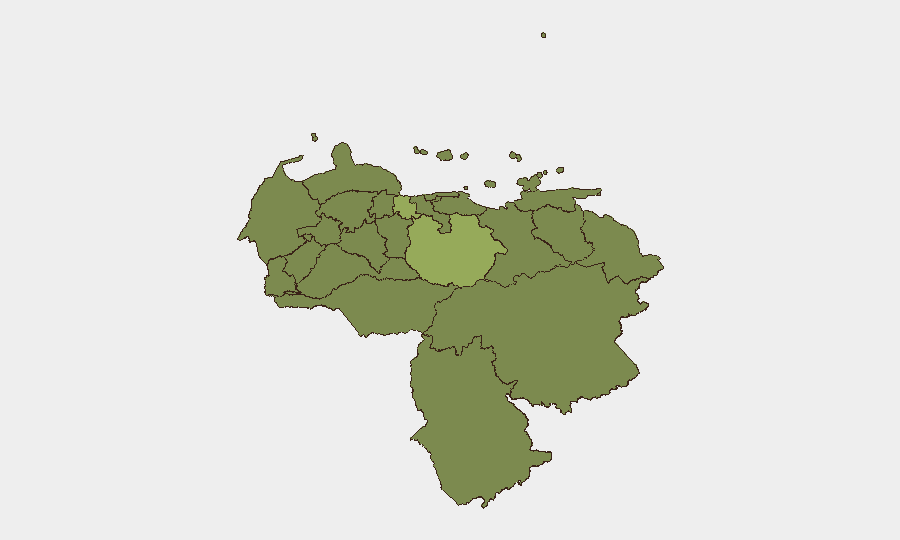
Guarico State (53.8) and Carabobo State (42.5) lead sub-national risk, followed by the Federal District (39.1), which encompasses Caracas. The concentration of risk in Guarico and Carabobo reflects both earthquake-related displacement and infrastructure strain, as well as underlying crime and armed-group activity; Federal District risk is driven by population density, government security presence, and the presence of colectivos and checkpoint operations. Together, these three regions account for the majority of tracked threat events and humanitarian displacement.
How GeoBit Would Assist
Security teams should deploy AOI Monitoring & Early Warning with persistent watch on Caracas, La Guaira, and Guarico/Carabobo states to detect sudden protests, checkpoint escalations, or aftershock-triggered evacuations. Intel Sweep and OSINT Fusion across X/Twitter, Telegram, and Venezuelan media will track government emergency statements, militia activity announcements, and displacement camp conditions in near-real time. Routing & Network Analysis can identify alternative travel corridors around active reconstruction zones and checkpoint concentrations, critical for duty-of-care planning during infrastructure disruption.
7-Day Outlook
Earthquake recovery operations will remain the dominant security driver through late July; no major escalation in political unrest or organized crime is indicated, but the protracted displacement environment and continued seismic activity present sustained risk of localized disruptions and humanitarian emergencies. Checkpoint and militia activity will likely persist at baseline levels; teams should maintain heightened vigilance for spontaneous demonstrations or security-force mobilizations.
Highest-Risk Areas — Ranked
| # | State / Region | Risk |
|---|---|---|
| 1 | Guarico State | 53.8 |
| 2 | Carabobo State | 42.5 |
| 3 | Federal District | 39.1 |
| 4 | Monagas State | 27.5 |
| 5 | Vargas State | 26.5 |
| 6 | Tachira State | 24.9 |
| 7 | Lara State | 24.9 |
| 8 | Zulia State | 23.8 |
| 9 | Falcon State | 23.8 |
| 10 | Federal Dependencies | 23.8 |
| 11 | Nueva Esparta State | 23.8 |
| 12 | Barinas State | 23.8 |
Sources
Previous Daily Briefs
A new Venezuela brief is written every day — each with its own risk map and downloadable CSV. Here's the last week; use the calendar to go further back.
📅 Browse every day by calendar →
Highlighted days have a brief. Tap a day for that day's map & analysis, or “csv” for that day's dataset ($5).
Atlas — our AI intelligence desk — emails them this snapshot personally. Nothing else, no list.