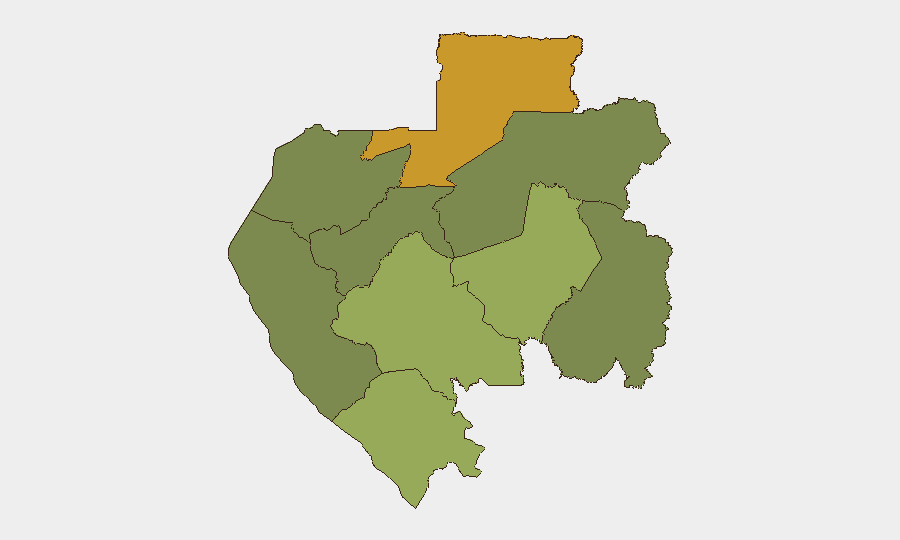
Situation Summary
Gabon remains at moderate-to-low overall threat (global rank #63), with no security incidents recorded during the October 13–19 week. The country continues to navigate political and institutional transitions following the August 2023 military seizure of power. Near-term risk is concentrated in remote northern and eastern provinces; the capital Libreville and western urban centers remain relatively stable, though internal political factional tensions persist within former ruling-party structures.
Key Developments
- Libreville, 13 October: Authorities deployed an API-PNR (Advanced Passenger Information / Passenger Name Record) system at Léon-Mba International Airport to enhance screening for transnational crime, drug trafficking, and terrorism. The system strengthens border and cross-border threat detection capability.
- Libreville, 14 October: The Parti démocratique gabonais (PDG)—the former ruling party—experienced renewed factional tensions during an internal seminar, with senior members coming close to opposing President Brice Clotaire Oligui Nguema. The incident signals ongoing internal political fragmentation.
- Port-Gentil, 14 October: The central prison's director announced enforcement measures targeting drug-related activities and prisoner absences, indicating ongoing internal security challenges within the correctional system.
- Port-Gentil / Western Gendarmerie Legion, 14 October: Colonel Cyrille Moudoumounene assumed command of the Western Gendarmerie Legion, representing a security leadership transition in Gabon's main western urban area.
Highest-Risk Areas
Woleu-Ntem Province (risk score 72) and Ogooué-Lolo Province (risk 58) significantly outpace all other regions and drive the national risk profile. Both are remote, sparsely populated northern and eastern territories with limited state capacity and law-enforcement presence. Ngounié and Nyanga provinces (risk 48 and 42 respectively) present elevated but secondary risk. By contrast, Estuaire Province—which contains the capital Libreville and primary economic centers—rates substantially lower (risk 15), reflecting stronger institutional control and security infrastructure. Organizations with operations or supply chains in the north should prioritize risk mitigation; Libreville-based and coastal operations face comparatively manageable threat environments.
How GeoBit Would Assist
Security teams managing Gabon operations should deploy AOI Monitoring & Early Warning on Woleu-Ntem and Ogooué-Lolo provinces to detect emerging instability, trafficking, or cross-border activity before escalation. OSINT fusion—combining multi-language search, X/Telegram monitoring, and entity extraction—enables real-time tracking of factional political dynamics and security-force leadership changes. For duty-of-care compliance, Routing & Network Analysis supports identification of safe travel corridors and alternative logistics pathways around high-risk provincial areas, while regime-stability search capabilities flag shifts in state capacity or institutional control that may affect permit processes, supply-chain predictability, or expatriate operating conditions.
7-Day Outlook
No imminent security incidents are signaled for the next seven days. Political tensions within the PDG and corrections-system management challenges warrant continued monitoring but do not indicate near-term destabilization. Organizations should maintain standard vigilance posture, with particular attention to remote northern regions and any signals of cross-border activity or factional violence spilling into urban centers.
Highest-Risk Areas — Ranked
| # | State / Region | Risk |
|---|---|---|
| 1 | Woleu-Ntem | 72 |
| 2 | Ogooué-Lolo Province | 58 |
| 3 | Ngounié Province | 48 |
| 4 | Nyanga Province | 42 |
| 5 | Haut-Ogooué Province | 35 |
| 6 | Moyen-Ogooué Province | 28 |
| 7 | Ogooué-Maritime Province | 25 |
| 8 | Estuaire Province | 15 |
| 9 | Ogooué-Ivindo | 0 |
Sources
Previous Weekly Briefs
A new Gabon brief is written every Monday, covering the week — each with its own risk map and downloadable CSV. Use the calendar to go further back.
- October 12, 2026
- October 5, 2026
- September 28, 2026
- September 21, 2026
- September 14, 2026
- September 7, 2026
- September 1, 2026
📅 Browse past briefs by calendar →
Highlighted days have a brief. Tap a day for that day's map & analysis, or “csv” for that day's dataset ($5).
Atlas — our AI intelligence desk — emails them this snapshot personally. Nothing else, no list.