Situation Summary
Afghanistan faces a severe and actively escalating security environment driven by sustained cross-border military confrontation between Pakistan and Afghanistan, compounded by internal anti-Taliban armed resistance. Pakistani airstrikes on Afghan urban centers (Kabul, Kandahar) and border provinces claimed at least 36 civilian lives as recently as 29 June, with travel advisories reconfirmed as current on 5 July indicating ongoing operational risk. The convergence of inter-state military strikes, Taliban-opposition clashes, and high civilian casualty rates has pushed the country to #12 global threat ranking and created unpredictable disruption across transportation, communications, and sanctuary for armed groups.
Key Developments
- Pakistani airstrikes in Kunar and urban centers (29 June – 5 July): Pakistani military conducted overnight strikes on Afghan provinces and cities following militant attacks in Pakistan. UN and diplomatic reporting circulating in early July confirms strikes in Kunar killed at least seven civilians and wounded 85+ in university and residential areas; Kabul, Kandahar and other urban centers remain under reported bombing threat as of 5 July per updated international travel advisories.
- Afghanistan-Pakistan border escalation and "open war" declarations (late June – early July): Pakistan declared "open war" with Afghanistan after striking Taliban military facilities; Kabul accused Pakistan of killing civilians in Paktia, Paktika and Kunar provinces. Pakistani sources reported intercepting Taliban-linked drone operations over Balochistan and Khyber. Diplomatic briefings dated 3–4 July describe fighting along the 2,400-km frontier as ongoing and likely to escalate.
- Anti-Taliban insurgent attack in Badakhshan (3–4 July): The Afghanistan Freedom Front (AFF) claimed responsibility for an armed attack on a Taliban military base in Badakhshan province, northeastern Afghanistan, indicating renewed localized anti-Taliban armed resistance activity.
- Reconfirmed "Do Not Travel" advisory – nationwide (current as of 5 July): Australia's Smartraveller and other foreign government advisories remain active, citing ongoing military conflict, high terrorism/kidnapping/detention threat, bombings in urban centers, and risk of sudden airport and border closures. The explicit "current 5 July" marking signals active, not historical, risk assessment.
- Indian diplomatic signaling on regional stability (4 July): India's Ministry of External Affairs formally addressed Pakistani attacks in Afghanistan during a 4 July media briefing, indicating that cross-border strikes and regional spillover are drawing sustained diplomatic attention and concern.
Highest-Risk Areas
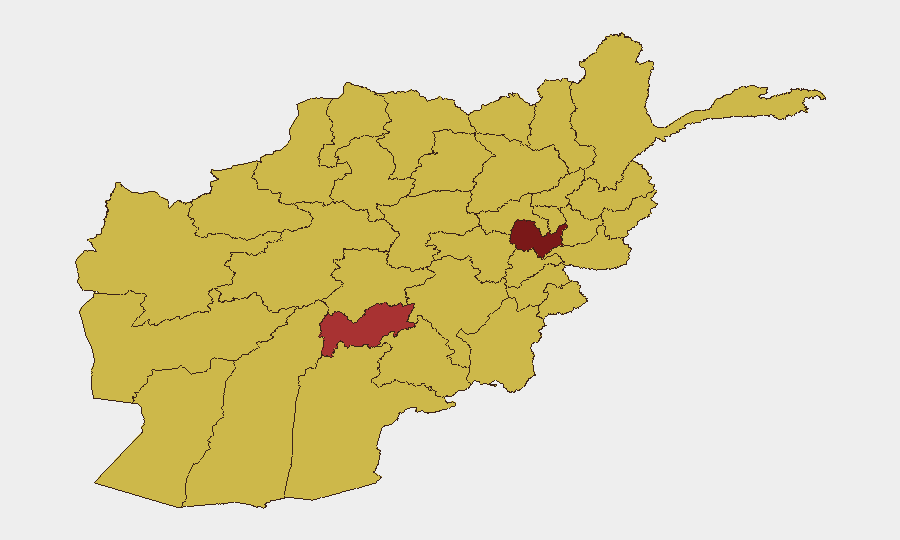
Kabul Province (risk 93.1) dominates the national picture due to direct exposure to cross-border airstrikes, anti-Taliban activity, and concentration of civilian infrastructure and foreign personnel. Uruzgan (79.7) and Ghor (67.9) provinces follow, driven by Taliban-opposition clashes and insurgent recruitment. The southern cluster—Paktika, Kandahar, Ghazni, Zabul, and Helmand (all 63.1–67.1)—forms a contiguous high-risk belt along the Pakistan border and reflects both cross-border military operations and endemic anti-Taliban armed groups. Border provinces (Kunar, Paktia, Paktika, Nimruz, Farah) carry compounded risk from Pakistani drone and air activity and Taliban-opposition friction.
How GeoBit Would Assist
Security teams monitoring Afghanistan should prioritize AOI Monitoring & Early Warning on Kabul, Kandahar, and border provinces (Kunar, Paktika, Paktia) to detect airstrike patterns and armed-group movement in near-real time. Intel Sweep and multi-language OSINT (Twitter, Telegram, local Afghan media) provide 24–48-hour situational updates on cross-border strikes and opposition claims; sentiment & temporal analysis helps distinguish active threats from historical reporting. Routing & Network Analysis supports alternative travel planning and safe-house positioning in event of airport/border closure.
7-Day Outlook
Cross-border Pakistani-Afghan military strikes will likely continue or intensify through mid-July absent diplomatic de-escalation; civilian harm and urban disruption will remain high in Kabul, Kandahar, and border zones. Anti-Taliban armed groups may exploit the Pakistan-Taliban friction to expand operations in the northeast and southern provinces. Personnel safety and asset security in Afghanistan remain contingent on sub-provincial location granularity and real-time threat monitoring.
Highest-Risk Areas — Ranked
| # | State / Region | Risk |
|---|---|---|
| 1 | Kabul Province | 93.1 |
| 2 | Uruzgan Province | 79.7 |
| 3 | Ghor Province | 67.9 |
| 4 | Paktika Province | 67.1 |
| 5 | Zabul Province | 63.1 |
| 6 | Kandahar Province | 63.1 |
| 7 | Ghazni Province | 63.1 |
| 8 | Farah Province | 63.1 |
| 9 | Nimruz Province | 63.1 |
| 10 | Helmand Province | 63.1 |
| 11 | Jowzjan Province | 63.1 |
| 12 | Balkh Province | 63.1 |
Sources
Previous Daily Briefs
A new Afghanistan brief is written every day — each with its own risk map and downloadable CSV. Here's the last week; use the calendar to go further back.
📅 Browse every day by calendar →
Highlighted days have a brief. Tap a day for that day's map & analysis, or “csv” for that day's dataset ($5).
Atlas — our AI intelligence desk — emails them this snapshot personally. Nothing else, no list.