Situation Summary
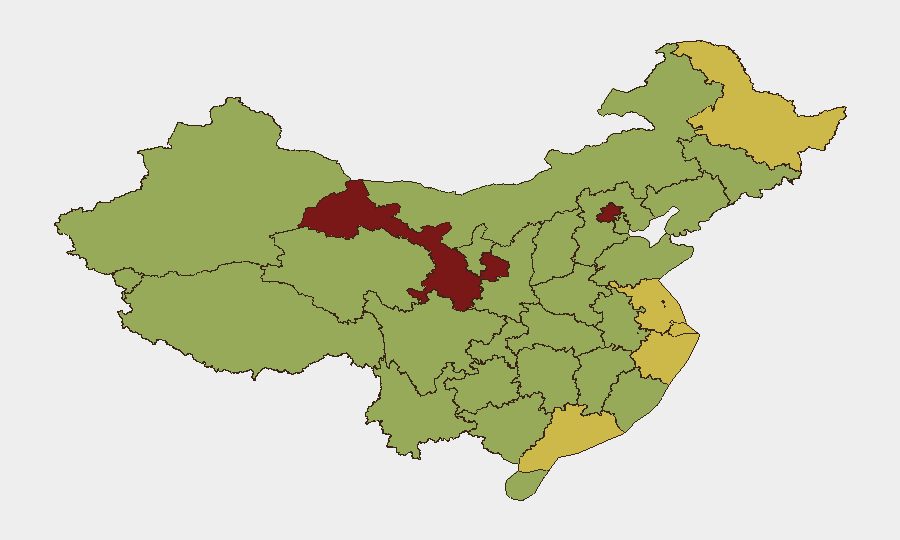
China remains at #18 in global threat ranking (composite score 78) with 572 tracked events, reflecting elevated geopolitical and military posture rather than acute domestic security instability. The past 48 hours have been dominated by a confirmed strategic military test—a submarine-launched long-range missile demonstration in the Pacific on 6 July—coupled with defensive diplomatic messaging and intensifying Western trade and cyber-policy responses. No major civil unrest, crime spikes, or travel-disrupting incidents have been verified inside mainland China during this window; risk remains concentrated in Beijing and northwestern regions (Gansu, Zhejiang) and is primarily geopolitical in character.
Key Developments
- Pacific Ocean / Submarine Launch Platform (6 July): China test-fired a long-range "strategic" missile from a nuclear-powered submarine, marking its first known sea-based demonstration of that class of weapon. Launch confirmed by U.S. media citing American and allied officials; development signals expansion of China's strategic deterrent capability and has heightened allied concerns over regional security.
- Beijing / Foreign Ministry (6 July): Spokesperson Mao Ning stated China is "not targeting any nation" with the missile test, framing the launch as an exercise within China's sovereign rights. Statement widely circulated on state media and social platforms; represents attempt to contain diplomatic fallout.
- Moscow / Russian Official Commentary (6 July): Russian officials publicly defended China's test-firing, arguing nuclear weapons remain the strongest deterrent against global conflict. External endorsement underscores China–Russia strategic alignment and may reinforce Western threat perception regarding China's military trajectory.
- Brussels / EU Policy (6 July publication): Reuters Breakingviews reports EU accelerating trade-defense and cybersecurity measures against China, including anti-dumping tariffs on electric vehicles and proposed rules to exclude Huawei from critical infrastructure and force EU supply-chain diversification. Reflects EU response to perceived economic coercion and cyber risk.
- Beijing / Ministry of Justice (6 July): BRILSA hosted High-Level Conference on Supply Chain Compliance and Dispute Prevention in Belt and Road contexts. While not a security incident, signals China's focus on managing international economic and infrastructure risk during current geopolitical tension.
- Hanoi / Ca Mau, Vietnam (coverage within 48h): Bloomberg reporting notes Vietnam advancing a USD 4 billion dual-use port project in its southernmost region, explicitly framed as response to China's influence in Cambodia and expanding regional footprint. Reflects regional mitigation strategies against perceived China-linked security risks.
Highest-Risk Areas
Beijing (84.4) and Gansu (82.8) are the top-risk regions; Beijing's elevation reflects proximity to central government, diplomatic activity, and heightened geopolitical attention, while Gansu's ranking likely correlates with border proximity and strategic infrastructure density. Zhejiang, Guangdong, and Shanghai (70.5–68.1) round out the highest-risk cluster, driven by major commercial, tech, and maritime hubs where foreign nationals and supply chains concentrate. Risk is primarily geopolitical and strategic rather than criminal or civil-unrest driven in the current window.
How GeoBit Would Assist
Security teams would deploy Intel Sweep and global event feeds to track evolving geopolitical and military signals; OSINT fusion (X/Twitter, social media, state media) to monitor official messaging and public sentiment; and Network & Actor Analysis to map strategic alignments (China–Russia) and detect policy shifts. AOI Monitoring & Early Warning on Beijing, key port cities, and border regions would provide persistent watch for escalation or domestic instability tied to external tensions.
7-Day Outlook
Diplomatic messaging is likely to stabilize temporarily as China continues to reframe the missile test as routine and non-threatening. Western trade and cyber-policy measures are expected to harden further, but implementation will be gradual. No major domestic security incident is currently forecast; risk remains concentrated in geopolitical and supply-chain domains rather than kinetic or civil unrest scenarios.
Highest-Risk Areas — Ranked
| # | State / Region | Risk |
|---|---|---|
| 1 | Beijing | 84.4 |
| 2 | Gansu | 82.8 |
| 3 | Zhejiang | 70.5 |
| 4 | Guangdong Province | 69.2 |
| 5 | Shanghai | 68.1 |
| 6 | Heilongjiang | 64.5 |
| 7 | Jiangsu | 61.6 |
| 8 | Hubei | 59.8 |
| 9 | Hunan | 59.3 |
| 10 | Guangxi | 56.2 |
| 11 | Jilin | 56.2 |
| 12 | Fujian | 55.8 |
Sources
Previous Daily Briefs
A new China brief is written every day — each with its own risk map and downloadable CSV. Here's the last week; use the calendar to go further back.
📅 Browse every day by calendar →
Highlighted days have a brief. Tap a day for that day's map & analysis, or “csv” for that day's dataset ($5).
Atlas — our AI intelligence desk — emails them this snapshot personally. Nothing else, no list.