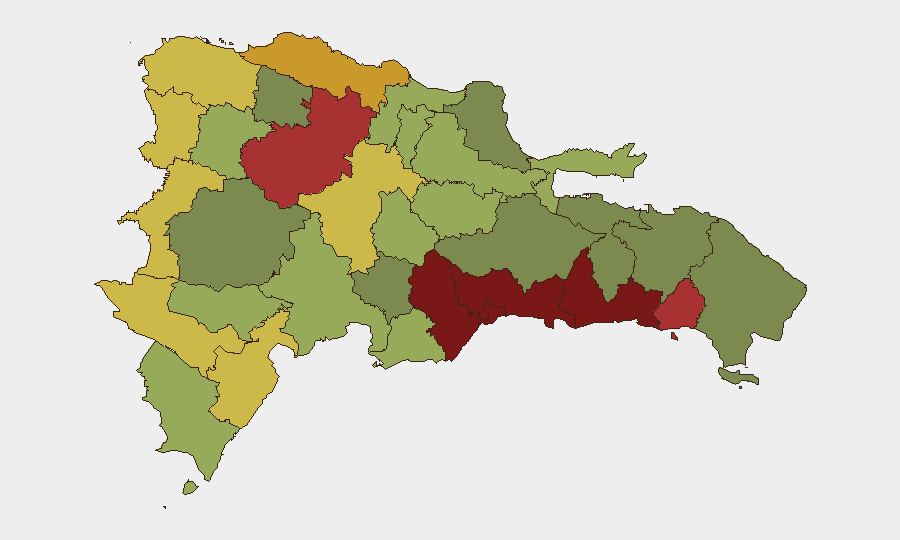
Situation Summary
Dominican Republic remains at composite threat level #110 globally, with crime and gang activity as the primary driver of risk. The security environment shows acute volatility concentrated in the National District, Santo Domingo, and Santiago provinces, where armed violence, organized crime involvement, and civil unrest create compounding risk. Recent incidents spanning August 6–12 indicate sustained levels of armed confrontation, including attacks on uniformed personnel and civilians, along with emerging communal tension tied to migration and resource competition. The trajectory remains elevated and fragmented rather than systemic, with localized flashpoints rather than nationwide destabilization.
Key Developments
- Navarrete (Santiago), August 12, 2026: A 48-hour protest/strike operation drew heavy National Police and military deployment; an Army private (Omar Peña Pérez) was wounded in the arm during demonstrations. The National Police director personally supervised the security response. Local reports cited detonations or gunfire near the director's convoy, though police denied the convoy came under direct attack.
- Multiple provinces, August 6–12: Five separate incidents of armed violence against civilians were recorded, including the fatal shooting of an Air Force Major outside a colmado (convenience store) on August 6, with his son also wounded; a National Police officer and civilian casualty from an armed motorcycle/vehicle exchange on August 12; and three homicides with gunshot or stab wounds across rural and urban areas. One Air Force Major shooting suspect voluntarily surrendered.
- Santiago and rural areas, August 9: Agricultural worker José Castillo Bello was found with multiple stab wounds, triggering community-led expulsion of Haitian nationals and destruction of their belongings—reflecting escalating xenophobic tension linked to economic stress and labor competition.
- Police/DICRIM operations, August 6–8: Multiple arrests were executed by the Preventive Police and DICRIM (criminal investigation unit), yielding homemade weapons, controlled substances, and cash seizures. On August 6, alleged DICRIM members attempted forcible removal of a key witness during an attempted homicide trial without judicial authorization, indicating potential corruption or witness intimidation.
- Santo Domingo/Nacional District area: Ongoing gang-driven violence continues to dominate incident reports, with multiple shootings and armed confrontations among unconfirmed perpetrators, reflecting persistent organized crime activity in the country's two highest-risk provinces.
Highest-Risk Areas
Santo Domingo (risk 92) and Nacional District (risk 88) together account for the largest concentration of gang-related violence and armed crime, driven by proximity to the capital, port infrastructure, and drug-trafficking networks. San Cristóbal, San Pedro de Macorís, and La Romana form a secondary high-risk belt along the southern corridor, where organized crime, smuggling, and economic desperation intersect. Santiago province (rank 6, risk 76) has emerged as a volatile flash point due to recent civil unrest, armed clashes with security forces, and xenophobic violence against migrant communities. Border provinces (Elías Piña, Dajabón) show sustained risk tied to human and contraband trafficking.
How GeoBit Would Assist
Security teams would deploy AOI Monitoring & Early Warning on high-risk municipalities (Santo Domingo, Santiago, San Cristóbal) to capture emerging protest, gang activity, and armed incidents in real time. Intel Sweep and OSINT fusion (X/Twitter, Telegram, local news corroboration) would provide 24–48-hour situational awareness of flash-point developments and police operations. Network & Actor Analysis would map gang structures and DICRIM operational patterns to assess corruption risks and witness-tampering trends.
7-Day Outlook
Armed violence and localized gang activity will likely persist at current levels, with Santo Domingo and Santiago remaining primary concern areas. Communal tensions tied to Haitian migration and economic hardship may trigger additional protests or vigilante action in rural and peri-urban zones. Police and military operations will continue, but sustainability and integrity of judicial processes remain compromised by reported corruption indicators.
Highest-Risk Areas — Ranked
| # | State / Region | Risk |
|---|---|---|
| 1 | Santo Domingo | 92 |
| 2 | Nacional District | 88 |
| 3 | San Cristóbal | 85 |
| 4 | San Pedro de Macorís | 83 |
| 5 | La Romana | 78 |
| 6 | Santiago | 76 |
| 7 | Puerto Plata | 72 |
| 8 | Elías Piña | 70 |
| 9 | Dajabón | 68 |
| 10 | Barahona | 65 |
| 11 | Independencia Province | 64 |
| 12 | La Vega | 62 |
Sources
Previous Daily Briefs
A new Dominican Republic brief is written every day — each with its own risk map and downloadable CSV. Here's the last week; use the calendar to go further back.
- August 13, 2026
- August 12, 2026
- August 11, 2026
- August 10, 2026
- August 9, 2026
- August 8, 2026
- August 7, 2026
📅 Browse every day by calendar →
Highlighted days have a brief. Tap a day for that day's map & analysis, or “csv” for that day's dataset ($5).
Atlas — our AI intelligence desk — emails them this snapshot personally. Nothing else, no list.