Situation Summary
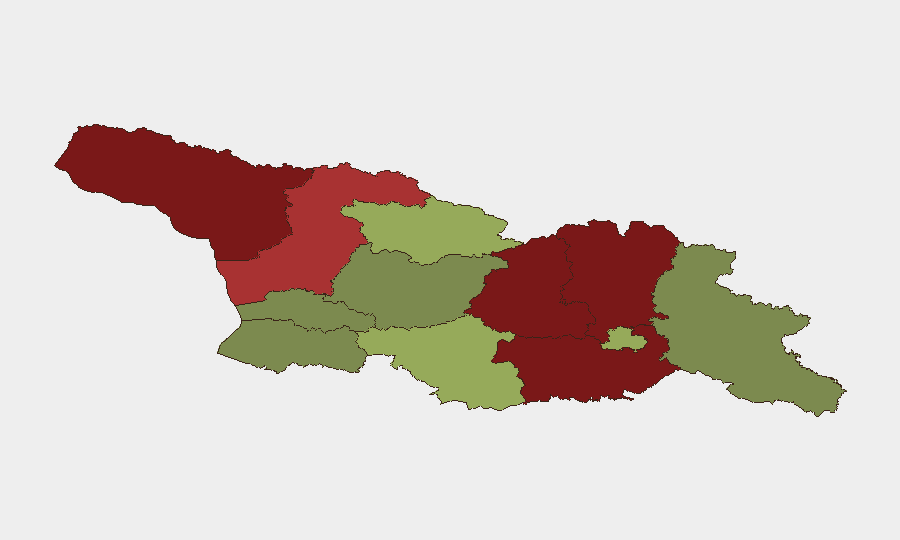
Georgia remains a low-threat environment globally (rank #89, composite score 18) with no tracked security events as of 2026-08-19. The country's overall stability is sustained, though significant sub-national risk concentration persists in the breakaway territories of Abkhazia (risk 95) and South Ossetia-adjacent zones, alongside Russia-adjacent regions in the north and east. Recent domestic incidents—scattered protests, infrastructure failures, and AI-generated threats—pose minimal systemic risk to corporate operations. The trajectory remains stable absent external geopolitical escalation.
Key Developments
- Tbilisi, 2026-08-17: Political protest continued in central Tbilisi around Parliament with 500–2,000 participants; concurrent small animal-rights demonstration near government buildings. Both protests remain within normal civic activity parameters and dispersed without reported violence.
- Tbilisi metro area, 2026-08-15: Heavy rainfall caused street flooding and damaged gas line near Rustaveli and Vaja-Pshavela metro stations; utility response initiated. Infrastructure vulnerability to weather events noted but managed.
- Nationwide, 2026-08-15: Automated AI-generated bomb threats prompted school evacuations and district-wide closures; no explosives located. Incident reflects operational vulnerability to synthetic threats but poses no kinetic risk.
- School incident, 2026-08-12: Ninth-grade student shot another student in the leg in a school bathroom; one student arrested on felony charges. Isolated criminal event with no broader security implications.
- Transport corridor, 2026-08-12 & 2026-08-14: Georgia-Baku cargo train caught fire on 12 August and again on 14 August at Shamkir Station (Azerbaijan); fire services responded both times. Pattern warrants monitoring of supply-chain integrity on this critical trade route.
Highest-Risk Areas
Risk is heavily concentrated in Georgia's northern and eastern autonomous territories. Abkhazia (risk 95) and Shida Kartli / Lower Kartli (risk 88 and 85 respectively) dominate the threat profile, driven by unresolved territorial disputes, Russian military presence, and limited state capacity. Samtskhe-Javakheti (risk 48) presents secondary concern due to Armenian border proximity. Conversely, Tbilisi (risk 45), Imereti (risk 32), and Guria (risk 28) pose significantly lower risk and remain suitable for routine corporate activity with standard duty-of-care protocols.
How GeoBit Would Assist
Security teams should deploy AOI Monitoring & Early Warning on Abkhazia, Shida Kartli, and the Georgia-Azerbaijan transport corridor to detect emerging flashpoints before escalation. Intel Sweep and X/Twitter OSINT provide real-time signals of protest momentum, supply-chain disruption, or unrest sentiment in Tbilisi and lower-risk zones. GIS & Spatial Analysis combined with Routing & Network Analysis enables dynamic re-routing of personnel and cargo around flooded or contested infrastructure, particularly on the Caucasus trade routes.
7-Day Outlook
No imminent escalation is forecast. Domestic protests remain episodic and non-violent; infrastructure incidents are weather-driven and manageable. The critical variable remains Russian military posture in Abkhazia and the breakaway regions—any shift there would rapidly elevate national risk. Corporate teams in Tbilisi and western zones should maintain routine vigilance; operations in the north and east should maintain elevated alertness on territorial boundaries.
Highest-Risk Areas — Ranked
| # | State / Region | Risk |
|---|---|---|
| 1 | Autonomous Republic of Abkhazia | 95 |
| 2 | Shida Kartli | 88 |
| 3 | Lower Kartli | 85 |
| 4 | Mtskheta-Mtianeti | 82 |
| 5 | Samegrelo-Upper Svaneti | 78 |
| 6 | Samtskhe-Javakheti | 48 |
| 7 | Tbilisi | 45 |
| 8 | Racha-Lechkhumi and Kvemo Svaneti | 42 |
| 9 | Kakheti | 38 |
| 10 | Autonomous Republic of Adjara | 35 |
| 11 | Imereti | 32 |
| 12 | Guria | 28 |
Sources
Previous Daily Briefs
A new Georgia brief is written every day — each with its own risk map and downloadable CSV. Here's the last week; use the calendar to go further back.
- August 18, 2026
- August 17, 2026
- August 16, 2026
- August 15, 2026
- August 14, 2026
- August 12, 2026
- August 11, 2026
📅 Browse every day by calendar →
Highlighted days have a brief. Tap a day for that day's map & analysis, or “csv” for that day's dataset ($5).
Atlas — our AI intelligence desk — emails them this snapshot personally. Nothing else, no list.