Situation Summary
Iraq remains elevated at #12 globally (composite threat score 98) amid a major Iran–US military exchange that has extended strikes and retaliatory fire into Iraqi territory and airspace. The past 48 hours have been marked by heightened alert status around U.S. and coalition facilities—particularly the Baghdad Green Zone—following Iranian drone and missile activity targeting U.S. assets in Iraq. Simultaneously, large-scale funeral processions for Iran's late Supreme Leader in Najaf and Karbala have drawn significant crowds under heavy security. The security environment is volatile but not yet characterized by large-scale civil unrest or widespread domestic attacks documented in open sources over the most recent period.
Key Developments
- Baghdad Green Zone & U.S. Embassy (July 7–8): Multiple regional outlets report heightened security perimeter alerts and small-arms fire in districts adjacent to the Green Zone following drone warnings and regional missile exchanges. No credible reports confirm direct hits on the embassy compound itself; posture reflects precautionary lockdown and air-defense readiness rather than sustained assault.
- U.S. and Coalition Military Bases Across Iraq (July 7–8): Iranian retaliatory strikes in the current conflict phase have included Iraqi-based U.S. military installations and diplomatic facilities among their targets. Open-source coverage confirms Iraq as an active theater for Iranian drone and missile fire without yet detailing base-by-base casualties in the last 48 hours.
- Najaf and Karbala Funeral Processions (July 7–8): Iraq's two most sacred Shia cities are hosting ceremonies for Iran's deceased Supreme Leader, with very large crowds and heavy security cordons deployed. No violence or significant civil unrest tied to these mass gatherings is reported within the last 24–48 hours, though crowd-management and secondary threat risks remain elevated.
- Iraqi Airspace Threat Posture (Ongoing, July 7–8): Security assessments flag Iraq's airspace and all U.S.-linked infrastructure as ongoing potential targets for further Iranian action. This reflects a current, evolving risk environment rather than new specific incidents but directly elevates travel and operational-security risk.
- Residual Debris and Alert Status (Spillover from Early July): Earlier incidents—including an unidentified drone shot down over Baghdad on July 1 and a PMF munitions depot explosion in Diyala on June 25—continue to drive heightened air-defense alert levels and drone-related sensitivities across Baghdad and the north.
Highest-Risk Areas
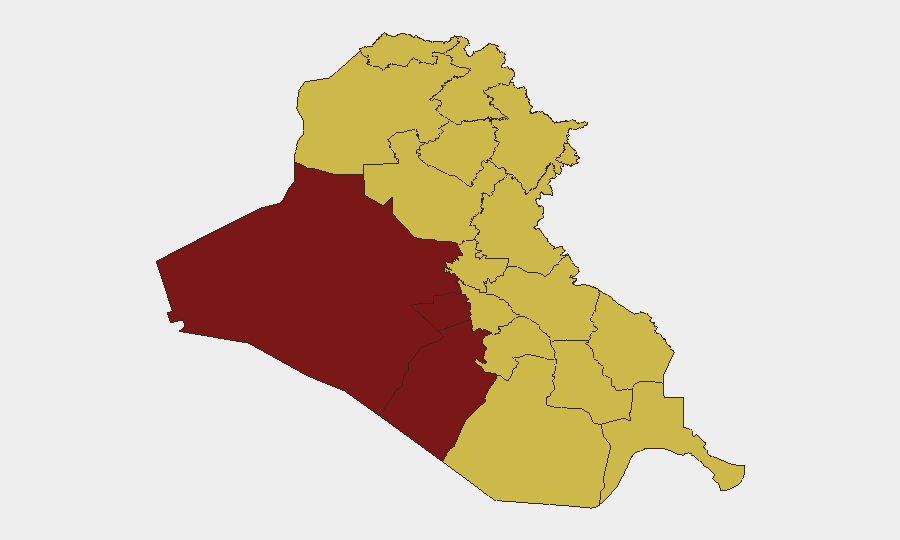
Al-Najaf and Karbala governorates lead the sub-national ranking (98.5 and 96.1 respectively), driven by the current mass gatherings and heavy security footprints around the Supreme Leader's ceremonies, combined with chronic sectarian sensitivities and historical targeting by extremist groups. Baghdad (70.5) remains the second-tier concern, with the Green Zone, U.S. Embassy, and coalition installations now directly exposed to Iranian strike operations. Anbar (85.8) rounds out the top-three zones of concern, reflecting ongoing militant activity and proximity to Syrian cross-border threats. The remaining southern and central governorates (Babil, Wasit, Basra, etc.) cluster at 68–69, indicating a broader, nationwide elevation above baseline risk but without the acute focal pressures of the holy cities and capital.
How GeoBit Would Assist
Security teams should deploy AOI Monitoring & Early Warning on the Green Zone, major U.S. bases, and Najaf/Karbala holy sites for persistent threat detection and alerting on renewed drone/missile activity or crowd disruptions. Intel Sweep, OSINT fusion, and multi-language Telegram/X monitoring will track Iranian messaging and Iraqi militia chatter in near-real time for operational intent signals. Routing & Network Analysis enables duty-of-care teams to map alternative movement corridors and safe zones away from high-risk facilities as conditions evolve.
7-Day Outlook
The Iran–US conflict remains in active retaliation mode, with further Iranian strikes on Iraqi-based U.S. assets probable within the week. Funeral processions in Najaf and Karbala will likely continue through early July; large crowds and security sweeps pose secondary crowd-surge and collateral-fire risks. Expect sustained elevation across all of Iraq, with tactical de-escalation or truce announcements the primary circuit-breaker for risk reduction.
Highest-Risk Areas — Ranked
| # | State / Region | Risk |
|---|---|---|
| 1 | Al-Najaf Governorate | 98.5 |
| 2 | Karbala | 96.1 |
| 3 | Al-Anbar Governorate | 85.8 |
| 4 | Baghdad Governorate | 70.5 |
| 5 | Babil Governorate | 69.1 |
| 6 | Wasit Governorate | 68.5 |
| 7 | Al-Qadisiyah Governorate | 68.5 |
| 8 | Dhi Qar Governorate | 68.5 |
| 9 | Al-Muthanna Governorate | 68.5 |
| 10 | Maysan Governorate | 68.5 |
| 11 | Al-Basra Governorate | 68.5 |
| 12 | Saladin Governorate | 68.5 |
Sources
Previous Daily Briefs
A new Iraq brief is written every day — each with its own risk map and downloadable CSV. Here's the last week; use the calendar to go further back.
📅 Browse every day by calendar →
Highlighted days have a brief. Tap a day for that day's map & analysis, or “csv” for that day's dataset ($5).
Atlas — our AI intelligence desk — emails them this snapshot personally. Nothing else, no list.