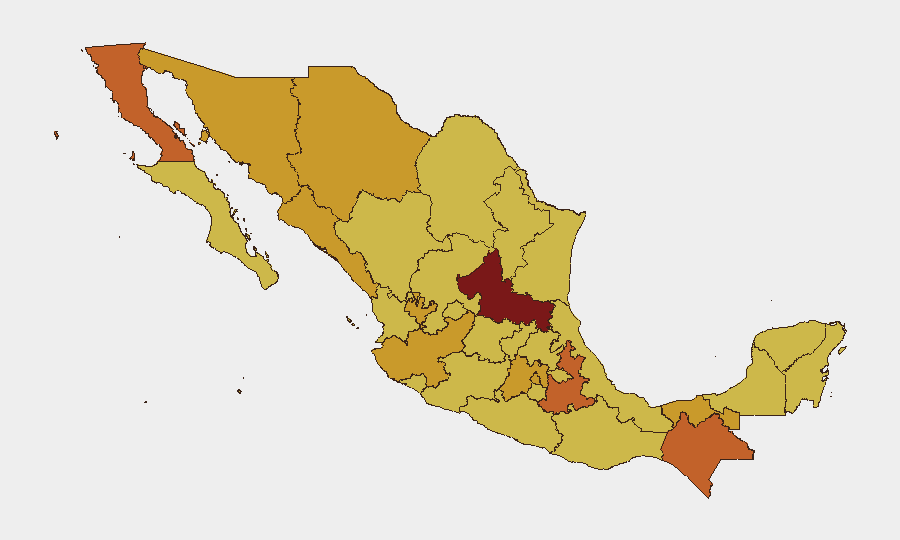
Situation Summary
Mexico remains the second-highest global threat environment (composite score 100), driven primarily by ongoing insurgency and cartel-related violence across 719 tracked events. The security posture is currently complicated by heightened diplomatic tensions with the US over migrant deaths in ICE custody, concurrent World Cup–related crowd risks in major cities, and persistent targeted violence against political and business figures in rural states. The trajectory shows no immediate de-escalation; instead, political friction, cartel operational tempo, and sub-national governance challenges are reinforcing one another across the country's highest-risk zones.
Key Developments
- Mexico City – July 14, 2026 – Foreign Ministry formally announced criminal complaints against US jurisdictions over at least 17 Mexican nationals who died in ICE custody or during arrest operations. President Claudia Sheinbaum instructed pursuit of parallel civil suits against private detention operators, signaling elevated diplomatic and legal confrontation that may affect cross-border mobility and enforcement cooperation.
- Houston, Texas – July 14, 2026 – Over 1,000 protesters marched following the fatal ICE shooting of Mexican national Lorenzo Salgado Araujo; Mexican authorities explicitly reference this case in their criminal-complaint push, linking US enforcement incidents to domestic political pressure and media coverage in Mexico.
- Oaxaca state – July 13–14, 2026 – Arrest announced in the killing of San Miguel Yogovana's municipal president; same timeframe saw ex-mayor Pedro Martínez Barroso (PVEM) shot dead inside his hardware store in San Juan Cacahuatepec, reflecting continued targeted violence against political figures in rural Oaxaca.
- Manzanillo, Colima – July 13–14, 2026 – Joint Mexican Navy and state security operation resulted in capture of alleged CJNG sicario ("Grupo TAI") carrying drugs and firearms; reinforces Level-4 travel advisory and active cartel enforcement operations in Colima.
- San Marcos, Guerrero – July 13, 2026 – 4.0-magnitude earthquake recorded near coastal municipality already designated high-risk for crime; infrastructure and travel disruption potential monitored alongside ongoing cartel and crime risks in the region.
- Mexico City, Guadalajara, Monterrey – mid-July 2026 (confirmed last 48h) – World Cup activity driving heightened crowd, petty-crime, and event-related security risks in three largest urban centers; affects corporate travel planning and duty-of-care assessments for personnel in these cities.
Highest-Risk Areas
San Luis Potosí (risk 100), Puebla (74.4), and Baja California (73.9) lead the sub-national rankings, with Chiapas, Sonora, and the State of Mexico closely clustered around 72–73. Guerrero, Chihuahua, Sinaloa, and Jalisco all register 70.8–71.5, indicating that risk is broadly distributed across 12 states rather than concentrated. The composite scores reflect convergence of cartel territorial control, migrant-trafficking operations, political instability, and weak institutional presence; San Luis Potosí's maximum score signals either sustained kidnapping/extortion activity or recent escalation in organized-crime indicators tracked by GeoBit's event database.
How GeoBit Would Assist
Corporate security teams should deploy AOI Monitoring & Early Warning with persistent watch on San Luis Potosí, Puebla, Colima, and Guerrero to capture real-time event signals and alert on arrests, military deployments, or kidnapping spikes. Routing & Network Analysis capabilities enable alternative journey planning for personnel traveling between major cities, avoiding highest-risk corridors during World Cup congestion. Multi-language OSINT and Telegram/X intelligence feeds provide early detection of cartel operational announcements, migrant-trafficking route changes, or political violence escalation in rural municipalities before they appear in mainstream media.
7-Day Outlook
Diplomatic friction over migrant deaths will likely sustain elevated political rhetoric and potential reciprocal enforcement actions, adding uncertainty to cross-border travel and corporate supply-chain operations. Cartel activity in Colima, Guerrero, and Oaxaca is expected to remain operationally active; targeted killings of municipal and business leaders in Oaxaca suggest localized power struggles that may spread to neighboring areas. World Cup–related crowd risks will persist in Mexico City, Guadalajara, and Monterrey through end of tournament play.
Highest-Risk Areas — Ranked
| # | State / Region | Risk |
|---|---|---|
| 1 | San Luis Potosí | 100 |
| 2 | Puebla | 74.4 |
| 3 | Baja California | 73.9 |
| 4 | Chiapas | 73 |
| 5 | Sonora | 72.5 |
| 6 | State of Mexico | 72.2 |
| 7 | Tabasco | 72.2 |
| 8 | Mexico City | 72.1 |
| 9 | Chihuahua | 71.5 |
| 10 | Sinaloa | 71.5 |
| 11 | Jalisco | 71.5 |
| 12 | Guerrero | 70.8 |
Sources
Previous Daily Briefs
A new Mexico brief is written every day — each with its own risk map and downloadable CSV. Here's the last week; use the calendar to go further back.
📅 Browse every day by calendar →
Highlighted days have a brief. Tap a day for that day's map & analysis, or “csv” for that day's dataset ($5).
Atlas — our AI intelligence desk — emails them this snapshot personally. Nothing else, no list.