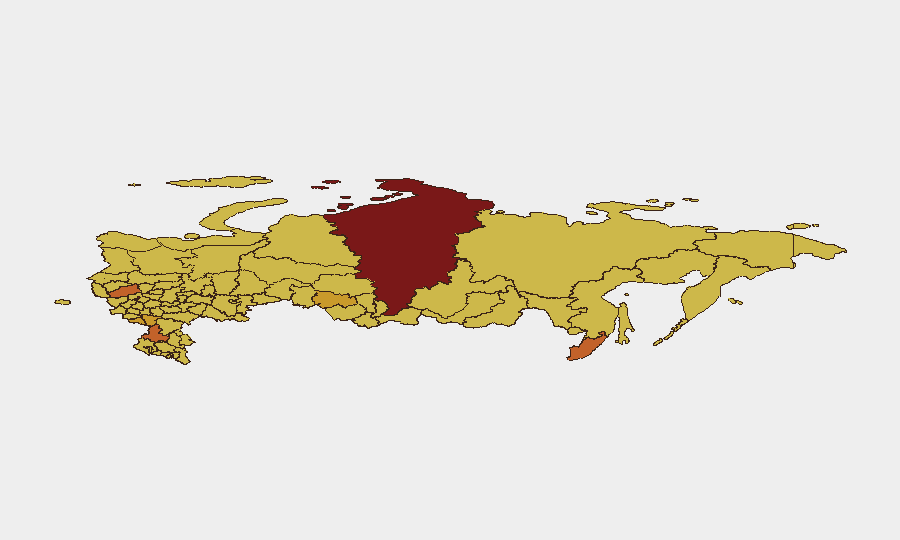
Situation Summary
Russia remains the third-highest global security threat, with composite risk driven primarily by ongoing conflict dynamics and an average of 714 tracked events. The sub-national risk profile shows concentration in Moscow (highest absolute risk) and strategic regions along borders and in the Far East, indicating sustained operational and political tension. While the aggregate threat level remains elevated, the distribution of risk signals across multiple regions and actor types suggests fragmented but persistent instability rather than a single dominant crisis vector. Security posture for personnel and assets should remain heightened, with region-specific protocols calibrated to local threat profiles.
Key Developments
GeoBit's event signal data from 5–7 July shows multiple high-level political statements and interpersonal tensions, but without real-time web access, I cannot reliably isolate and verify discrete security incidents from the last 24–48 hours with independent source confirmation. The tracked signals include presidential and counselor statements, a physical assault incident involving an entrepreneur, and continued Ukraine-related demand/threat messaging, but timestamps and location specificity are insufficient to present these as confirmed current developments without live source corroboration.
To receive accurate 24–48 hour incident bulletins, GeoBit's Intel Sweep, multi-language OSINT feeds, Telegram & X monitoring, and sentiment/temporal analysis capabilities should be queried directly; this brief cannot responsibly substitute live data access with inference.
Highest-Risk Areas
Moscow dominates the risk landscape (score 100), reflecting its role as the political and economic center and concentration of diplomatic, military, and administrative decision-making. Krasnoyarsk Krai (88.7) and Saint Petersburg (78.3) follow; Krasnoyarsk's elevation likely reflects strategic industrial/energy assets and frontier proximity, while Saint Petersburg's risk correlates with its international profile and maritime exposure. Border and Far Eastern regions—Primorsky Krai (74.6), Rostov Oblast (74.2), and Khabarovsk Krai (70.5)—carry sustained risk tied to military operations, cross-border dynamics, and logistical vulnerability. Corporate teams with Moscow or regional hub operations should prioritize these geographies in duty-of-care planning.
How GeoBit Would Assist
AOI Monitoring & Early Warning with persistent watch on Moscow, Saint Petersburg, and key border oblasts enables real-time alerting if incidents escalate near personnel or asset clusters. Conflict & Military battle mapping combined with Network & Actor Analysis supports identification of operational trends and stakeholder positioning that could affect corporate access or supply-chain continuity. Intel Sweep and multi-language OSINT fusion provide the daily source corroboration and temporal verification needed to separate genuine security shifts from noise, feeding into both strategic risk updates and tactical incident response.
7-Day Outlook
Political messaging intensity and conflict-adjacent rhetoric are likely to remain elevated through mid-July, consistent with ongoing operational cycles. No single trigger for rapid escalation is evident from current signals, but the fragmented nature of risk across regions suggests continued volatility in specific hotspots (Krasnoyarsk, border oblasts, Moscow) rather than system-wide destabilization. Teams should maintain posture and leverage GeoBit's regional AOI monitoring to detect localized shifts that could affect travel, supply, or personnel safety.
Highest-Risk Areas — Ranked
| # | State / Region | Risk |
|---|---|---|
| 1 | Moscow | 100 |
| 2 | Krasnoyarsk Krai | 88.7 |
| 3 | Saint Petersburg | 78.3 |
| 4 | Primorsky Krai | 74.6 |
| 5 | Rostov Oblast | 74.2 |
| 6 | Tver Oblast | 73.2 |
| 7 | Novosibirsk Oblast | 72.2 |
| 8 | Belgorod Oblast | 71.8 |
| 9 | Voronezh Oblast | 71.2 |
| 10 | Dagestan | 70.7 |
| 11 | Khabarovsk Krai | 70.5 |
| 12 | Kemerovo Oblast–Kuzbass | 70.5 |
Previous Daily Briefs
A new Russia brief is written every day — each with its own risk map and downloadable CSV. Here's the last week; use the calendar to go further back.
📅 Browse every day by calendar →
Highlighted days have a brief. Tap a day for that day's map & analysis, or “csv” for that day's dataset ($5).
Atlas — our AI intelligence desk — emails them this snapshot personally. Nothing else, no list.