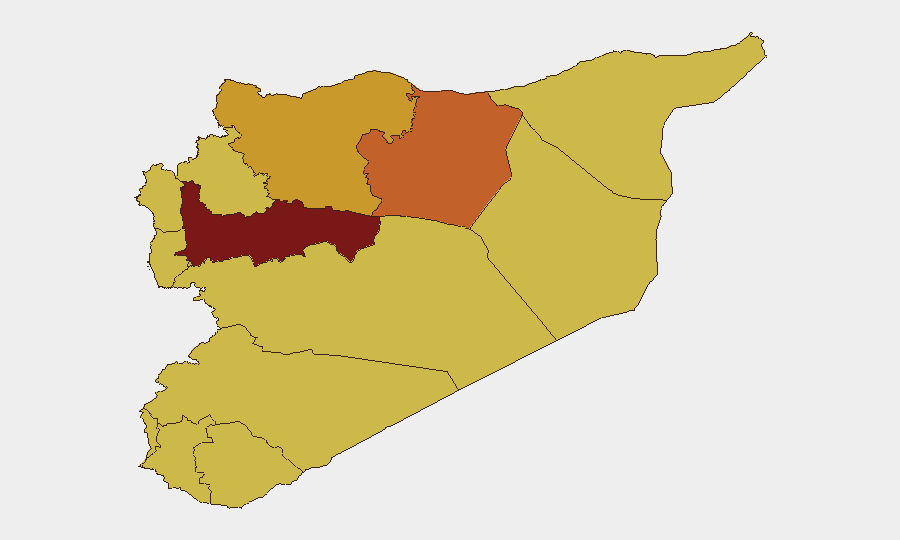
Situation Summary
Syria remains the fifth-highest-threat environment globally (composite score 100), driven by ongoing civil conflict and a sharp spike in urban terrorism in Damascus coinciding with a high-profile French diplomatic visit. Two bomb attacks in central Damascus on 7 July, including twin blasts near the French President's hotel, killed at least 28 people and wounded dozens, signaling either a coordinated attack or opportunistic targeting during elevated security movements. Concurrent armed clashes between government forces and Druze militia, plus detention operations and small-arms combat involving state and ruler forces, underscore persistent fragmentation and instability across multiple threat vectors.
Key Developments
- Damascus (central city, near Four Seasons Hotel) – 7 July 2026
Twin bombs detonated near the hotel where French President Macron was staying, wounding 18 people including four police officers; devices were placed in a dumpster and vehicle. Windows shattered across a busy commercial zone and at least one vehicle was ignited.
- Damascus (Jaramana checkpoint) – 7 July 2026
A suspect on a motorcycle opened fire and threw two hand grenades at a security checkpoint at the city entrance, wounding three officers; the suspect was killed when a third grenade detonated in his hand.
- Damascus (Presidential Palace vicinity) – 7 July 2026
Despite the bombings, French President Macron proceeded to talks with President al‑Sharaa under reinforced security; no immediate claim of responsibility issued by Syrian or international sources.
- Damascus (urban security response) – 7 July 2026
Syrian security forces and defence ministry units sealed roads, established additional checkpoints, and deployed alongside Syrian Red Crescent teams across central districts and the blast zone.
- Syria (nationwide) – 7–8 July 2026
Recorded events include conventional military clashes (government vs. Druze), arrest/detention operations at ministry and prison facilities, police mobilization, and small-arms combat; no clear unified command or statement reconciling incidents across regions.
- Damascus (Justice Palace vicinity) – Recent context (within past week)
A separate bomb attack at a Damascus café near the Justice Palace killed at least 10 and wounded 20, contributing to sustained urban terrorism risk in the capital prior to the Macron visit.
Highest-Risk Areas
Hama Governorate leads all sub-national zones (risk 100), reflecting sustained civil-conflict intensity and militia activity; Damascus Governorate (96.1) has risen sharply due to the twin bombings, detention operations, and security force mobilization in the past 48 hours. Ar-Raqqa and Aleppo (73.9 and 72 respectively) remain unstable due to residual ISIS presence and fragmented local control, while the UNDOF zone, southern governorates (Dar'a, Al-Quneitra), and Idleb cluster at risk 70, indicating active armed faction presence and checkpoint enforcement. The concentration of top-two risks in Hama and Damascus reflects both insurgent/militia strength and state-security responses that create secondary hazards (detention, curfews, route closures).
How GeoBit Would Assist
Teams with personnel or assets in Syria should prioritize AOI Monitoring & Early Warning (persistent watch on Damascus central districts, Hama, and known militia strongholds with real-time alerting) and Intel Sweep (24-hour global event feeds and multi-language OSINT to track factional statements, detention announcements, and attack claims before mainstream media). Routing & Network Analysis and GIS & Spatial Analysis enable alternative journey planning and checkpoint mapping to identify safer movement corridors; Conflict & Military tracking provides force-disposition updates to anticipate flashpoints before kinetic escalation.
7-Day Outlook
Expect continued elevated security posture in Damascus and security-force deployments to persist through at least mid-July as Syrian authorities investigate the twin bombings and detain suspects. Clashes between government and Druze forces, plus factional activity in Hama and northern zones, are likely to generate further localized violence and checkpoint disruptions; no near-term de-escalation signal is apparent.
Highest-Risk Areas — Ranked
| # | State / Region | Risk |
|---|---|---|
| 1 | Hama Governorate | 100 |
| 2 | Damascus Governorate | 96.1 |
| 3 | Ar-Raqqa Governorate | 73.9 |
| 4 | Aleppo Governorate | 72 |
| 5 | Lattakia Governorate | 70 |
| 6 | Tartus Governorate | 70 |
| 7 | UNDOF | 70 |
| 8 | Al-Quneitra Governorate | 70 |
| 9 | Dar'a Governorate | 70 |
| 10 | Idleb Governorate | 70 |
| 11 | Homs Governorate | 70 |
| 12 | Rif Dimashq Governorate | 70 |
Sources
Previous Daily Briefs
A new Syria brief is written every day — each with its own risk map and downloadable CSV. Here's the last week; use the calendar to go further back.
📅 Browse every day by calendar →
Highlighted days have a brief. Tap a day for that day's map & analysis, or “csv” for that day's dataset ($5).
Atlas — our AI intelligence desk — emails them this snapshot personally. Nothing else, no list.