Situation Summary
The UAE faces elevated but currently contained security risk stemming from active regional hostilities between the United States and Iran, with direct impact on UAE-linked maritime assets in the Strait of Hormuz. On 15 July, Iranian cruise missiles struck two UAE-operated tankers ("Mombasa" and "Al Bahiyah"), killing one Indian crew member and injuring eight others—the first confirmed kinetic attack on UAE-associated commercial shipping in the current escalation cycle. While UAE air defenses remain at full readiness and official statements stress that missile threats detected remain outside UAE borders, the country's political leadership has condemned Iranian attacks on neighboring states and asserted its right to retaliate, raising the threshold for further escalation. Information-warfare activity, including unverified social media claims of explosions in Dubai and Abu Dhabi (denied by Dubai Media Office on 16 July), adds a secondary risk of public anxiety and travel disruption.
Key Developments
- Strait of Hormuz (15 July): Two UAE-operated tankers—"Mombasa" and "Al Bahiyah"—were struck by Iranian cruise missiles in the southern shipping lane; one Indian crew member died, eight were injured, and fires were subsequently controlled. Attack confirmed by UAE Ministry of Defense and ADNOC Logistics & Services.
- Strait of Hormuz (15 July): UKMTO reported a third tanker hit by unidentified object approximately 40 nm northeast of Qalhat, Oman, with crew unharmed; heightened risk to UAE-associated shipping in the corridor.
- Abu Dhabi & Dubai (16 July): Social media and Iranian outlets circulated claims of explosions in downtown Dubai and attacks in Abu Dhabi; Government of Dubai Media Office issued public denial, characterizing reports as false and directing public reliance on official sources.
- UAE National Posture (14–15 July): National Emergency, Crisis and Disaster Management Authority (NCEMA) and Ministry of Foreign Affairs confirmed air defenses and monitoring systems operating at full 24/7 readiness, with precautionary alerts issued; all detected missile threats reported as outside UAE borders.
- UAE Diplomatic Stance (15–16 July): UAE condemned Iranian missile and drone attacks on Bahrain, Kuwait, and Jordan, and publicly asserted its full right to retaliate against threats to national security—a significant rhetorical escalation reflecting elevated regional conflict risk.
- Maritime Operations (14–16 July): UAE-linked supertankers were operating with AIS (transponders) disabled when attacked; shipping industry reporting indicates substantial increase in operational and crew-safety risk for UAE commercial vessels transiting Hormuz.
Highest-Risk Areas
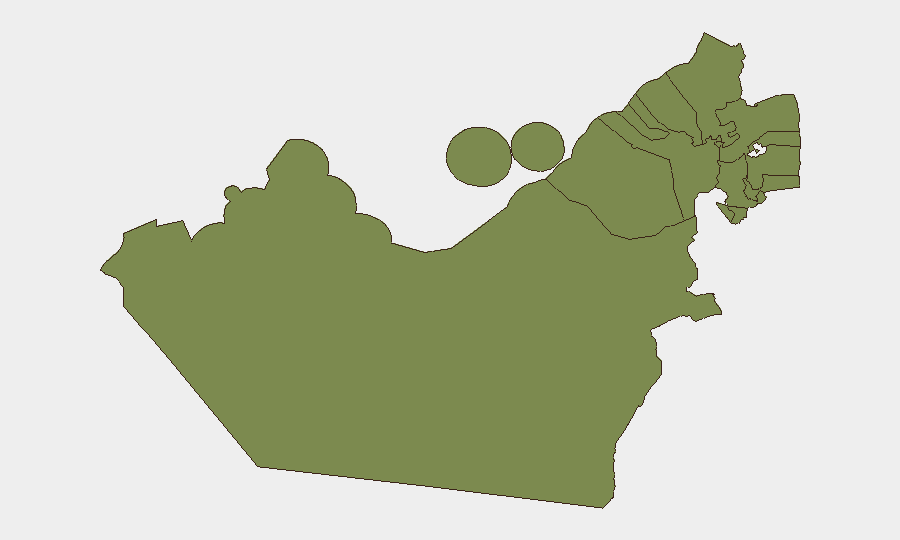
Abu Dhabi Emirate (score 31.8) and Dubai (27.0) dominate the sub-national risk profile, reflecting their concentration of national energy infrastructure, international shipping hubs, and government/diplomatic presence. Both emirates face direct exposure to maritime attack risk in the Strait of Hormuz corridor and remain primary targets for regional missile and drone activity should escalation widen. Remaining emirates (Ras al-Khaimah, Sharjah, Ajman, Fujairah, Umm al-Quwain) show minimal detected risk, consistent with lower strategic/economic priority and distance from active maritime conflict zones.
How GeoBit Would Assist
Corporate security teams should deploy Maritime & Aviation tracking and AOI (Area-of-Interest) Monitoring & Early Warning to maintain real-time visibility of UAE-linked shipping corridors and port activity, with automated alerting on vessel movement anomalies or proximity to attack zones. OSINT fusion, multi-language media search, and sentiment analysis across Arabic, English, and Persian sources will distinguish verified incidents from information-warfare narratives (e.g., the Dubai explosion rumors). Early Warning & Prediction modeling, informed by battle mapping and force-structure analysis of regional military deployments, can project escalation pathways and give duty-of-care teams advance warning of personnel evacuation or facility hardening triggers.
7-Day Outlook
The maritime attack pattern suggests Iran is targeting commercial shipping as a pressure mechanism while avoiding direct strikes on UAE soil—a calibrated escalation to avoid full-scale UAE/US retaliation. However, the UAE's public assertion of its right to retaliate and continued US military presence in the region create risk of unintended escalation or miscalculation within the next 7 days. Organizations should maintain heightened vigilance on Hormuz corridor activity and monitor official UAE civil-defense alerts while preparing contingency plans for temporary business disruption or personnel relocation.
Highest-Risk Areas — Ranked
| # | State / Region | Risk |
|---|---|---|
| 1 | Abu Dhabi Emirate | 31.8 |
| 2 | Dubai | 27 |
| 3 | Ras al-Khaimah | 2.1 |
| 4 | Sharjah Emirate | 1.8 |
| 5 | Ajman Emirate | 1.8 |
| 6 | Fujairah Emirate | 1.8 |
| 7 | Umm al-Quwain | 1.8 |
Sources
Previous Daily Briefs
A new United Arab Emirates brief is written every day — each with its own risk map and downloadable CSV. Here's the last week; use the calendar to go further back.
📅 Browse every day by calendar →
Highlighted days have a brief. Tap a day for that day's map & analysis, or “csv” for that day's dataset ($5).
Atlas — our AI intelligence desk — emails them this snapshot personally. Nothing else, no list.