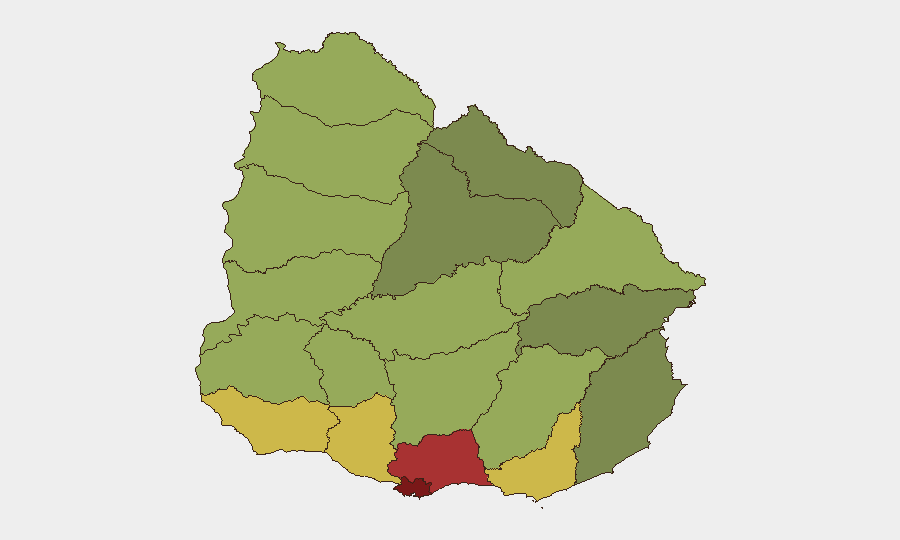
Situation Summary
Uruguay remains a low-threat environment with a composite security score of 5 (ranked #141 globally). No verified acute incidents—armed confrontations, civil unrest, infrastructure attacks, or travel disruptions—have been detected in the last 24–48 hours across national multi-source monitoring. The country's security baseline is stable, with routine crime and policing activity consistent with semester-level trends rather than emergent acute triggers.
Key Developments
- No verified significant incidents in the last 24–48 hours. Multi-source monitoring (mainstream and local media, near-real-time security feeds, and travel advisories) identified no armed confrontations, civil unrest, infrastructure disruptions, or travel-risk alerts for Uruguay on 2026-07-20 or 2026-07-21.
- Diplomatic signal: Uruguay–Chile relations. A "Reduce Relations" signal was flagged on 2026-07-22 between Uruguay and Chile; specifics remain limited in available reporting and do not appear to have triggered domestic security incidents or policy changes affecting travel or operations within Uruguay as of this briefing.
- Community statement on file (2026-07-20). A public statement was logged from a community actor on 2026-07-20; no details confirm escalation, violence, or operational impact in Uruguay.
- Ongoing crime baseline. Recent semester-level data (January–June 2026) show a 6.6% increase in homicides nationally; however, individual violent incidents cited in coverage predate the last 24–48 hours and are confined to earlier July activity in Montevideo neighborhoods. No new spikes or organized-violence triggers are evident for 2026-07-20–22.
- Travel conditions: routine precautions. Government travel guidance continues to recommend "exercise normal safety precautions" in Uruguay, with no new warnings or incident-driven advisories issued in the briefing window.
Highest-Risk Areas
Montevideo (risk 92) remains the principal driver of national risk, reflecting its concentration of crime, organized activity, and population density; Canelones (78) and Maldonado (68) follow as secondary hotspots. Crime in Montevideo clusters in specific neighborhoods and is predominantly opportunistic rather than conflict-driven; armed robbery, theft, and gang-related homicides occur at a higher rate than in rural departments. San José, Colonia, and Soriano (64, 62, 58 respectively) are moderately elevated but substantially lower than the capital. Risk scores reflect seasonal tourism influx (particularly Maldonado's beach districts) and transient population exposure rather than state-level instability. Northern departments (Artigas, Salto, Paysandú) remain lowest-risk, consistent with lower urbanization and criminal organization presence.
How GeoBit Would Assist
Teams with operations in Uruguay should employ AOI Monitoring & Early Warning to establish persistent watches on Montevideo's high-crime neighborhoods and border regions; OSINT fusion (social media, local news, and radio SIGINT) to detect emerging gang activity or organized-crime signals; and Risk & Threat Assessment to track semester-long crime trends and correlate them with tourism seasons and diplomatic developments. Routing & Network Analysis can be used to generate safer travel corridors within and between departments, avoiding known incident zones.
7-Day Outlook
No acute escalation drivers are visible for the next seven days. Diplomatic tensions with Chile warrant routine monitoring for spillover into domestic policy or civil unrest, but current reporting suggests limited domestic impact. Crime and security conditions are expected to remain consistent with the July baseline, with Montevideo continuing to require heightened situational awareness.
Highest-Risk Areas — Ranked
| # | State / Region | Risk |
|---|---|---|
| 1 | Montevideo | 92 |
| 2 | Canelones | 78 |
| 3 | Maldonado | 68 |
| 4 | San José | 64 |
| 5 | Colonia | 62 |
| 6 | Soriano | 58 |
| 7 | Río Negro | 56 |
| 8 | Salto | 54 |
| 9 | Artigas | 52 |
| 10 | Paysandú | 50 |
| 11 | Florida | 48 |
| 12 | Flores | 46 |
Sources
Previous Daily Briefs
A new Uruguay brief is written every day — each with its own risk map and downloadable CSV. Here's the last week; use the calendar to go further back.
📅 Browse every day by calendar →
Highlighted days have a brief. Tap a day for that day's map & analysis, or “csv” for that day's dataset ($5).
Atlas — our AI intelligence desk — emails them this snapshot personally. Nothing else, no list.