Situation Summary
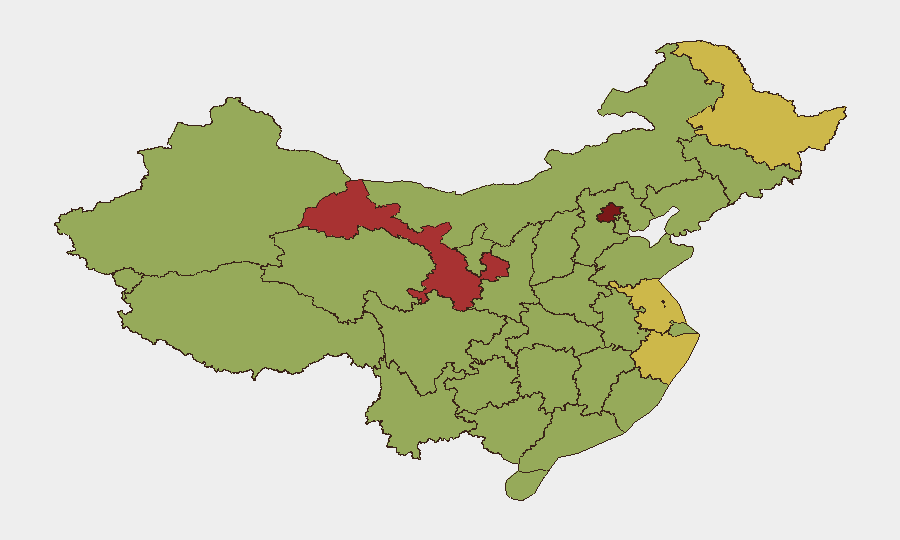
China remains at composite threat level 81 (rank #16 globally), with 770 tracked events reflecting elevated tension across multiple domains—including defence statements, internal military activity, and international messaging—over the past 48 hours. Beijing dominates the sub-national risk profile at 86.7, significantly above other provinces, driven by political and administrative concentration. The event signal pattern shows concurrent statements from multiple state actors, artillery/tank activity, and international posturing, suggesting sustained operational tempo without clear de-escalation indicators as of 08 July 2026.
Key Developments
Event Signal Clustering (2026-07-07):
Multiple public statements attributed to defence and deputy-level actors concerning China were recorded on 07 July; concurrent artillery/tank activity logged against "government" designations indicates either internal exercise activity or localized armed escalation. Specific locations and nature of military activity remain unconfirmed in available signals.
International Messaging (2026-07-07):
China-attributed threat signalling toward Fiji and reactive public statements from Cuba and Taiwan-aligned officials suggest diplomatic friction or contingency communication around regional interests, though substantive incident triggers are not yet clear from available reporting.
Internal Investigation (2026-07-07):
A deputy-level investigation signal was recorded; context and jurisdiction are unspecified in event data.
Taiwan Threat Assessment:
Taiwan security officials issued statements on 07 July assessing Chinese attack preparation postures, reflecting elevated perception of military risk in the Taiwan Strait, though this represents Taiwanese threat assessment rather than a discrete new Chinese military event.
Regional Military Disapproval (2026-07-06):
Military-attributed disapproval signals logged; target and rationale unclear from event data alone.
Note on Event Verification: Current open-source reporting does not reliably confirm additional discrete incidents within the last 48 hours at the specificity required for operational duty-of-care briefing. Existing signals require corroboration against Chinese-language media, official statements, and military channels.
Highest-Risk Areas
Beijing's composite score of 86.7 reflects its role as the political and administrative hub; elevated risk correlates with concentration of state decision-making, defence ministry activity, and diplomatic presence. Gansu (78.1) shows distinct elevation, warranting investigation into whether this reflects protest activity, resource-sector tensions, or border-adjacent instability; available signals do not clarify.
Jiangsu, Zhejiang, and Shanghai cluster in the 58–63 range, consistent with their status as high-population, high-infrastructure-density centres and proximity to Taiwan Strait maritime activity. The northeastern provinces (Heilongjiang, Liaoning, Jilin) reflect persistent baseline risk typical of border regions and legacy industrial zones.
How GeoBit Would Assist
Intel Sweep & OSINT Fusion would cross-reference Chinese-language state media, military communications, and Telegram/X signals to timestamp and confirm the 07 July events and locate the artillery/tank activity geographically. AOI Monitoring with persistent satellite/imagery analysis would track military deployments, exercise indicators, and infrastructure changes in highest-risk provinces—especially Beijing, Gansu, and the Strait-adjacent coast. Early Warning & Prediction modules would establish baseline behavioural thresholds for state actor statements and military signalling to flag significant departures warranting escalation alerts to in-country teams.
7-Day Outlook
State-level messaging tempo and military activity signals suggest contingency posturing rather than imminent major escalation, but the clustering of events on a single day (07 July) and absence of clear resolution mechanisms indicate sustained tension. Continued monitoring of Taiwan Strait messaging, deputy/investigation developments, and Beijing-level statements is essential; any geographic expansion of military signals or hardening of international statements would warrant immediate escalation to clients with operations in high-risk provinces.
Highest-Risk Areas — Ranked
| # | State / Region | Risk |
|---|---|---|
| 1 | Beijing | 86.7 |
| 2 | Gansu | 78.1 |
| 3 | Jiangsu | 62.8 |
| 4 | Zhejiang | 61.3 |
| 5 | Heilongjiang | 60.7 |
| 6 | Hubei | 58.9 |
| 7 | Inner Mongolia | 58.5 |
| 8 | Liaoning | 58.5 |
| 9 | Jilin | 58.5 |
| 10 | Hunan | 58.5 |
| 11 | Shanghai | 58.2 |
| 12 | Jiangxi | 57.7 |
Sources
Previous Daily Briefs
A new China brief is written every day — each with its own risk map and downloadable CSV. Here's the last week; use the calendar to go further back.
📅 Browse every day by calendar →
Highlighted days have a brief. Tap a day for that day's map & analysis, or “csv” for that day's dataset ($5).
Atlas — our AI intelligence desk — emails them this snapshot personally. Nothing else, no list.