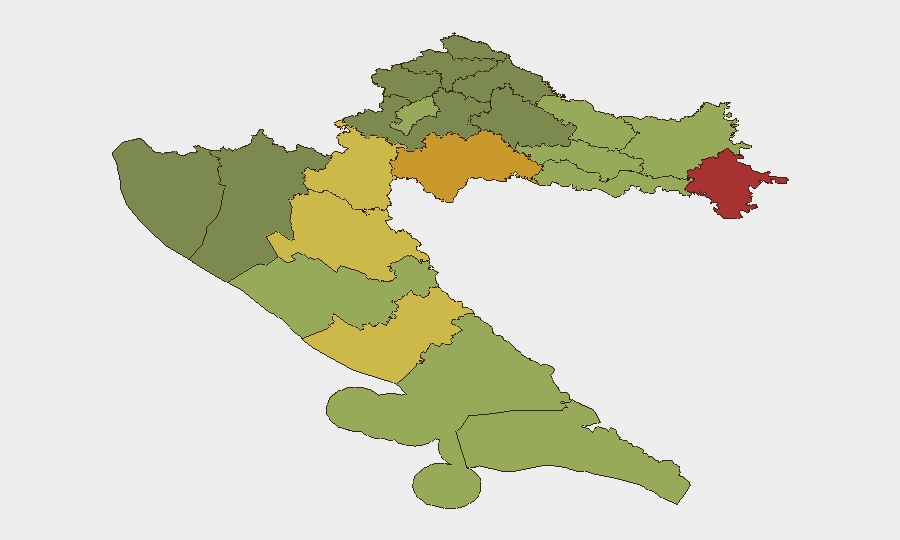
Situation Summary
Croatia remains a low-threat environment globally (rank #143, composite score 7) with no tracked active crises, but sub-national risk concentration in the northeast and border regions reflects legacy conflict-zone vulnerabilities, ongoing organized crime, and emerging transnational threats. Recent incidents—including a state-level cyberattack suspected of foreign-intelligence links, targeted violence against law enforcement, and child-exploitation networks—signal persistent security gaps despite overall stability. The security posture is stable but requires vigilance in high-risk counties and border transit corridors.
Key Developments
- Zagreb, 7 August — A 33-year-old Serbian national arrested on suspicion of hacking multiple Croatian state institutions; investigators examining possible links to Serbia's BIA intelligence service, indicating potential state-sponsored cyber activity against government targets.
- Zadar County, 6–7 August — Police reported a cluster of property crimes including warehouse burglary (Privlaka, cash and cigarettes stolen), moped theft (Biograd na Moru), wallet theft (Poluotok area), and security camera theft (Borik area); pattern suggests organized petty-crime activity in coastal zone.
- Krapina, 5 August — A police officer shot dead inside a café at a shopping center; incident assessed as targeted, investigation ongoing; reflects rare but serious risk to law enforcement in civilian spaces.
- Trogir/Kaštel Štafilić (Split Airport vicinity), 7 August — A 39-year-old German national filed criminal report for operating a drone in a prohibited zone near Split Airport; reported as second such incident in days, indicating repeated aviation-security boundary violations.
- Škrljevo station (Zagreb–Rijeka rail line), 6 August — A freight train passed a red signal in proximity to a passenger train; power cut and traffic suspended; indicates railway-infrastructure risk during peak summer travel season.
- Zagreb (date reported 7 August) — Police arrested a 45-year-old Italian national for covert filming of nude minors; transnational child-exploitation network exposure requiring cross-border law-enforcement coordination.
Highest-Risk Areas
Vukovar-Srijem, Sisak-Moslavina, and Karlovac counties (risk scores 78, 72, 68 respectively) dominate the threat landscape, reflecting post-conflict economic fragility, weak institutional capacity, proximity to Serbian border, and historical organized-crime networks in the eastern corridor. Lika-Senj and Šibenik-Knin counties (65, 62) extend risk into the mountainous interior and Dalmatian coast, where property crime, smuggling, and transnational trafficking exploit limited law-enforcement presence. Zagreb and coastal Split-Dalmatia (50, 48) remain lower-risk but face emerging cyberattacks, aviation-security lapses, and petty-crime clusters targeting tourists and infrastructure.
How GeoBit Would Assist
Teams operating in Croatia should employ Intel Sweep and global event feeds for real-time cyberattack and organized-crime intelligence, AOI Monitoring with alerting on Vukovar-Srijem and Sisak-Moslavina counties to detect escalating instability, Maritime & Aviation tracking to monitor coastal and airport-zone security incidents, and Network & Actor Analysis to map transnational crime and intelligence links (particularly Serbian-Croatian vectors). Routing & Network Analysis supports alternative journey planning around high-risk border and rail corridors during peak travel periods.
7-Day Outlook
No imminent escalation expected; however, cyberattack frequency and sophistication may increase if state-actor involvement is confirmed, and summer tourism season will sustain petty-crime and aviation-security incidents in coastal and airport zones. Northeast counties will remain under pressure from organized crime and cross-border trafficking. Duty-of-care teams should maintain heightened awareness for personnel traveling to or resident in Zadar, Krapina, and Zagreb, with particular attention to cybersecurity posture and aviation-zone compliance.
Highest-Risk Areas — Ranked
| # | State / Region | Risk |
|---|---|---|
| 1 | Vukovar-Srijem County | 78 |
| 2 | Sisak-Moslavina County | 72 |
| 3 | Karlovac County | 68 |
| 4 | Lika-Senj County | 65 |
| 5 | Šibenik-Knin County | 62 |
| 6 | Brod-Posavina County | 58 |
| 7 | Zadar County | 55 |
| 8 | Osijek-Baranja County | 52 |
| 9 | City of Zagreb | 50 |
| 10 | Split-Dalmatia County | 48 |
| 11 | Požega-Slavonia County | 45 |
| 12 | Virovitica-Podravina County | 42 |
Sources
Previous Daily Briefs
A new Croatia brief is written every day — each with its own risk map and downloadable CSV. Here's the last week; use the calendar to go further back.
📅 Browse every day by calendar →
Highlighted days have a brief. Tap a day for that day's map & analysis, or “csv” for that day's dataset ($5).
Atlas — our AI intelligence desk — emails them this snapshot personally. Nothing else, no list.