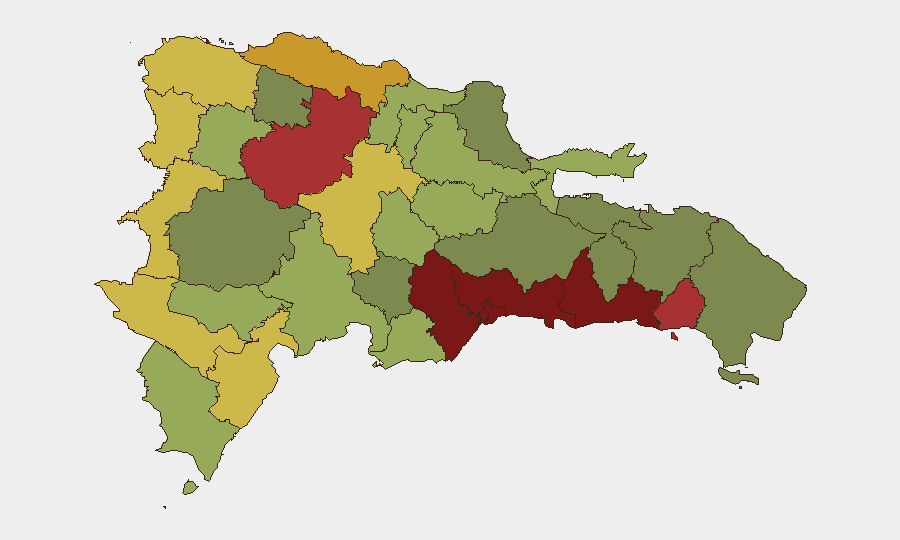
Situation Summary
Dominican Republic remains ranked #110 globally in composite threat, with crime and gang violence as the primary driver. The security environment is characterized by persistent street-level violence, property crime, and sporadic community confrontations, concentrated in urban centers. An ongoing diplomatic incident—expulsion of nine Cuban diplomats with an August 16 deadline—creates a secondary political-intelligence risk, though it has not yet translated into domestic civil unrest. Overall trajectory shows endemic criminality without indication of imminent systemic destabilization.
Key Developments
- Santo Domingo / National level – Cuban diplomatic expulsion deadline (Aug 16, 2026)
Dominican Foreign Ministry expulsion order targeting nine Cuban diplomats and ~21 family members reaches its final deadline today (August 16). The measure, announced August 13, cites Vienna Convention protocols and is widely reported to stem from alleged surveillance of Cuban defectors during the Santo Domingo 2026 Central American and Caribbean Games. Cuban state media frames the move as U.S.-influenced; the Cuban embassy continues operating with remaining staff, and diplomatic relations remain intact despite the tension.
- Santo Domingo area – street robbery arrests (Aug 14–15, 2026)
Dominican National Police Division of Investigation (DICRIM C-2) arrested Justin Esteban Peguero ("Polote"), 21, in connection with a series of *arrebatos* (snatch thefts) targeting pedestrians in public areas. Recovery included 17 handbags, personal documents, and bank cards, indicating active enforcement against opportunistic street robbery in urban zones.
- National / analytical release – youth homicide statistics (Aug 15, 2026)
Dominican authorities released a statistical bulletin noting that between 2007–2024, 60.82% of homicide victims were aged 15–35, with 91% male. While historical data rather than a discrete incident, publication on August 15 may influence domestic security debates and operational posture.
- Background context (August 6–10, 2026)
Recent violent incidents include fatal shootings at a liquor venue (Aug 9), confrontations during community protests over landfill and agricultural labor disputes (Aug 9–10), and a traffic-related gunfight involving a police officer (Aug 7). These incidents underscore ongoing gang and community-level violence, particularly in and around Santo Domingo, Nacional District, and San Cristóbal provinces.
Highest-Risk Areas
Santo Domingo (risk 92) and Nacional District (risk 88) dominate the sub-national ranking and account for the largest concentration of reported violent incidents, driven by gang activity, street robbery, and community confrontations. San Cristóbal (risk 85), San Pedro de Macorís (risk 83), and La Romana (risk 78) follow, forming a high-risk corridor in the southern and southeastern regions. Risk drivers include organized crime, opportunistic robbery, and sporadic inter-community violence; northern and border provinces (Santiago, Puerto Plata, Elías Piña, Dajabón) rank lower but remain elevated due to drug-trafficking routes and informal commerce activity.
How GeoBit Would Assist
Security teams managing personnel or assets in Dominican Republic should deploy AOI Monitoring & Early Warning on Santo Domingo, Nacional District, and San Pedro de Macorís to track emerging violence, protest, or crowd activity in real time. Multi-language OSINT (X/Twitter, Telegram, local Dominican media feeds) combined with sentiment and temporal analysis will flag shifts in gang communication, police operations, or community tensions. Network & Actor Analysis can map local criminal networks and track expulsions or leadership changes that may alter territorial control or violence patterns.
7-Day Outlook
The Cuban diplomatic expulsion deadline (today, August 16) is unlikely to trigger immediate domestic unrest, though geopolitical rhetoric may intensify in information space and create secondary operational friction. Street-level crime and community violence will likely persist at current endemic levels, with concentrated risk in urban centers; no major policy or security-force shifts are signaled. Monitor for secondary effects of the diplomatic incident on Cuba-linked diaspora networks or protest activity, particularly in Santo Domingo.
Highest-Risk Areas — Ranked
| # | State / Region | Risk |
|---|---|---|
| 1 | Santo Domingo | 92 |
| 2 | Nacional District | 88 |
| 3 | San Cristóbal | 85 |
| 4 | San Pedro de Macorís | 83 |
| 5 | La Romana | 78 |
| 6 | Santiago | 76 |
| 7 | Puerto Plata | 72 |
| 8 | Elías Piña | 70 |
| 9 | Dajabón | 68 |
| 10 | Barahona | 65 |
| 11 | Independencia Province | 64 |
| 12 | La Vega | 62 |
Sources
Previous Daily Briefs
A new Dominican Republic brief is written every day — each with its own risk map and downloadable CSV. Here's the last week; use the calendar to go further back.
- August 15, 2026
- August 14, 2026
- August 13, 2026
- August 12, 2026
- August 11, 2026
- August 10, 2026
- August 9, 2026
📅 Browse every day by calendar →
Highlighted days have a brief. Tap a day for that day's map & analysis, or “csv” for that day's dataset ($5).
Atlas — our AI intelligence desk — emails them this snapshot personally. Nothing else, no list.