Situation Summary
Georgia remains at composite threat rank #90 globally with no tracked security events as of 23 August, but faces persistent structural risks concentrated in occupied and adjacent territories. Pro-European protest activity in central Tbilisi has entered its 633rd consecutive day, with large gatherings on 22 August continuing a pattern of occasional police response involving tear gas and water cannon. The country-wide travel-risk index stands at "heightened caution" (Level 2 of 4), driven primarily by instability in Abkhazia and South Ossetia rather than generalized urban violence.
Key Developments
- Tbilisi – sustained opposition protests (22 August 2026, evening). Pro-European and anti-government demonstrators rallied for the 633rd consecutive day at Parliament (Rustaveli Avenue), Tbilisi City Council (Freedom Square), and via organized march from Avlabari metro station toward the Government office. Demands centered on new parliamentary elections, release of political prisoners, repeal of restrictive laws, and disengagement from Russia. Law-enforcement presence remained firm; historical crackdowns in this protest series have involved tear gas, water cannon, and mass administrative detentions.
- Sachkhere Municipality – detained citizen released (21 August 2026). Georgia's State Security Service reported release and return to Tbilisi-controlled territory of a Georgian citizen illegally detained near Perevi village on 17 August, close to the South Ossetia administrative boundary. The incident underscores ongoing risk of arbitrary detention by de facto/Russian forces near occupation lines.
- Country-wide travel-risk reassessment (current as of 18–23 August 2026). Multi-country advisory composite (Spain, UK, US) rates Georgia at Level 2 ("heightened caution," 2.22/4), with some European governments rating it "high risk." Explicit do-not-travel advisories remain in effect for Abkhazia and South Ossetia; areas immediately adjacent to occupation boundary lines flagged for avoidance unless operationally necessary.
Highest-Risk Areas
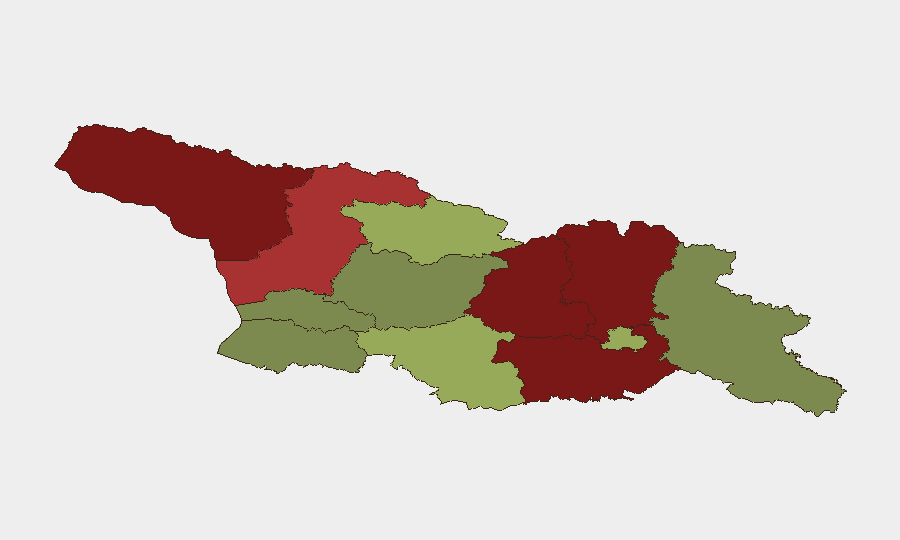
Abkhazia (risk 95) and Shida Kartli (risk 88) drive the country's threat profile, followed by Lower Kartli (85) and Mtskheta-Mtianeti (82)—all territories either under Russian occupation or directly adjacent to disputed administrative boundaries where arbitrary detention, military presence, and restricted access create acute duty-of-care exposure. Samtskhe-Javakheti (48) and Tbilisi (45) represent secondary risk clusters; Tbilisi's elevation reflects sustained protest activity and police response capacity rather than widespread violence. Southern and western regions (Imereti, Guria, Adjara) register substantially lower risk (32, 28, 35 respectively) and remain operationally accessible.
How GeoBit Would Assist
Corporate teams with personnel or assets in Georgia should employ AOI Monitoring & Early Warning (persistent watch on Tbilisi Parliament/Freedom Square and occupation boundary areas with alerting on police activity or crowd-size escalation), OSINT Fusion (Telegram/X monitoring of protest organizers and state-security announcements), and Routing & Network Analysis (alternative journey planning to avoid central Tbilisi protest zones or high-risk border regions). Sentiment & Temporal Analysis on opposition messaging would flag shifts in protest intensity or police posture within 6–12 hours of action.
7-Day Outlook
Protest activity in Tbilisi is expected to persist at current cadence (daily or near-daily gatherings) through at least late August without a clear political off-ramp; the 633-day duration suggests organizational durability. Abkhazia and South Ossetia remain static high-risk zones with no near-term security improvement; travel avoidance in those areas should remain standing policy. No escalation in armed conflict is signaled; the primary near-term duty-of-care risk is exposure to protest-zone police response in central Tbilisi and detention risk near occupation boundaries.
Highest-Risk Areas — Ranked
| # | State / Region | Risk |
|---|---|---|
| 1 | Autonomous Republic of Abkhazia | 95 |
| 2 | Shida Kartli | 88 |
| 3 | Lower Kartli | 85 |
| 4 | Mtskheta-Mtianeti | 82 |
| 5 | Samegrelo-Upper Svaneti | 78 |
| 6 | Samtskhe-Javakheti | 48 |
| 7 | Tbilisi | 45 |
| 8 | Racha-Lechkhumi and Kvemo Svaneti | 42 |
| 9 | Kakheti | 38 |
| 10 | Autonomous Republic of Adjara | 35 |
| 11 | Imereti | 32 |
| 12 | Guria | 28 |
Sources
Previous Daily Briefs
A new Georgia brief is written every day — each with its own risk map and downloadable CSV. Here's the last week; use the calendar to go further back.
- August 22, 2026
- August 21, 2026
- August 20, 2026
- August 19, 2026
- August 18, 2026
- August 17, 2026
- August 16, 2026
📅 Browse every day by calendar →
Highlighted days have a brief. Tap a day for that day's map & analysis, or “csv” for that day's dataset ($5).
Atlas — our AI intelligence desk — emails them this snapshot personally. Nothing else, no list.