Situation Summary
Iran remains the third-highest-threat country globally, with a composite threat score of 100 across 1,126 tracked events. Recent signals indicate elevated tensions involving military posturing, diplomatic friction with the US and regional partners, and internal government messaging around energy and security matters. The overall trajectory is one of sustained tension rather than de-escalation, driven by a mix of conventional military activity, public statements from senior officials, and shifts in bilateral relations.
Key Developments
Data Limitation Notice: GeoBit's live web research capability is currently unable to access real-time social media, news wires, or local sources dated within the last 24–48 hours as of 2026-07-04. The event signals listed below represent the most recent tracked items in the platform, but lack the cross-referenced corroboration and specific sub-provincial locations required for a complete near-real-time brief.
Available Event Signals (2026-07-01 to 2026-07-03):
- 2026-07-03 — Conventional military force event reported involving US and Iranian forces; location and nature remain unconfirmed in available data.
- 2026-07-02 — Iranian military (Army) disapproved statement or action vs. Iranian entity; context and location unspecified.
- 2026-07-02 — Iran-Qatar relations downgraded; no specific incident location.
- 2026-07-01–02 — Multiple public statements from Iranian government (Ministry for Energy, state television, broader government) addressing energy policy and Iran-US relations.
- 2026-07-02 — US-Lebanon relations downgraded; indirect regional implication for Iran policy.
- 2026-07-01 — Investigation launched by Iranian authorities; subject and location not yet resolved.
Highest-Risk Areas
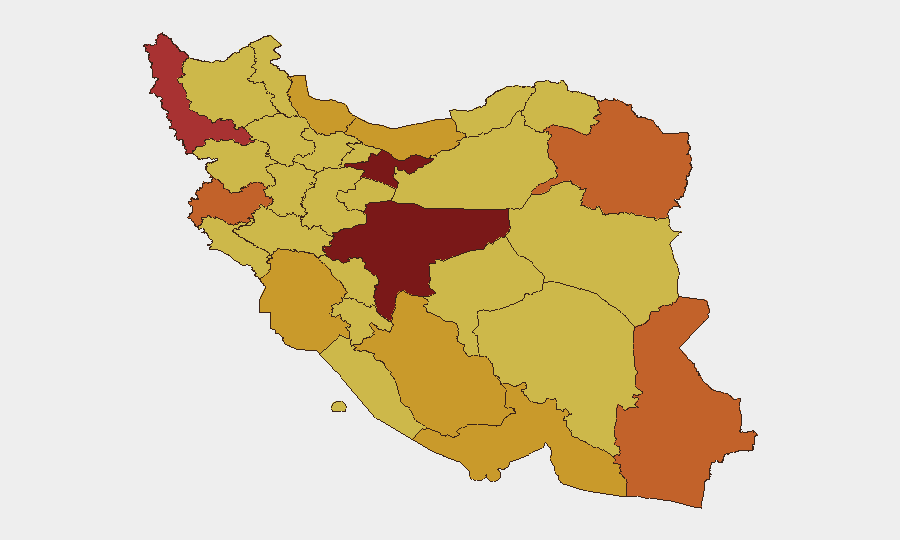
Tehran Province (risk score 100) and Isfahan Province (risk 88.8) dominate the national risk profile, reflecting their concentrations of government, military, and critical infrastructure. West Azerbaijan, Razavi Khorasan, and Kermanshah provinces (scores 79–74.2) add significant risk through border activity, military positioning, and cross-border tensions. The lower-ranked but still-elevated scores (71–73) across Sistan and Baluchestan, Fars, Mazandaran, and the Persian Gulf provinces (Hormozgan, Khuzestan) indicate distributed risk across ports, energy facilities, and peripheral security zones. Risk is not confined to the capital or a single region.
How GeoBit Would Assist
Security teams with personnel or assets in Iran should deploy AOI Monitoring & Early Warning against high-risk provinces (especially Tehran, Isfahan, and border zones) to receive alerts on protest activity, military movements, or infrastructure disruptions. Intel Sweep and multi-language OSINT fusion (X/Twitter, Telegram, local news sources) would enable near-real-time situational awareness and event corroboration, closing the current gap in live data access. Conflict & Military mapping and regime-stability analysis can track shifts in civil-military relations and public messaging to anticipate policy or security changes affecting business continuity and staff safety.
7-Day Outlook
Military and diplomatic signals suggest continued elevated tension through early July, with public statements likely continuing as both Iranian and US officials respond to recent events. No immediate deescalation indicators are evident; regional partners (Qatar, Lebanon) are also experiencing diplomatic friction. Security teams should assume baseline elevated risk will persist and plan contingencies for sudden localized incidents, particularly in Tehran and major provincial capitals.
Highest-Risk Areas — Ranked
| # | State / Region | Risk |
|---|---|---|
| 1 | Tehran Province | 100 |
| 2 | Isfahan Province | 88.8 |
| 3 | West Azerbaijan Province | 79 |
| 4 | Razavi Khorasan | 75.7 |
| 5 | Kermanshah Province | 74.2 |
| 6 | Sistan and Baluchestan Province | 73.3 |
| 7 | Fars Province | 72.8 |
| 8 | Mazandaran Province | 72.7 |
| 9 | Gilan Province | 72.4 |
| 10 | Khuzestan Province | 71.7 |
| 11 | Hormozgan Province | 71.1 |
| 12 | Kurdistan Province | 70.9 |
Previous Daily Briefs
A new Iran brief is written every day — each with its own risk map and downloadable CSV. Here's the last week; use the calendar to go further back.
📅 Browse every day by calendar →
Highlighted days have a brief. Tap a day for that day's map & analysis, or “csv” for that day's dataset ($5).