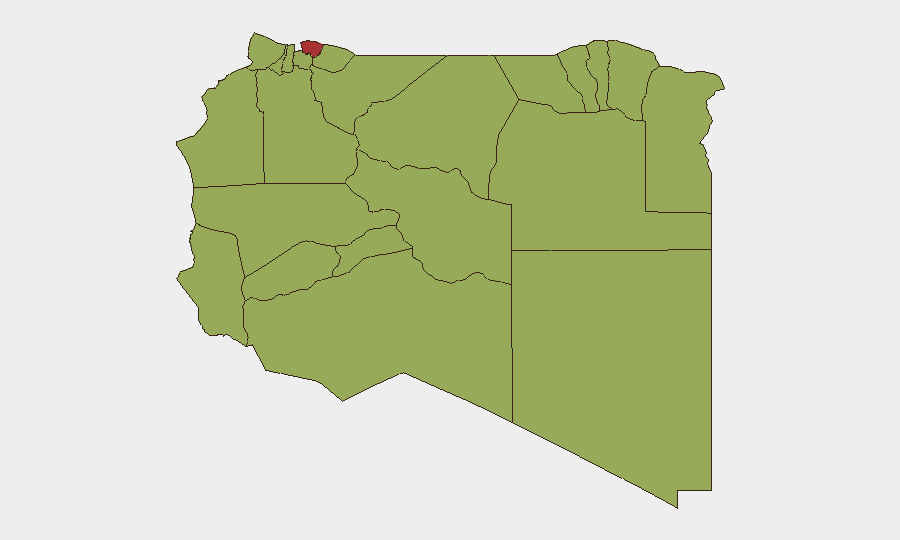
Situation Summary
Libya remains at composite threat rank #23 globally (score 66) with 13 tracked events. The security environment is concentrated in Tripoli, which dominates the risk profile at 76.5—nearly 40% higher than secondary hotspots—driven by civil unrest centered on power and service delivery. A cluster of western and southern regions (Nalut, Ghat, Az Zawiya, Murzuq, Kufra) share elevated but uniform risk scores of 46.5, reflecting fragmentation and transregional vulnerabilities rather than acute incident concentration. No major security escalation has been confirmed in the last 24–48 hours; the threat posture remains broadly stable but tense.
Key Developments
No verified new incidents reported in the last 24–48 hours. The most recent trackable events are:
- 2026-07-29: Demonstrate/Rally reported across Libya with anti-government sentiment (location unspecified).
- 2026-07-28: Demonstrate/Rally activity in Tripoli.
Earlier signals (27–28 July) indicate sustained civil protest activity centered on service disruptions (electricity, fuel access) and road blockades in western Libya. These events have not escalated to armed confrontation or territorial control challenges. Situation remains under routine government response; no security force casualties or major infrastructure damage reported.
Highest-Risk Areas
Tripoli's risk score of 76.5 reflects its function as the de facto capital and seat of competing political authority; civil unrest, governance friction, and transient crowd activity create persistent exposure to personnel and fixed assets. The secondary cluster—Nalut, Ghat, Az Zawiya, Wadi al Shatii, Murzuq, Kufra, and southern/border regions—share uniform 46.5 scores, indicating endemic fragmentation, weak state presence, cross-border trafficking networks, and militia activity rather than acute incident likelihood. Nalut and Ghat border Tunisia and Algeria respectively and are known conduits for weapons and personnel flow; Kufra and Murzuq remain transit hubs for both formal commerce and illicit networks. Tripoli demands prioritized monitoring; secondary regions warrant baseline awareness and contingency planning rather than escalated alert posture.
How GeoBit Would Assist
Intelligence & OSINT (Intel Sweep, X/Twitter & Telegram OSINT, multi-language search, sentiment analysis) enables real-time monitoring of Tripoli protest dynamics and regional grievances before crowd events create access or movement constraints. AOI Monitoring & Early Warning applied to Tripoli, Nalut, Ghat, and border crossings provides persistent watch with alerting thresholds, triggering duty-of-care notification before incidents impact personnel or supply chains. Routing & Network Analysis supports alternative journey planning around Tripoli blockade zones and southern border regions to maintain operational continuity; Conflict & Military tracking and Network & Actor Analysis map militia geography and governance fractures in secondary regions to inform risk posture for remote teams or assets.
7-Day Outlook
Civil unrest in Tripoli is likely to persist at current levels, with periodic rally/blockade activity tied to fuel and electricity availability. No indicators of armed escalation, military repositioning, or state collapse are present. Risk in secondary regions (west and south) remains chronic but non-acute; teams should operate under standard enhanced vigilance protocols, maintain liaison with local authorities, and sustain contingency mobility plans.
Highest-Risk Areas — Ranked
| # | State / Region | Risk |
|---|---|---|
| 1 | Tripoli | 76.5 |
| 2 | Nalut | 46.5 |
| 3 | Ghat | 46.5 |
| 4 | Baladiyah Surman | 46.5 |
| 5 | Az Zawiya District | 46.5 |
| 6 | Wadi al Shatii | 46.5 |
| 7 | Wadi al Hayaa | 46.5 |
| 8 | Murzuq | 46.5 |
| 9 | Kufra | 46.5 |
| 10 | Nuqat al Khams | 46.5 |
| 11 | Jafara | 46.5 |
| 12 | Murqub | 46.5 |
Sources
Previous Daily Briefs
A new Libya brief is written every day — each with its own risk map and downloadable CSV. Here's the last week; use the calendar to go further back.
📅 Browse every day by calendar →
Highlighted days have a brief. Tap a day for that day's map & analysis, or “csv” for that day's dataset ($5).
Atlas — our AI intelligence desk — emails them this snapshot personally. Nothing else, no list.