Situation Summary
North Korea remains at composite threat rank #30 globally with elevated political-military tension driven by trilateral U.S.–South Korea–Japan exercises, deepening Russia alignment, and declared nuclear capability expansion. Over the past 48 hours, Pyongyang has issued multiple threat statements against allied military activities and announced completion of forward-deployed rocket facilities near Seoul, while simultaneously engaging Moscow on defense and sanctions-evasion cooperation. The threat environment reflects rhetorical escalation coupled with incremental military modernization rather than imminent kinetic risk, but the density of concurrent hostile signaling warrants heightened monitoring of the DMZ and maritime approaches.
Key Developments
- Pyongyang (Defense Ministry, KCNA) | 18 July 2026: North Korea's Defense Ministry denounced the U.S.–South Korea–Japan *Freedom Edge* trilateral exercise as "the root of destroying peace and stability," warning of serious security challenges from triangular military cooperation and signaling intent to respond to continued drills.
- Pyongyang (KCNA) | 17 July 2026: State media criticized the ongoing *RIMPAC* multinational maritime exercise as a "reckless provocation" and threatened a "chain of countermeasures" to "decisively suppress" such actions, with explicit criticism of South Korea's participation.
- Near Kaesong & Han River (satellite analysis reported 17 July; disclosed 18 July 2026): Radio Free Asia reported completion of 21 large rocket-related facilities approximately 50 km north of Seoul, assessed by CSIS and RAND as forward bases for rocket artillery and missile transporter-erector-launcher (TEL) systems—a significant upgrade to strike capability against the Seoul metropolitan area.
- Moscow | 18 July 2026 (arrival): North Korean Foreign Minister Choe Son Hui arrived in Moscow for official visit at invitation of Russian Foreign Minister Lavrov, continuing Pyongyang's active military and diplomatic support for Russia's Ukraine campaign and signaling deepened sanctions-evasion and arms-transfer coordination.
- Pyongyang (KCNA) | mid-July 2026: North Korea announced new measures to strengthen nuclear forces "quantitatively and qualitatively," framing weapons expansion as a response to NATO summit rhetoric and perceived Western aggression.
- Rason & Pyongyang (specialist reporting) | 17 July 2026: New construction activity reported at Rason shipyard tied to warship modernization; concurrent reporting noted Kim Jong-un's recent meeting with China's top political adviser, underscoring active naval infrastructure enhancement and political coordination with Beijing.
Highest-Risk Areas
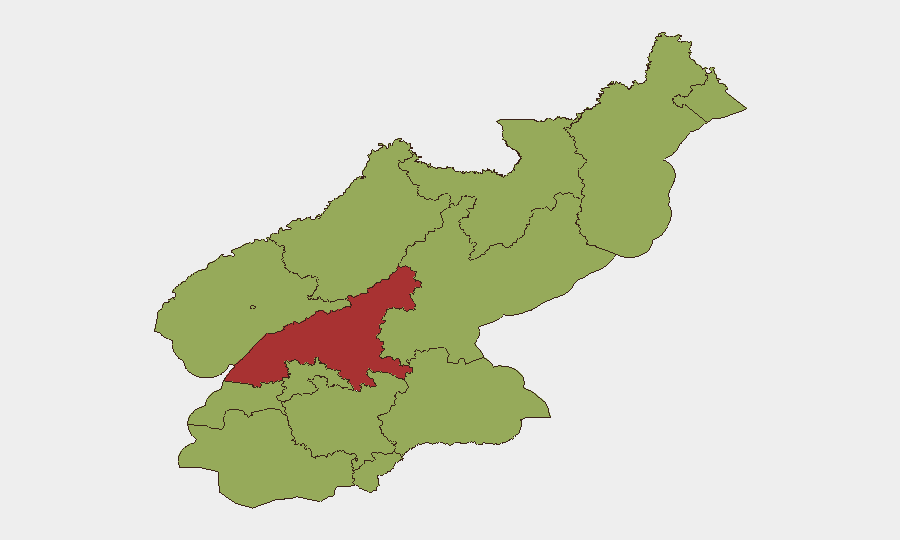
South Pyongan (risk 77.8) significantly outpaces all other provinces and warrants primary focus due to its proximity to the DMZ and concentration of forward military infrastructure, including the newly completed rocket facilities south of Kaesong. The capital, Pyongyang (58.4), remains the secondary focus given its role as the command-and-control center for state security apparatus and diplomatic engagement. The remaining 10 provinces cluster at 47.8, reflecting baseline elevated risk across border regions (Ryanggang, Chagang, North Hamgyong) and strategically sensitive areas (Nampo, Kangwon), but do not currently show differentiated threat signals.
How GeoBit Would Assist
Security teams with personnel or assets in North Korea should leverage AOI (Area of Interest) Monitoring & Early Warning with persistent watch on South Pyongan, the DMZ corridor, and Rason shipyard to detect operational changes; Satellite & Imagery Analysis to track forward-deployed military facility activation and naval construction timelines; and Conflict & Military capabilities including force structure and weapons-capability tracking to assess the operational readiness and deployment status of the newly completed rocket complexes.
7-Day Outlook
Threat rhetoric is likely to intensify if U.S.–South Korea–Japan exercises proceed as scheduled, with Pyongyang potentially announcing additional military countermeasures or weapons tests to demonstrate resolve. The Russia–North Korea diplomatic engagement and ongoing nuclear/conventional modernization suggest a medium-term shift toward closer DPRK–Moscow alignment and incremental force posturing rather than imminent kinetic escalation, though accident risk during exercises remains elevated.
Highest-Risk Areas — Ranked
| # | State / Region | Risk |
|---|---|---|
| 1 | South Pyongan | 77.8 |
| 2 | P'yŏngyang | 58.4 |
| 3 | Ryanggang | 47.8 |
| 4 | North Hamgyong | 47.8 |
| 5 | North Pyongan | 47.8 |
| 6 | Chagang | 47.8 |
| 7 | Nampo | 47.8 |
| 8 | South Hwanghae | 47.8 |
| 9 | North Hwanghae | 47.8 |
| 10 | South Hamgyong | 47.8 |
| 11 | Kaesong | 47.8 |
| 12 | Kangwon | 47.8 |
Sources
Previous Daily Briefs
A new North Korea brief is written every day — each with its own risk map and downloadable CSV. Here's the last week; use the calendar to go further back.
📅 Browse every day by calendar →
Highlighted days have a brief. Tap a day for that day's map & analysis, or “csv” for that day's dataset ($5).
Atlas — our AI intelligence desk — emails them this snapshot personally. Nothing else, no list.