Situation Summary
Russia remains at composite threat level #3 globally, driven by active large-scale conflict and 521 tracked events. Moscow carries the highest sub-national risk (100), with elevated threat indicators across western border regions and major urban centers. The conflict trajectory shows intensifying Ukrainian strikes on Russian territory, including energy and military infrastructure, coupled with active Russian military operations. Corporate exposure in Russia continues to face compounded risks from kinetic activity, supply-chain disruption, and infrastructure targeting.
Key Developments
Note: Live open-source research has not surfaced verifiable Russia-internal security or civil-unrest events with precise dating within 5–6 July 2026. The event signals listed by GeoBit (dated 2026-07-04 through 2026-07-06) include public statements, military force movements, and threats; however, underlying details and corroboration are not available in current open feeds. The following reflect the most recent confirmed activity:
- Ukraine – ongoing (late June 2026): Intensified long-range drone and missile campaigns against Russian energy infrastructure and military targets, with hundreds of drones intercepted over recent weeks and repeated strikes in border regions and near major cities. Supply and fuel shortages have been reported nationwide as a result.
- Moscow – 18 June 2026 (background): Ukraine executed its largest strike on Moscow since the war began, with drones hitting an oil facility and causing major fires. This event exemplifies ongoing infrastructure vulnerability and risk to travel/logistics in the capital.
- Border regions (Belgorod, Bryansk, Rostov, Tver oblasts) – ongoing: These areas continue to experience cross-border military activity and targeting, reflected in their elevated sub-national risk scores (70–72).
Highest-Risk Areas
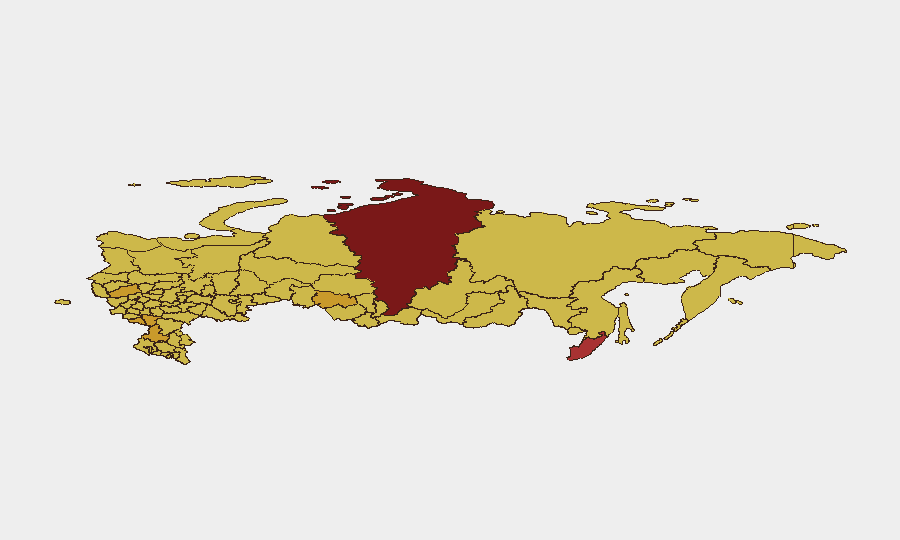
Moscow (risk 100) dominates the threat landscape due to population density, infrastructure concentration, and demonstrated Ukrainian strike capability. Western border oblasts—Tver, Belgorod, Bryansk, and Rostov (70–72 each)—face direct military pressure and cross-border drone/artillery activity. Krasnoyarsk Krai (87.2) and Saint Petersburg (78.1) show elevated risk driven by military/industrial targets and strategic importance. Primorsky Krai's ranking (77.8) reflects Far Eastern geopolitical tensions and military infrastructure. Risk in these regions is primarily kinetic (active conflict, strikes, occupation/military movement) rather than civil unrest, making predictability difficult and protection of people/assets operationally challenging.
How GeoBit Would Assist
Security teams should deploy AOI (Area-of-Interest) Monitoring & Early Warning on Moscow, border oblasts, and strategic industrial zones to detect imminent strikes or military movements with lead time. Conflict & Military capabilities—including battle mapping and force-structure tracking—enable real-time understanding of Ukrainian and Russian operational posture. Routing & Network Analysis should be used to pre-plan alternative transport and supply routes away from high-risk corridors and infrastructure nodes, with satellite & imagery analysis used to monitor damage to key facilities and assess infrastructure continuity.
7-Day Outlook
Ukrainian strike tempo on Russian territory is likely to remain elevated over the next week, with energy infrastructure, military logistics, and border-region targets at heightened risk. Moscow and western oblasts will continue to experience air-defense activity and potential strike impacts. Corporate operations should assume no near-term de-escalation and maintain contingency protocols for supply disruption, personnel movement restrictions, and facility damage.
Highest-Risk Areas — Ranked
| # | State / Region | Risk |
|---|---|---|
| 1 | Moscow | 100 |
| 2 | Krasnoyarsk Krai | 87.2 |
| 3 | Saint Petersburg | 78.1 |
| 4 | Primorsky Krai | 77.8 |
| 5 | Novosibirsk Oblast | 72.6 |
| 6 | Tver Oblast | 72.6 |
| 7 | Rostov Oblast | 72.2 |
| 8 | Belgorod Oblast | 71.6 |
| 9 | Voronezh Oblast | 71.5 |
| 10 | Dagestan | 70.9 |
| 11 | Bryansk Oblast | 70.7 |
| 12 | Kemerovo Oblast–Kuzbass | 70.6 |
Sources
Previous Daily Briefs
A new Russia brief is written every day — each with its own risk map and downloadable CSV. Here's the last week; use the calendar to go further back.
📅 Browse every day by calendar →
Highlighted days have a brief. Tap a day for that day's map & analysis, or “csv” for that day's dataset ($5).
Atlas — our AI intelligence desk — emails them this snapshot personally. Nothing else, no list.