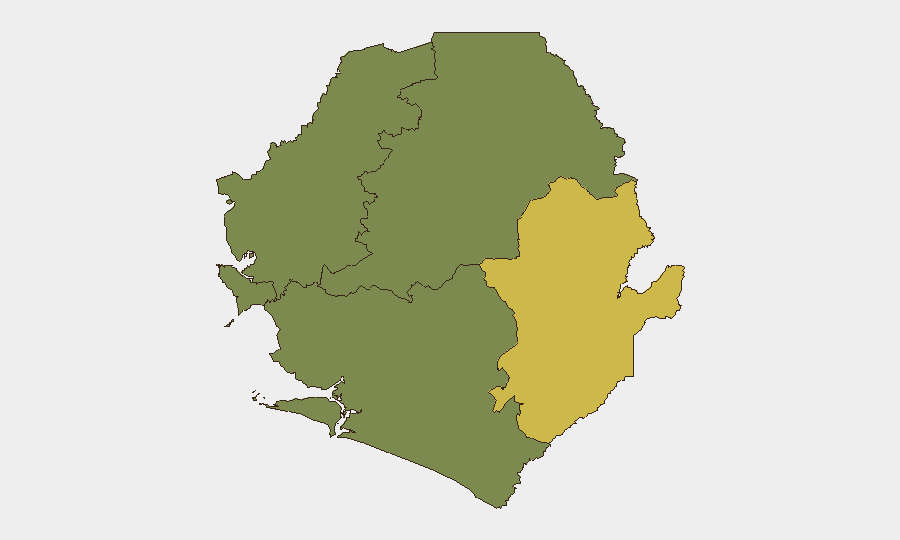
Situation Summary
Sierra Leone maintains a composite threat rank of #89 globally with no tracked security incidents in the current 24–48-hour window. The security environment remains broadly stable, with endemic risks concentrated in the Eastern Province (composite risk score 68) and Western Area (score 35), while other regions present minimal active threat signals. Structural vulnerabilities—including organized crime, human trafficking, and border-area tensions with Guinea—persist but have not escalated into acute incidents in the reporting period.
Key Developments
No corroborated security, conflict, civil-unrest, or major crime incidents meeting the 24–48-hour specificity threshold have been identified in current open-source reporting or X/Twitter monitoring as of 29 July 2026.
Background context (older than 48 hours but operationally relevant):
- Waterloo & Makeni (22 July): Sierra Leone Police reported rescuing 16 trafficking victims and arresting 8 Guinean suspects in human trafficking operations, reflecting ongoing organized crime activity in transit zones.
- Freetown (23 July): Police issued a public warning on rising mobile money fraud and urged mobile network operators to strengthen controls.
- Kenema (date unconfirmed, recent weeks): Tensions among bike riders' union leadership prompted police mediation; no acute clash reported in the last 48 hours.
- Kailahun (21–22 June, report handover in recent weeks): Internal Affairs Ministry received the Independent Police Complaint Board's report on June unrest linked to a bike rider death and police barracks burning.
Highest-Risk Areas
The Eastern Province dominates the sub-national risk profile (score 68), driven by border proximity to Guinea, limited state presence in remote districts (Kailahun, Kenema), trafficking corridors, and residual community tensions following mid-2026 incidents. The Western Area (score 35) concentrates urban crime risk in Freetown, including armed robbery, gang activity, and fraud schemes targeting mobile money users and expatriate populations. The remaining provinces present minimal active threat signals but retain background vulnerabilities typical of post-conflict environments with weak institutional capacity.
How GeoBit Would Assist
Intelligence & OSINT: Continuous Intel Sweep and multi-language X/Twitter–OSINT monitoring would detect early signals of trafficking movements, criminal organization activity, or border tensions before they escalate into acute incidents. AOI Monitoring & Early Warning: Persistent area-of-interest watch on Kailahun, Kenema, and Freetown districts with alerting would provide 24-hour situational awareness of protest triggers, security-force movements, or crime clusters affecting duty-of-care obligations. Network & Actor Analysis: Mapping of trafficking networks, bike-rider unions, and cross-border criminal actors would enable targeted risk mitigation for operations in high-exposure areas.
7-Day Outlook
No acute security deterioration is forecast in the near term; the threat environment is expected to remain at current baseline levels. Routine monitoring should focus on Eastern Province border dynamics with Guinea, urban crime patterns in Freetown, and organized crime activity in trafficking zones, with attention to protest-trigger calendars (local government activity, labor disputes) that could mobilize community unrest in Kenema and Kailahun districts.
Highest-Risk Areas — Ranked
| # | State / Region | Risk |
|---|---|---|
| 1 | Eastern Province | 68 |
| 2 | Western Area | 35 |
| 3 | North West Province, Sierra Leone | 0 |
| 4 | Northern Province, Sierra Leone | 0 |
| 5 | Southern Province, Sierra Leone | 0 |
Sources
Previous Daily Briefs
A new Sierra Leone brief is written every day — each with its own risk map and downloadable CSV. Here's the last week; use the calendar to go further back.
📅 Browse every day by calendar →
Highlighted days have a brief. Tap a day for that day's map & analysis, or “csv” for that day's dataset ($5).
Atlas — our AI intelligence desk — emails them this snapshot personally. Nothing else, no list.