Situation Summary
Uruguay remains in a stable, low-threat security environment with no verified acute incidents in the last 24–48 hours. The country ranks #145 globally on GeoBit's composite threat index (score 5) and continues to meet international "exercise normal safety precautions" travel standards. A minor diplomatic signal involving reduced relations with Chile (logged 2026-07-22) carries no operational security impact. Overall trajectory remains flat and benign.
Key Developments
- Nationwide (2026-07-22): Diplomatic event logged—reduction in Uruguay–Chile relations—assessed as administrative and non-impacting for operational security; no associated protests, consular incidents, or travel restrictions reported.
- Montevideo & Canelones (last 48 hours): No verified new homicides, mass-casualty incidents, or gang confrontations meeting acute incident thresholds despite departmental risk scores of 92 and 78 respectively. Monitoring confirms absence of fresh crime spikes.
- National infrastructure (last 24 hours): No service disruptions, utility failures, or transport network incidents reported across any department.
- Civil unrest & protest activity (nationwide, last 48 hours): No active demonstrations, roadblocks, or labor actions flagged in monitoring feeds.
- Border & regional stability (last 24 hours): No cross-border incidents, trafficking disruptions, or security developments involving Argentina, Brazil, or Paraguay affecting Uruguayan operations.
Highest-Risk Areas
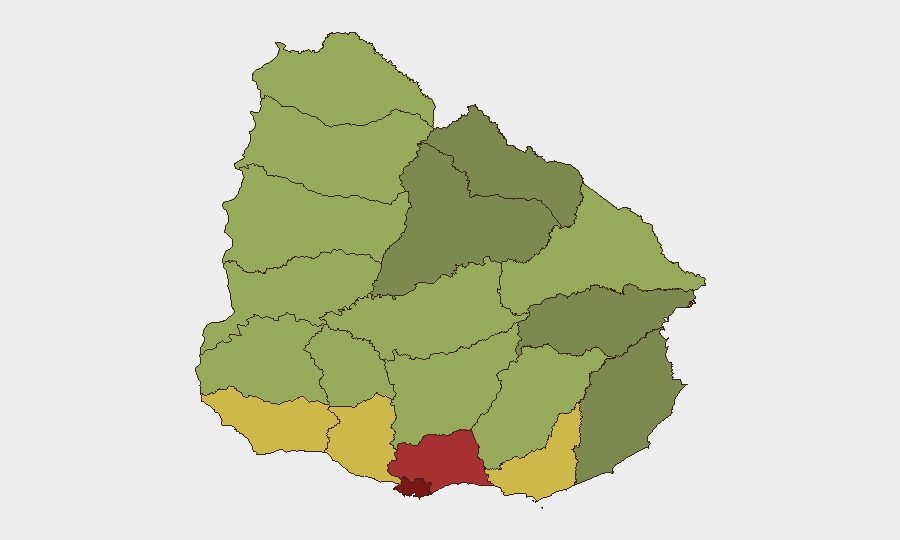
Montevideo (risk 92) and Canelones (risk 78) drive the country's composite risk profile, primarily due to persistent homicide and organized-crime activity concentrated in urban and peri-urban zones. Maldonado (68), San José (64), and Colonia (62) follow, reflecting similar crime-driven threats in secondary cities and tourist corridors. These rankings reflect chronic structural vulnerabilities—gang presence, drug trafficking, and socioeconomic drivers—rather than acute crises; no departments have escalated in the last 48 hours. Risk remains diffuse and localized rather than national.
How GeoBit Would Assist
Security teams should employ Intel Sweep and multi-language OSINT fusion to monitor gang activity, homicide trends, and organized-crime signals in Montevideo and Canelones departments on a rolling basis. AOI Monitoring & Early Warning configured for high-risk neighborhoods, transport corridors, and corporate/diplomatic facilities would provide persistent watch and alerting if incident patterns spike. Routing & Network Analysis supports journey planning that avoids known hotspots and identifies alternative routes for personnel and asset movement in urban areas.
7-Day Outlook
No indicators suggest imminent security degradation in Uruguay over the next seven days. The diplomatic signal with Chile is unlikely to cascade into domestic instability or travel disruption. Monitoring will continue to track homicide and organized-crime trends in Montevideo and Canelones, but absent a significant triggering event, the operating environment is expected to remain stable and routine.
Highest-Risk Areas — Ranked
| # | State / Region | Risk |
|---|---|---|
| 1 | Montevideo | 92 |
| 2 | Canelones | 78 |
| 3 | Maldonado | 68 |
| 4 | San José | 64 |
| 5 | Colonia | 62 |
| 6 | Soriano | 58 |
| 7 | Río Negro | 56 |
| 8 | Salto | 54 |
| 9 | Artigas | 52 |
| 10 | Paysandú | 50 |
| 11 | Florida | 48 |
| 12 | Flores | 46 |
Sources
Previous Daily Briefs
A new Uruguay brief is written every day — each with its own risk map and downloadable CSV. Here's the last week; use the calendar to go further back.
📅 Browse every day by calendar →
Highlighted days have a brief. Tap a day for that day's map & analysis, or “csv” for that day's dataset ($5).
Atlas — our AI intelligence desk — emails them this snapshot personally. Nothing else, no list.