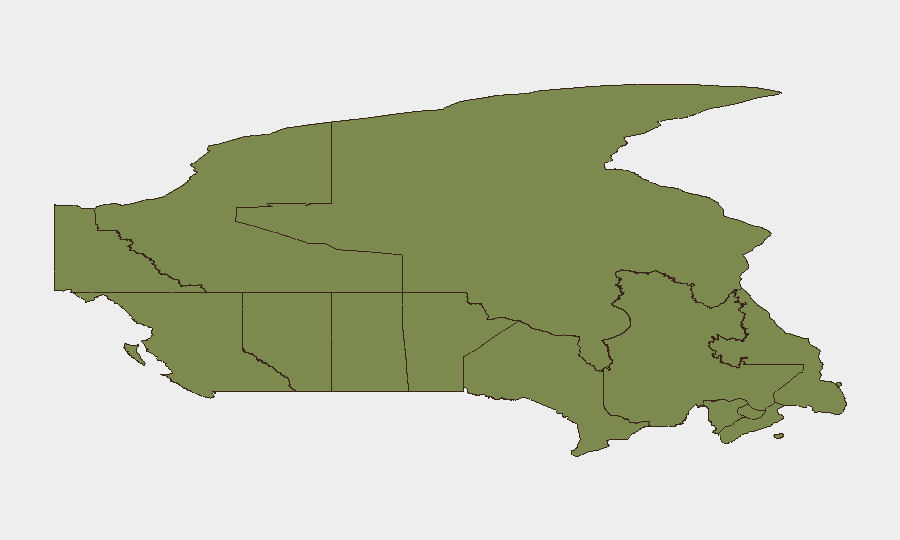
Situation Summary
Canada maintains a composite threat score of 2.5 globally (rank #66), reflecting moderate and fragmented security challenges rather than systemic instability. Recent event signals show clustering around law-enforcement actions, public statements, and diplomatic friction, with no indicators of widespread civil unrest or critical infrastructure failure. Ontario and Nunavut dominate sub-national risk rankings, though a significant cyber-intrusion campaign affecting multiple Canadian organizations has elevated infrastructure vulnerability across the country. The security environment remains contained but warrants active monitoring in specific jurisdictions and sectors.
Key Developments
- Irricana, Alberta – Fatal police shooting (July 14, 2026)
Alberta Serious Incident Response Team (ASIRT) announced investigation into fatal RCMP use-of-force incident during domestic disturbance response near Irricana; one death confirmed.
- Edmonton–northern Alberta corridor – Transport disruption (July 12–15, 2026)
Alberta government warned of multi-day traffic delays from oversized industrial load movement north from Edmonton; ongoing impact on regional highways through current period.
- National cyber – SharpViewStateKing web-shell compromise (advisory mid-July 2026, ongoing)
Canadian Centre for Cyber Security issued active alert on stealthy implant framework affecting Canadian organizations; indicators include newly created user accounts, suspicious VPN software, and altered antivirus exclusions.
- Affected Canadian networks – Credential and tool compromise (ongoing)
Cyber Centre emphasized rotation of all passwords and credentials on victim systems and inspection for unauthorized changes to security and remote-access software; no sector or organization count disclosed in current advisory.
- Vancouver, Ontario, Montreal – Arrest/detention activity (July 14–15, 2026)
Multiple law-enforcement detentions logged across Ontario (Toronto), Montreal, and related incidents; Solicitor General and municipal officials issued public statements; limited detail available on charges or context.
- Canada–United States relations – Diplomatic messaging (July 14, 2026)
Public statements exchanged between Canadian officials and U.S. government; expulsion/deportation event recorded; Vatican diplomatic activity also noted; full context not yet publicly detailed.
Highest-Risk Areas
Ontario's risk score (31.8) is substantially higher than all other provinces, driven by concentrated law-enforcement incidents and ongoing criminal or administrative detentions in Toronto and surrounding areas. Nunavut (24.2) and British Columbia (21.7) follow, likely reflecting isolated incidents, remote-area response challenges, or emerging criminal activity; Manitoba and Alberta (8.5 and 8.1 respectively) show moderate baseline risk. The remaining provinces cluster below 7.0, indicating lower event density. Ontario's outsized score suggests either concentrated activity in a specific jurisdiction or recurring event types; security teams with personnel or operations in the Greater Toronto Area should apply heightened situational awareness.
How GeoBit Would Assist
Security teams can deploy Area-of-Interest (AOI) Monitoring & Early Warning on Toronto, Montreal, and Edmonton to receive real-time alerts on law-enforcement, infrastructure, and public-order events. Cyber intelligence and network analysis can correlate SharpViewStateKing indicators across organizational networks and cross-reference compromised credential patterns with employee onboarding and access-control logs. OSINT fusion and multi-language search will provide corroboration of diplomatic developments and their implications for cross-border personnel and supply chains.
7-Day Outlook
No immediate escalation indicators are present; law-enforcement activity and cyber incidents appear contained. Close monitoring of Ontario political and criminal-justice developments, combined with sector-wide cyber-hygiene enforcement, should remain the priority. Diplomatic messaging warrants daily review for any cross-border travel or trade implications.
Highest-Risk Areas — Ranked
| # | State / Region | Risk |
|---|---|---|
| 1 | Ontario | 31.8 |
| 2 | Nunavut | 24.2 |
| 3 | British Columbia | 21.7 |
| 4 | Manitoba | 8.5 |
| 5 | Alberta | 8.1 |
| 6 | Saskatchewan | 6.9 |
| 7 | Quebec | 6.8 |
| 8 | Prince Edward Island | 5.1 |
| 9 | Newfoundland and Labrador | 1.9 |
| 10 | Yukon | 1.8 |
| 11 | Northwest Territories | 1.8 |
| 12 | New Brunswick | 1.8 |
Previous Daily Briefs
A new Canada brief is written every day — each with its own risk map and downloadable CSV. Here's the last week; use the calendar to go further back.
📅 Browse every day by calendar →
Highlighted days have a brief. Tap a day for that day's map & analysis, or “csv” for that day's dataset ($5).
Atlas — our AI intelligence desk — emails them this snapshot personally. Nothing else, no list.