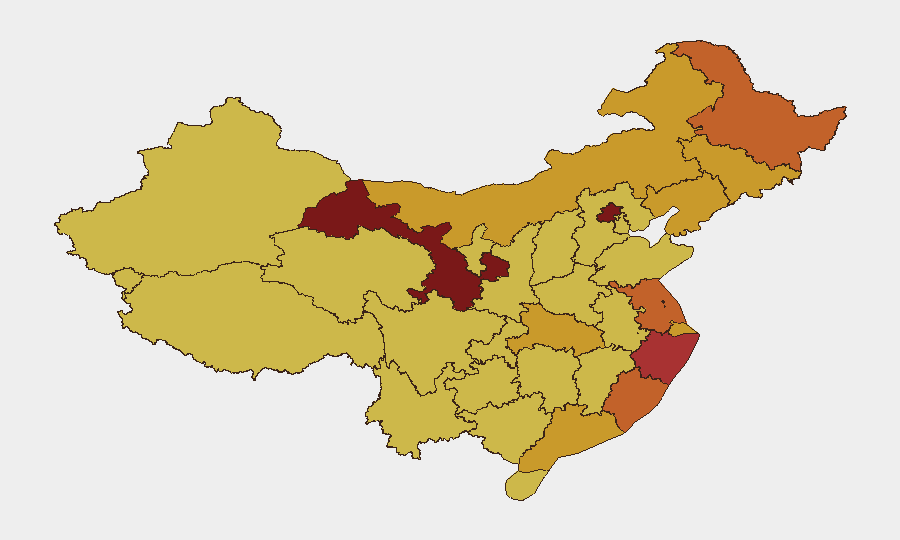
Situation Summary
China's composite security threat score remains at global rank #8 (score 100), driven by elevated military posturing, maritime friction, and diplomatic tensions spanning the Taiwan Strait, East China Sea, and contested island zones. Recent signals (2026-07-07 to 2026-07-08) indicate heightened conventional military activity, public statements from defense and diplomatic officials, and unresolved inter-agency investigations. The threat environment shows no immediate de-escalation; Beijing appears to be sustaining pressure across multiple domains simultaneously.
Key Developments
- Taiwan Strait & East Coast Taiwan (2026-07-08) — Taiwan's Ocean Affairs Council reported escalation in Chinese military and coast guard operations, including grey-zone tactics targeting Taiwan, Japan, and the Philippines; Reuters confirmed this as an ongoing current concern rather than a one-off incident.
- Senkaku Islands / Disputed East China Sea (2026-07-07–08) — China and Japan issued conflicting accounts of a maritime confrontation involving coast guards near the Senkakus; the incident underscores recurring friction in contested waters and suggests tactical probing continues.
- Central Military & Defense Official Statements (2026-07-07) — Chinese defense ministry and deputy-level officials made public statements; concurrent artillery/tank activity was reported, indicating synchronized messaging with operational posturing.
- Shanghai Military-Presence Signal (2026-07-08) — A conventional military force event involving Shanghai and the US was flagged, suggesting elevated operational readiness or exercises in China's most economically vital coastal hub.
- Ongoing Investigation Activity (2026-07-07–08) — Deputy-level investigative actions and a business-versus-police officer investigation were recorded; these signals, though not immediately operational, may indicate internal coordination activity or potential personnel/asset seizure risk.
- Diplomatic Coordination Signals (2026-07-08) — Public statements by spokespersons and statements involving Caracas, Cuba, and Japan suggest diplomatic alignment-building, likely in response to Taiwan Strait tensions and US-China friction.
Highest-Risk Areas
Beijing (rank 1, score 100) remains the epicenter, reflecting decision-making concentration and signaling intensity; Gansu (88.6), though landlocked, carries elevated risk tied to military/strategic infrastructure. The coastal tier—Zhejiang, Fujian, Jiangsu, Shanghai, and Liaoning (scores 72.6–77.1)—dominates because these regions host forward-deployed military assets, economic chokepoints, and direct exposure to Taiwan Strait and East China Sea tensions. Heilongjiang and Inner Mongolia (both 71.4+) reflect northern maritime and border-zone sensitivities. Risk concentration in coastal and capital zones underscores that foreign nationals, supply chains, and corporate assets in these regions face compound exposure: military escalation, port/maritime disruption, and potential asset freezes or investigative interference.
How GeoBit Would Assist
Intel Sweep & OSINT fusion with multi-language social media monitoring (X, Telegram) and satellite/imagery analysis would provide early warning of military movement, vessel positioning, and operational readiness changes before official statements. Persistent AOI monitoring with alerting around Beijing, Shanghai, Taiwan Strait approaches, and Senkaku waters would flag incidents within hours. Network & actor analysis combined with conflict event feeds enables security teams to track which officials/military units are coordinating, anticipate policy shifts, and pre-position staff or supply-chain contingencies. Alternative route & network analysis supports real-time rerouting of personnel and cargo away from high-friction zones.
7-Day Outlook
Military and diplomatic signals are expected to persist or intensify through early-to-mid July, with Taiwan Strait and East China Sea remaining flashpoints. Investigative activity and asset-seizure risk will likely remain elevated in coastal provinces. Corporate travel, shipping, and personnel placement decisions should assume sustained operational friction rather than de-escalation; contingency protocols for Beijing, Shanghai, and maritime zones warrant immediate review.
Highest-Risk Areas — Ranked
| # | State / Region | Risk |
|---|---|---|
| 1 | Beijing | 100 |
| 2 | Gansu | 88.6 |
| 3 | Zhejiang | 77.1 |
| 4 | Fujian | 74.8 |
| 5 | Jiangsu | 73.9 |
| 6 | Heilongjiang | 73.1 |
| 7 | Shanghai | 72.6 |
| 8 | Hubei | 71.7 |
| 9 | Inner Mongolia | 71.4 |
| 10 | Liaoning | 71.4 |
| 11 | Jilin | 71.4 |
| 12 | Guangdong Province | 71.1 |
Sources
Previous Daily Briefs
A new China brief is written every day — each with its own risk map and downloadable CSV. Here's the last week; use the calendar to go further back.
📅 Browse every day by calendar →
Highlighted days have a brief. Tap a day for that day's map & analysis, or “csv” for that day's dataset ($5).
Atlas — our AI intelligence desk — emails them this snapshot personally. Nothing else, no list.