Situation Summary
The Dominican Republic remains at moderate security risk (rank #111 globally, composite score 14), with crime and gang activity as primary drivers. Over the past 48 hours, law-enforcement operations have intensified in Santo Domingo's high-crime neighborhoods, while a diplomatic crisis with Cuba and announced traffic restrictions in the Colonial City have introduced secondary operational considerations. No major violent incidents have been confirmed in the Dominican Republic within the last 24–48 hours, though underlying tensions around labor rights and localized protests persist.
Key Developments
- Nationwide anti-narcotics raids in Santo Domingo (August 15). The DNCD conducted 7 raids and 68 street interventions across multiple barrios in the Distrito Nacional (Villas Agrícolas, Los Girasoles, 30 de Mayo, San Carlos, Los Guandules, Ciudad Nueva, and others), resulting in 15 arrests, seizure of ~10.38 kg of narcotics, firearms, ballistic equipment, and cash. This represents active operational enforcement against micro-trafficking networks in the capital's highest-risk zone.
- Cuban embassy expulsion deadline (August 16–17). The Dominican Foreign Ministry ordered nine Cuban embassy officials and ~21 family members to depart by August 16. As of August 15, the Cuban ambassador called for "resistance," and while diplomatic relations remain open, the dispute poses risk of public demonstrations or security incidents around the embassy in Santo Domingo.
- Traffic restrictions in Colonial City, Santo Domingo (starting August 17). Authorities announced a "traffic calming plan" limiting vehicle access in the historic center, effective August 17. Implementation will involve increased police presence and new checkpoints, potentially affecting incident response times and crowd dynamics in a high-tourism area.
- Labor and holiday period tensions (August 16–17). The Ministry of Labor clarified that August 16 (Día de la Restauración) is a non-working holiday and August 17 is a normal working day. Recent community clashes (e.g., Los Aguacates camp dispute, August 10–11) signal persistent labor and land-resource tensions that may be heightened during the holiday period.
- Police deployment in Navarrete, Santiago (ongoing from August 11). Following a 48-hour strike and reported gunshots near the police director's inspection route on August 11, law-enforcement vigilance remains elevated in protest-prone areas of Santiago province, though no confirmed new incidents have been reported in the last 24–48 hours.
Highest-Risk Areas
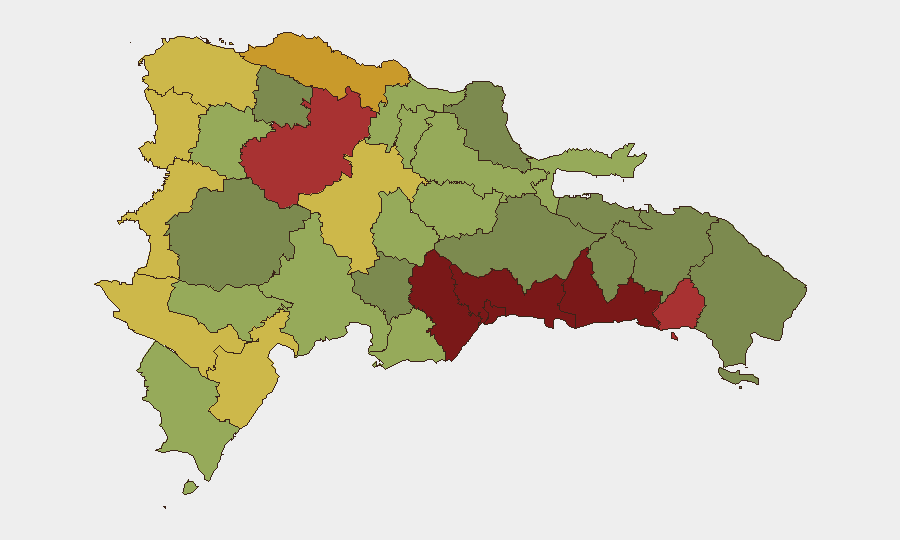
Santo Domingo and the Distrito Nacional (risk scores 92 and 88, respectively) dominate the sub-national ranking and drive the country's overall crime-focused threat profile. These zones experience persistent micro-trafficking, street crime, and armed robbery; the August 15 DNCD raids exemplify routine enforcement in neighborhoods where gang activity and drug distribution are concentrated. San Cristóbal, San Pedro de Macorís, and La Romana (scores 85–78) form a secondary cluster of concern in the eastern and southern provinces, while border regions (Elías Piña, Dajabón) and other provincial capitals (Santiago, Puerto Plata) face secondary crime and protest-related risks.
How GeoBit Would Assist
Corporate security teams should deploy AOI Monitoring & Early Warning on Santo Domingo's highest-risk neighborhoods and the Cuban embassy precinct to detect emerging demonstrations or enforcement operations. Intel Sweep and multi-language OSINT (including X/Twitter, local media, and regional crime databases) enable continuous tracking of gang activity, labor unrest, and police operations. Routing & Network Analysis tools assist duty-of-care teams in identifying safe transit corridors during the new traffic restrictions in the Colonial City and around protest-prone areas.
7-Day Outlook
The diplomatic crisis with Cuba and labor sensitivities around the August 16 holiday may trigger localized protests or public gatherings in Santo Domingo over the next 3–5 days, though no major violence is currently forecast. Continued police anti-narcotics operations in the capital's barrios will likely persist, maintaining a visible security presence. Baseline crime risk (robbery, micro-trafficking) is expected to remain elevated in the top-ranked zones (Santo Domingo, Distrito Nacional, San Cristóbal).
Highest-Risk Areas — Ranked
| # | State / Region | Risk |
|---|---|---|
| 1 | Santo Domingo | 92 |
| 2 | Nacional District | 88 |
| 3 | San Cristóbal | 85 |
| 4 | San Pedro de Macorís | 83 |
| 5 | La Romana | 78 |
| 6 | Santiago | 76 |
| 7 | Puerto Plata | 72 |
| 8 | Elías Piña | 70 |
| 9 | Dajabón | 68 |
| 10 | Barahona | 65 |
| 11 | Independencia Province | 64 |
| 12 | La Vega | 62 |
Sources
Previous Daily Briefs
A new Dominican Republic brief is written every day — each with its own risk map and downloadable CSV. Here's the last week; use the calendar to go further back.
- August 16, 2026
- August 15, 2026
- August 14, 2026
- August 13, 2026
- August 12, 2026
- August 11, 2026
- August 10, 2026
📅 Browse every day by calendar →
Highlighted days have a brief. Tap a day for that day's map & analysis, or “csv” for that day's dataset ($5).
Atlas — our AI intelligence desk — emails them this snapshot personally. Nothing else, no list.