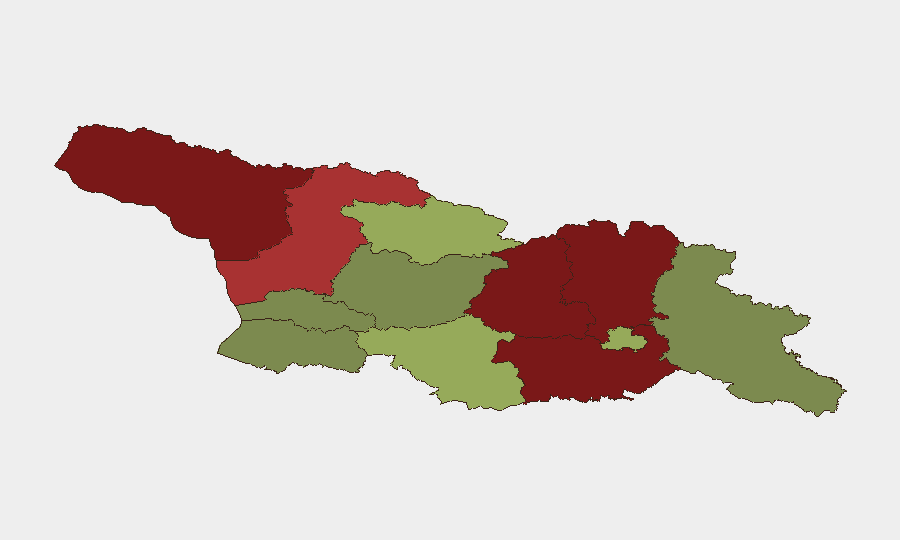
Situation Summary
Georgia remains a low-threat environment globally (rank #90, composite score 18) with no tracked high-impact security events in the last 24–48 hours. The country's risk profile is driven primarily by geopolitical tensions in separatist-controlled northern and southern regions (Abkhazia, South Ossetia, and adjacent disputed territories) rather than active incidents affecting the capital or populated lowlands. Routine pro-European demonstrations continue in Tbilisi and regional cities as part of a sustained political campaign, but these remain non-violent and pose minimal direct threat to corporate operations or resident nationals in central Georgia.
Key Developments
- Tbilisi – ongoing pro-EU protests (confirmed through 22 August 2026): Demonstrations continued outside Parliament on Rustaveli Avenue and Tbilisi City Council, marking the 633rd consecutive day of daily rallies. Participants demanded release of political prisoners, repeal of laws deemed repressive, and alignment with European integration. Most recent open confirmation is 22 August; no escalation or arrests reported in the 23–24 August window.
- Multi-city parallel demonstrations (confirmed through 22 August 2026): Associated pro-EU rallies took place in Batumi, Kutaisi, and Akhaltsikhe, with participants carrying Georgian and EU flags. These remain non-violent and do not show signs of widening disorder as of latest available reporting.
- Russian diplomatic pressure and border-crossing narratives (reported 20–21 August 2026): The Russian Foreign Ministry publicly urged Georgian authorities to investigate alleged "Russophobic incidents" against Russian citizens. Georgian officials disputed social-media claims that 20,000 Russians entered in 24 hours via the Upper Lars checkpoint, stating actual inflow was significantly lower. No escalation or closure of the checkpoint confirmed in the 23–24 August period.
- No new critical-infrastructure incidents (last confirmed incident 18 August 2026): A nationwide blackout on 18 August prompted investigation by Georgia's State Security Service, with authorities attributing it to software errors rather than external interference. No fresh outages or sabotage reports are confirmed for 23–24 August.
- No active armed clashes or terrorism events reported in 23–24 August window: Border regions remain under heightened monitoring due to longstanding separatist presence, but no combat, drone activity, or major violence is confirmed in the most recent 48-hour period.
Highest-Risk Areas
Abkhazia (risk 95) and South Ossetia–adjacent regions (Shida Kartli, risk 88; Lower Kartli, risk 85) drive Georgia's elevated sub-national scores owing to frozen conflict, Russian military presence, and periodic ceasefire violations. Mtskheta-Mtianeti and Samegrelo-Upper Svaneti carry elevated risk due to proximity to the northern border and historical conflict zones. By contrast, central Georgia—including Tbilisi (risk 45), Imereti (risk 32), and the southern regions—present substantially lower operational risk. For most corporate security operations, Tbilisi and major commercial hubs remain suitable for normal duty-of-care protocols, while travel to northern and eastern border zones should be subject to explicit risk assessment and security-clearance procedures.
How GeoBit Would Assist
A security team protecting assets and personnel in Georgia should employ GeoBit's AOI Monitoring & Early Warning capability to track Tbilisi protest dynamics and Russian border-crossing pressure in near real-time; OSINT fusion (X/Twitter, Telegram, local media) to corroborate and distinguish routine from escalatory political activity; and Conflict & Military mapping to maintain situational awareness of separatist-region activity and any military repositioning. Routine use of Intel Sweep and multi-language search would flag emerging diplomatic incidents or infrastructure disruptions before they affect travel or operations.
7-Day Outlook
The pro-EU protest campaign is likely to continue on its established daily rhythm without marked escalation or dispersal in the near term. Border tension linked to Russian domestic politics (mobilization rumors, migration flows) may persist but is unlikely to trigger checkpoint closures or armed incidents. Corporate and diplomatic operations in Tbilisi and main commercial zones face minimal acute risk over the next seven days.
Highest-Risk Areas — Ranked
| # | State / Region | Risk |
|---|---|---|
| 1 | Autonomous Republic of Abkhazia | 95 |
| 2 | Shida Kartli | 88 |
| 3 | Lower Kartli | 85 |
| 4 | Mtskheta-Mtianeti | 82 |
| 5 | Samegrelo-Upper Svaneti | 78 |
| 6 | Samtskhe-Javakheti | 48 |
| 7 | Tbilisi | 45 |
| 8 | Racha-Lechkhumi and Kvemo Svaneti | 42 |
| 9 | Kakheti | 38 |
| 10 | Autonomous Republic of Adjara | 35 |
| 11 | Imereti | 32 |
| 12 | Guria | 28 |
Sources
Previous Daily Briefs
A new Georgia brief is written every day — each with its own risk map and downloadable CSV. Here's the last week; use the calendar to go further back.
- August 23, 2026
- August 22, 2026
- August 21, 2026
- August 20, 2026
- August 19, 2026
- August 18, 2026
- August 17, 2026
📅 Browse every day by calendar →
Highlighted days have a brief. Tap a day for that day's map & analysis, or “csv” for that day's dataset ($5).
Atlas — our AI intelligence desk — emails them this snapshot personally. Nothing else, no list.