Situation Summary
Iran remains the 6th-highest global threat environment (composite score 100), driven by active military escalation and a high operational tempo of hostile events across multiple domains (1,049 tracked incidents). The past 72 hours have seen intensified U.S.–Iran military signaling, Iranian threats toward Israeli interests, and public statements from Tehran rejecting international pressure, indicating hardening positions on multiple fronts. The security picture reflects a cycle of military posturing, rhetorical escalation, and reduced diplomatic engagement that carries direct risk to personnel and assets across the country.
Key Developments
- 2026-07-04 · Tehran Province. Iranian government issued public threat toward Israeli targets; escalates direct confrontation rhetoric beyond proxy channels.
- 2026-07-04 · National. Industry sector issued public statement; context and sectoral impact require ongoing monitoring for operational disruption signals.
- 2026-07-02 · National. U.S. military conventional force activity reported in relation to Iran; signals heightened operational readiness and potential for unintended escalation.
- 2026-07-02 · National. Iranian government rejected United Nations position; reflects erosion of diplomatic off-ramps and hardening of stance.
- 2026-07-02 · National. U.S. government issued rejection statement (nature of proposal/demand unclear from available signals); further narrows negotiation space.
- 2026-07-04 · National. United Arab Emirates rejected Iranian position; indicates regional coalition-building against Tehran and potential secondary pressure points.
- 2026-07-02 · National. Iranian military (Army) disapproved of unnamed action; internal disagreement or public distancing from policy signals possible instability or factional tension.
*Note: Granular location-specific incidents within Iran proper are not reliably confirmed in the 24–48h window. The signals above reflect state-level actors and postures; ground-level security events require corroboration.*
Highest-Risk Areas
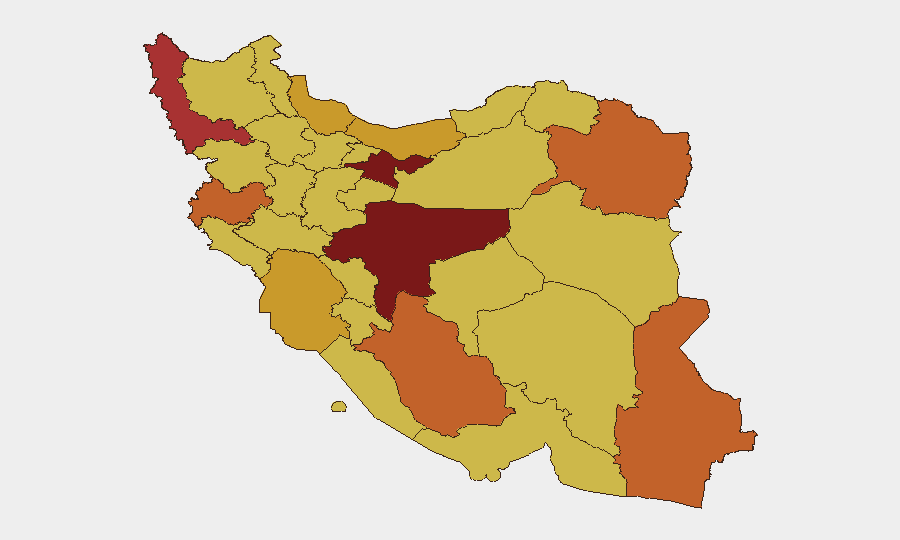
Tehran Province (risk 100) dominates the threat landscape as the political, military, and intelligence center; elevated risk reflects concentration of decision-making, sensitive installations, and foreign presence. Isfahan Province (89.7) and West Azerbaijan (76) follow—Isfahan hosts critical industrial and research assets vulnerable to military action or sabotage, while West Azerbaijan's proximity to Iraq and Turkey makes it a transit corridor for military activity and proxy movements. The next tier—Kermanshah, Razavi Khorasan, Sistan and Baluchestan—spans border regions exposed to cross-border militant activity, tribal instability, and intelligence operations. All provinces ranked above 70 should be treated as active operational environments; risk is not evenly distributed by type (military vs. crime vs. protest) and requires asset-specific threat modeling.
How GeoBit Would Assist
Security teams should deploy AOI Monitoring & Early Warning on Tehran, Isfahan, and high-value facility locations to detect movement, activity spikes, or infrastructure changes in near-real time. Intel Sweep (global event feeds, X/Telegram OSINT, multi-language media) provides continuous signal fusion on military posture, government statements, and factional messaging—critical for distinguishing policy shifts from operational moves. Battle Mapping, Force Structure, and Weapons-Capability Tracking enable situational awareness of U.S. and Iranian military deployments and readiness; Routing & Network Analysis supports alternative travel and supply-chain planning for personnel and logistics in escalation scenarios.
7-Day Outlook
Expect sustained rhetorical escalation and continued military signaling from both Iran and the U.S., with elevated risk of miscalculation or unintended kinetic engagement. Regional actors (UAE, Gulf states) are hardening positions; this reduces Tehran's diplomatic flexibility and may trigger broader proxy activity or economic pressure. Personnel in Tehran, Isfahan, and border provinces face elevated exposure; travel and facility-security protocols should reflect active-war baseline, not routine-operating assumptions.
Highest-Risk Areas — Ranked
| # | State / Region | Risk |
|---|---|---|
| 1 | Tehran Province | 100 |
| 2 | Isfahan Province | 89.7 |
| 3 | West Azerbaijan Province | 76 |
| 4 | Kermanshah Province | 74.4 |
| 5 | Razavi Khorasan | 73.8 |
| 6 | Sistan and Baluchestan Province | 73.4 |
| 7 | Fars Province | 73.3 |
| 8 | Gilan Province | 72.6 |
| 9 | Mazandaran Province | 72.6 |
| 10 | Khuzestan Province | 71.7 |
| 11 | Semnan Province | 70.6 |
| 12 | Bushehr Province | 70.5 |
Sources
Previous Daily Briefs
A new Iran brief is written every day — each with its own risk map and downloadable CSV. Here's the last week; use the calendar to go further back.
📅 Browse every day by calendar →
Highlighted days have a brief. Tap a day for that day's map & analysis, or “csv” for that day's dataset ($5).
Atlas — our AI intelligence desk — emails them this snapshot personally. Nothing else, no list.