Situation Summary
North Korea remains at composite threat rank #32 globally (score 69) amid escalating diplomatic realignment toward Russia and intensified military posturing against U.S.–allied exercises on the peninsula. Over the past 48 hours, the DPRK has signaled deepening strategic coordination with Moscow—including Foreign Minister Choe Son‑hui's unscheduled Moscow visit and confirmed participation of Korean People's Army personnel in the Kursk conflict—while simultaneously amplifying rhetorical warnings against U.S.–Japan–South Korea drills and expanding rocket-artillery infrastructure along the DMZ. The trajectory is one of heightened regional military tension coupled with DPRK strategic repositioning, raising indirect sanctions and political-isolation risk for entities with operations or personnel in North Korea.
Key Developments
- Pyongyang–Moscow, 18–19 July – Foreign Minister Choe Son‑hui conducted an unusual, unscheduled visit to Russia for talks with Foreign Minister Lavrov, interpreted by analysts as potential advance coordination for a future Kim Jong‑un visit and signals of deepening DPRK–Russia military-strategic ties.
- Moscow, 19 July – Russian President Putin publicly thanked North Korean authorities for deploying Korean People's Army personnel to support the "liberation of the Kursk region," effectively confirming DPRK active participation in the Russia–Ukraine conflict.
- South Pyongan Province (DMZ area south of Kaesong), 17–18 July – Satellite imagery analysis identified 21 newly constructed long buildings at small military bases near the Demilitarized Zone, assessed as storage and maintenance facilities for Transporter Erector Launchers (TELs) for missiles and rocket artillery aimed southward.
- Pyongyang, 18–19 July – DPRK Defence Ministry issued a statement condemning U.S.–Japan–South Korea "military collusion" and warning of "unpredictable escalation" in response to trilateral military exercises, including RIMPAC 2026 and "Freedom Edge" drills.
- East Sea (Northern Limit Line area), ongoing since 13 July – South Korean Ministry of Unification formally requested North Korean cooperation in search and potential repatriation of a South Korean Navy sailor who drifted north of the inter-Korean maritime boundary; cross-border custody incidents create localized diplomatic tension and operational risk for regional vessels.
Highest-Risk Areas
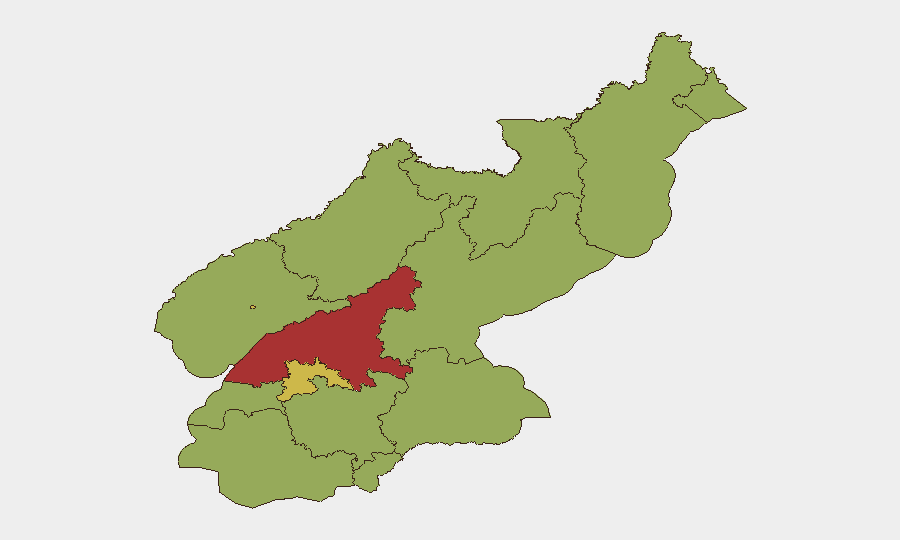
South Pyongan Province (risk 78.3) dominates the sub-national ranking, driven by concentration of forward-deployed military infrastructure, DMZ proximity, and rocket-artillery expansion now visible via satellite. Pyongyang itself (62.3) remains elevated due to political volatility and diplomatic incidents, while secondary risks cluster around border and coastal regions (Nampo, Ryanggang, North/South Hamgyong, Kaesong) where military activity, sanctions enforcement, and cross-border friction are most acute. The expansion of TEL facilities near Kaesong underscores why South Pyongan's risk score has diverged sharply from other provinces, signaling that forward-deployed military capabilities are driving both tactical and strategic threat concentration in the north-central border zone.
How GeoBit Would Assist
Security teams monitoring North Korea should employ Satellite & Imagery Analysis and GIS & Spatial Analysis to track military infrastructure expansion in real time, particularly near the DMZ and coastal areas. AOI Monitoring & Early Warning persistent watch on South Pyongan, Pyongyang, and inter-Korean maritime zones provides advance notification of military mobilization, exercise escalation, or diplomatic incidents. Network & Actor Analysis combined with OSINT fusion & corroboration (Intel Sweep, X/Twitter, KCNA statement tracking) enables detection of leadership movements—such as Choe Son‑hui's Moscow trip—that signal strategic realignment and indirect sanctions or political-risk shifts affecting operations.
7-Day Outlook
Military rhetoric and exercises are expected to remain elevated as U.S.–allied drills continue through late July. North Korea is likely to conduct further public statements or small-scale military demonstrations (missile tests, artillery drills) in response, particularly if RIMPAC or Freedom Edge operations expand. The DPRK–Russia alignment deepens the risk of secondary sanctions pressure and further isolation, indirectly constraining business, travel, and humanitarian logistics on the peninsula.
Highest-Risk Areas — Ranked
| # | State / Region | Risk |
|---|---|---|
| 1 | South Pyongan | 78.3 |
| 2 | P'yŏngyang | 62.3 |
| 3 | Nampo | 52.3 |
| 4 | Ryanggang | 48.3 |
| 5 | North Hamgyong | 48.3 |
| 6 | North Pyongan | 48.3 |
| 7 | Chagang | 48.3 |
| 8 | South Hwanghae | 48.3 |
| 9 | North Hwanghae | 48.3 |
| 10 | South Hamgyong | 48.3 |
| 11 | Kaesong | 48.3 |
| 12 | Kangwon | 48.3 |
Sources
Previous Daily Briefs
A new North Korea brief is written every day — each with its own risk map and downloadable CSV. Here's the last week; use the calendar to go further back.
📅 Browse every day by calendar →
Highlighted days have a brief. Tap a day for that day's map & analysis, or “csv” for that day's dataset ($5).
Atlas — our AI intelligence desk — emails them this snapshot personally. Nothing else, no list.