Situation Summary
Russia remains the second-highest composite threat globally (score 100), driven by the ongoing war and associated instability across multiple regions. Event signals from the past 48 hours reflect continued diplomatic friction, military activity, and domestic policy disputes—primarily involving Moscow, Ukrainian actors, and U.S. officials. Moscow itself ranks as the single highest-risk sub-national area (score 100), with nine other regions scoring between 70–90.1, indicating threat concentration in the capital, southern border oblasts, and Far Eastern territories. The security environment shows no signs of near-term de-escalation.
Key Developments
- Moscow · 2026-07-07 – Russian spokesman disapproved of a statement or action by an unidentified Russian entity or official, suggesting internal policy disagreement or messaging conflict at senior levels.
- Moscow · 2026-07-05 – Moscow issued a demand to Ukrainian counterparts, consistent with ongoing negotiation, sanctions, or territorial disputes tied to the active war.
- Moscow · 2026-07-06 – Conventional military force deployment or engagement reported involving Ukrainian forces and Moscow-area targets or assets; specific location and casualty/damage scale not yet granular.
- Belgorod Oblast · 2026-07-07 – Belgorod authorities rejected an unspecified proposal, demand, or statement, likely related to border security, evacuation orders, or conflict-zone governance.
- United States–Russia Diplomatic Friction · 2026-07-06 – Washington issued a threat directed at Vladimir Putin, reflecting heightened U.S.–Russia tension over Ukraine, sanctions, or third-party actions.
- Public Statements from Multiple Actors · 2026-07-04 to 2026-07-07 – Counselors, medical officials, operatives, and regional figures issued public statements, indicating active information operations, civil-military coordination messaging, or morale management across regions.
- Armed Forces Territory Occupation · 2026-07-06 – Reports indicate occupation or territorial control change involving armed forces and Russian-held or disputed territory; specific location and extent not yet determined.
Note: GeoBit event signals reflect actor types and action categories detected in real-time feeds; precise location coordinates, casualty figures, and operational context are pending detailed corroboration and may be released in supplementary tactical updates.
Highest-Risk Areas
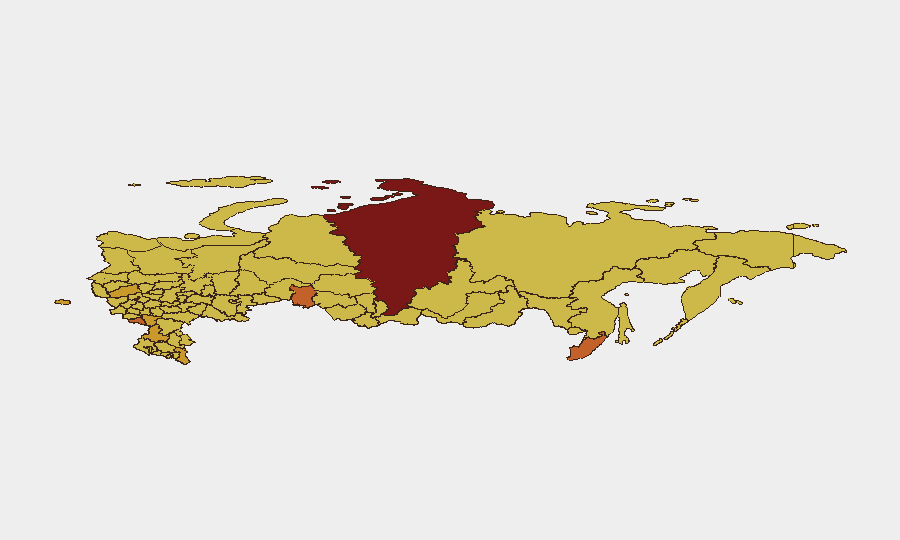
Moscow (score 100) dominates the ranking and reflects capital-city concentration of political decision-making, military command infrastructure, and symbolic targets. Krasnoyarsk Krai (90.1) and the southern border oblasts—Belgorod (73.5), Voronezh (72), Rostov (71.8)—show elevated risk due to proximity to combat zones, drone/missile strike history, and civilian evacuation pressures. Saint Petersburg (75.8) and Kaliningrad (71.5) face NATO border exposure and dual-use infrastructure vulnerability. Far Eastern Primorsky Krai (74.1) reflects long-range supply-chain exposure and regional geopolitical friction with China and Japan.
How GeoBit Would Assist
Security teams with personnel or assets in Russia should activate AOI Monitoring & Early Warning on Moscow, Belgorod, and Krasnoyarsk Krai to receive automated alerts on incident activity, curfews, and military movement. Intel Sweep and X/Twitter & Telegram OSINT capabilities provide real-time sentiment analysis, actor positioning, and messaging shift detection to flag policy changes or evacuation triggers before they are announced. Battle Mapping and Force Structure tracking offer granular visibility into Ukrainian and Russian deployments near corporate facilities, enabling rapid route re-planning via Routing & Network Analysis if conventional corridors become impassable.
7-Day Outlook
Diplomatic and military friction is likely to remain elevated, with public statements, demands, and military signaling continuing through early July. Risk of fresh conventional strikes on Moscow or southern oblasts remains non-negligible given the pattern of drone and artillery activity. Personnel security protocols, evacuation rehearsals, and asset monitoring should remain at heightened readiness; no near-term ceasefire or de-escalation indicators are present in current signals.
Highest-Risk Areas — Ranked
| # | State / Region | Risk |
|---|---|---|
| 1 | Moscow | 100 |
| 2 | Krasnoyarsk Krai | 90.1 |
| 3 | Saint Petersburg | 75.8 |
| 4 | Primorsky Krai | 74.1 |
| 5 | Belgorod Oblast | 73.5 |
| 6 | Omsk Oblast | 73.3 |
| 7 | Voronezh Oblast | 72 |
| 8 | Rostov Oblast | 71.8 |
| 9 | Kaliningrad | 71.5 |
| 10 | Tver Oblast | 71.3 |
| 11 | Dagestan | 71.1 |
| 12 | Leningrad Oblast | 70.9 |
Sources
Previous Daily Briefs
A new Russia brief is written every day — each with its own risk map and downloadable CSV. Here's the last week; use the calendar to go further back.
📅 Browse every day by calendar →
Highlighted days have a brief. Tap a day for that day's map & analysis, or “csv” for that day's dataset ($5).
Atlas — our AI intelligence desk — emails them this snapshot personally. Nothing else, no list.