Situation Summary
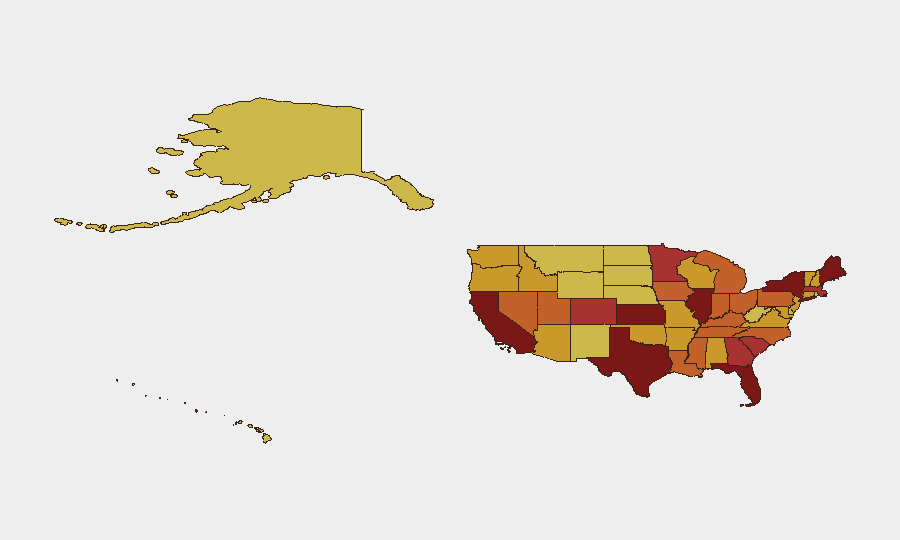
The United States remains the 11th-highest-risk country globally (composite score 99) with 7,321 tracked events, reflecting fragmented but sustained security pressures across cyber, law-enforcement, public-health, and transnational domains. Texas and California dominate sub-national risk rankings (99.2 and 99.1 respectively), driven by cross-border enforcement activity, scale of operations, and concentration of critical infrastructure. Recent law-enforcement operations, a significant foodborne-illness outbreak, and regulatory changes in defense-sector cybersecurity compliance are the primary current drivers. The trajectory indicates sustained operational tempo in immigration enforcement, ongoing ransomware and cyber-crime disruption, and emerging transnational-repression concerns targeting diaspora populations.
Key Developments
- United States (nationwide) – July 14, 2026 – FBI seizes NetNut proxy infrastructure. The FBI announced seizure of hundreds of domains associated with a major residential proxy service abused for fraud, account takeovers, and cybercrime, disrupting infrastructure used to mask criminal activity across U.S. networks.
- Boston, Massachusetts – July 14, 2026 – BlackCat ransomware operator sentenced. Federal court sentenced Angelo Martino to 70 months in prison for assisting BlackCat/ALPHV ransomware attacks against U.S. companies, underscoring ongoing ransomware targeting of corporate and critical-infrastructure entities.
- United States (multiple states) – July 14, 2026 – Cyclosporiasis outbreak surges to 1,645 confirmed cases. CDC reported lab-confirmed cases jumped by more than 800 within one week, indicating elevated public-health and food-supply-chain risk across affected states; no link to civil unrest identified to date.
- Texas & Maine – July 9–14, 2026 – ICE suspends vehicle stops after fatal shootings. U.S. Immigration and Customs Enforcement suspended immigration-related vehicle stops on July 14 following fatal shootings of two individuals in separate incidents in Texas and Maine within six days, signaling heightened concern over use-of-force and potential civil-unrest escalation.
- Mexico–United States (cross-border) – July 12–13, 2026 – Mexico files criminal complaints over deaths in U.S. custody. Mexico's foreign ministry began filing criminal complaints with U.S. state prosecutors regarding deaths of Mexican citizens in U.S. immigration custody and enforcement operations, escalating political and legal friction around enforcement practices.
- Washington, D.C. – July 14, 2026 – Bipartisan transnational-repression bill introduced. U.S. lawmakers introduced legislation to increase penalties for foreign government agents threatening diaspora and dissident communities on U.S. soil, reflecting heightened concern over surveillance and coercion by state actors including China and Iran.
- United States (defense-industrial base) – July 13, 2026 – CMMC Phase II suspended. Department of War suspended Phase II of the Cybersecurity Maturity Model Certification program, creating uncertainty in defense-contractor compliance and supply-chain cybersecurity risk management.
Highest-Risk Areas
Texas and California's elevated rankings (99.2 and 99.1) reflect concentration of cross-border enforcement activity, scale of critical infrastructure, and volume of high-consequence operations. Maine's placement at 95.3 is driven by recent fatal ICE enforcement incidents. Kansas, New York, and Florida reflect broader patterns of enforcement activity, cyber-threat concentration, and transnational repression targeting diaspora populations. Texas and California will remain primary focus areas for duty-of-care teams managing personnel or assets in cross-border zones and critical-infrastructure sectors.
How GeoBit Would Assist
Security teams should employ Intel Sweep and global event feeds to track ongoing law-enforcement and cross-border activity; Network & Actor Analysis to map ransomware-operator ecosystems and proxy-service disruption effects on corporate networks; and AOI Monitoring & Early Warning on high-risk sub-national regions (Texas, Maine, California) to detect emerging enforcement operations or civil-unrest signals. Sentiment & temporal analysis on X/Twitter and Telegram would provide early warning of escalation in transnational-repression activity targeting organizational diaspora personnel.
7-Day Outlook
Cyber-crime disruption operations are likely to continue with periodic domain seizures and prosecutions; ICE enforcement suspension may create near-term operational clarity but does not resolve underlying cross-border tension. Cyclosporiasis outbreak trajectory and Mexico–U.S. diplomatic friction warrant continued monitoring. No imminent systemic escalation is indicated, but fragmented operational pressures across multiple domains will persist.
Highest-Risk Areas — Ranked
| # | State / Region | Risk |
|---|---|---|
| 1 | Texas | 99.2 |
| 2 | California | 99.1 |
| 3 | Maine | 95.3 |
| 4 | Kansas | 91.3 |
| 5 | New York | 89.8 |
| 6 | Florida | 86.5 |
| 7 | Illinois | 82.4 |
| 8 | Georgia | 79.6 |
| 9 | Minnesota | 79.2 |
| 10 | South Carolina | 79.2 |
| 11 | Colorado | 78.4 |
| 12 | Massachusetts | 77.7 |
Sources
Previous Daily Briefs
A new United States brief is written every day — each with its own risk map and downloadable CSV. Here's the last week; use the calendar to go further back.
📅 Browse every day by calendar →
Highlighted days have a brief. Tap a day for that day's map & analysis, or “csv” for that day's dataset ($5).
Atlas — our AI intelligence desk — emails them this snapshot personally. Nothing else, no list.