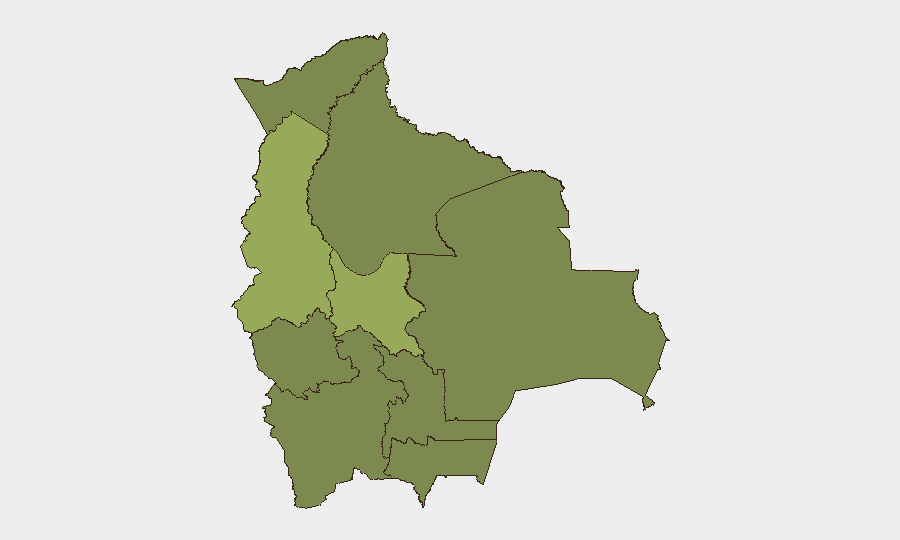
Situation Summary
Bolivia remains classified as a moderate-risk jurisdiction (global rank #49, composite threat score 40) with elevated volatility concentrated in Cochabamba and La Paz. Recent 48-hour signals indicate diplomatic tensions (public statements involving Peru, Spain, and Colombia), domestic institutional strain (government relations reduction, arrests involving prosecutors and judges), and localized armed incidents. The threat environment reflects a mix of inter-state rhetorical escalation, internal governance friction, and criminal activity rather than widespread civil unrest or systemic breakdown at this time.
Key Developments
- 2026-07-11 · La Paz (Government Relations): Government has reduced relations with an unnamed counterpart, signaling diplomatic friction at the executive level.
- 2026-07-11 · National (Presidential Statement): Presidential public statement issued; content and target not specified in available signals, but timing aligns with multi-state disputes.
- 2026-07-11 · Nationwide (Diplomatic): Public statement issued in dispute with Colombia; details of grievance or response not yet clarified.
- 2026-07-10 · Multi-state (Diplomatic): Public statements exchanged with Peru and Spain, suggesting coordinated or sequential diplomatic messaging.
- 2026-07-10 · National (Judicial): Prosecutor arrest/detention event; context (detainee identity, jurisdiction, charges) not yet available.
- 2026-07-09 · National (Criminal): Armed engagement reported between Bolivian security forces and criminal actor designated "Valparaiso"; location and casualty count unknown.
- 2026-07-09 · National (Judicial): Judge-prison custody dispute; suggests possible judicial or detention-facility friction.
Highest-Risk Areas
Cochabamba's composite risk score (57.9) substantially exceeds all other departments and drives the national threat profile. La Paz (44.5) remains a secondary risk hub, reflecting capital-city concentration of political, judicial, and administrative friction. Together, these two regions account for the majority of tracked institutional and diplomatic signal activity. The remaining seven departments cluster at 27.9, indicating either lower incident density or more diffuse, chronic-level threats (likely linked to narcotics trafficking, organized crime, and border-zone instability). Cochabamba's elevation likely reflects recent protest activity, coca-sector disputes, or criminal-organization clashes; La Paz reflects executive and judicial tension alongside urban crime.
How GeoBit Would Assist
Security and duty-of-care teams should deploy AOI Monitoring & Early Warning on Cochabamba and La Paz to detect escalation signals (roadblocks, protest mobilization, armed clashes) before they disrupt operations or travel corridors. Multi-language OSINT (social media, local news, radio SIGINT) would clarify the substance of current diplomatic disputes and judicial detentions in real time, reducing lag between event and corporate awareness. Routing & Network Analysis can model alternative transportation and supply-chain pathways if primary routes (particularly those linking La Paz to Cochabamba and Santa Cruz) become disrupted by civil action or security incidents.
7-Day Outlook
Diplomatic friction with Peru, Spain, and Colombia is unlikely to translate into armed escalation but may trigger tit-for-tat trade or visa measures that complicate corporate and personnel movement. Internal judicial and prosecutorial tension suggests possible institutional instability or anti-corruption action; monitor for cascade effects on mining, energy, and finance sectors. Cochabamba remains the highest-risk flashpoint for localized unrest; further armed incidents or protest mobilization there would likely cascade into supply-chain and staff-movement impacts within 48 hours.
Highest-Risk Areas — Ranked
| # | State / Region | Risk |
|---|---|---|
| 1 | Cochabamba | 57.9 |
| 2 | La Paz | 44.5 |
| 3 | Santa Cruz | 29.9 |
| 4 | Potosí | 27.9 |
| 5 | Tarija | 27.9 |
| 6 | Pando | 27.9 |
| 7 | Beni | 27.9 |
| 8 | Oruro | 27.9 |
| 9 | Chuquisaca | 27.9 |
Sources
Previous Daily Briefs
A new Bolivia brief is written every day — each with its own risk map and downloadable CSV. Here's the last week; use the calendar to go further back.
📅 Browse every day by calendar →
Highlighted days have a brief. Tap a day for that day's map & analysis, or “csv” for that day's dataset ($5).
Atlas — our AI intelligence desk — emails them this snapshot personally. Nothing else, no list.