Situation Summary
China remains at moderate-to-elevated threat posture (rank #18 globally, composite score 87). Recent signal activity reflects diplomatic friction and internal investigative activity, with 1,224 tracked events recorded. The cybersecurity sector has experienced acute volatility following a July 8 national vulnerability advisory. No large-scale civil unrest or kinetic incidents have been confirmed in the last 48 hours, but sustained signal density warrants close monitoring of Beijing and Gansu Province.
Key Developments
- Beijing, July 8, 2026: China's National Vulnerability Database issued a critical advisory flagging a "backdoor" vulnerability in Anthropic's Claude Code, prompting immediate corporate security responses across the tech sector.
- China, July 8–9, 2026: Alibaba implemented an enterprise-wide ban on Claude Code usage by employees, signaling rapid operational escalation in response to the cybersecurity advisory.
- Beijing/National level, July 7, 2026: Defence Ministry and Deputy-level public statements recorded; underlying content and intent unclear from available signals, but timing coincides with heightened diplomatic signaling.
- Shanghai, July 8, 2026: Conventional military force activity reported involving Shanghai and US-related actors; nature and scale not yet clarified in available reporting.
- July 7, 2026: Artillery/tank-level activity recorded in connection with China vs. Government actors; geographic specificity and operational context require further OSINT corroboration.
- July 9, 2026: Disapproval statements issued by European, exile, and international human rights organizations targeting China; typical of periodic advocacy activity with limited direct operational impact.
Highest-Risk Areas
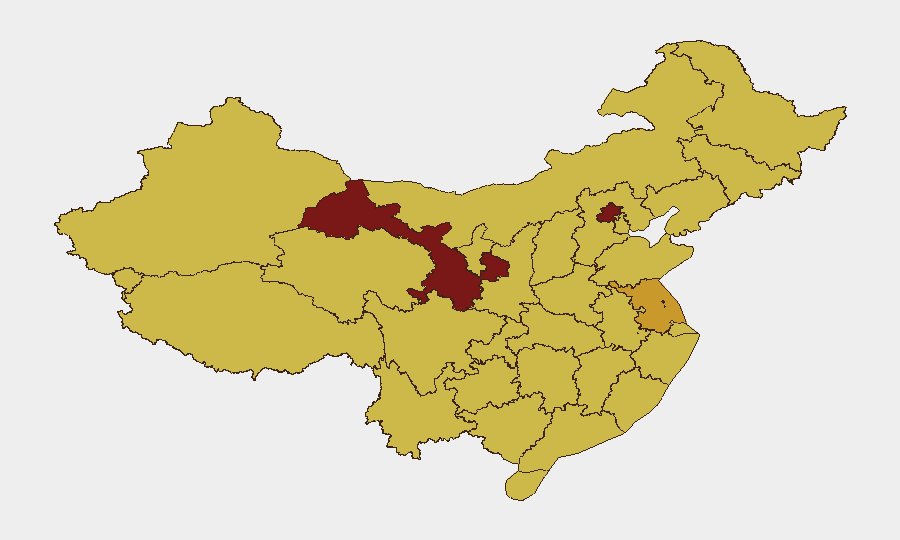
Beijing (90.9) and Gansu (84.2) dominate the sub-national threat landscape, reflecting both capital-region political and administrative risk concentration and activity in Gansu's historically sensitive border and resource-extraction zones. Jiangsu, Fujian, and the Guangdong–Zhejiang corridor (all 64–71 range) reflect economic density, cross-strait proximity, and maritime activity. Shanghai's ranking (63.2) reflects military-adjacent signals and port infrastructure criticality. The concentration of risk in Beijing and coastal/eastern provinces reflects China's political and economic geography; inland western regions like Gansu suggest persistent tension around governance and resource management.
How GeoBit Would Assist
Security teams should activate AOI Monitoring & Early Warning on Beijing (capital), Shanghai (military signals), and Gansu (emerging volatility) with 24-hour alerting thresholds. Parallel OSINT Fusion runs combining X/Twitter, Telegram, and multi-language feeds would clarify intent behind July 7–8 Defence Ministry and Deputy statements. Network & Actor Analysis and Sentiment & Temporal Analysis on Claude Code bans would track downstream supply-chain and organizational security cascades, particularly for firms with subsidiary or joint-venture exposure in China. Conflict & Military battle-mapping and Force Structure queries would validate the nature and scale of July 7–8 military-related signals before they escalate.
7-Day Outlook
Short-term trajectory remains stable but conditional. The Claude Code vulnerability and corporate response may drive secondary cyber-hygiene actions across the enterprise sector; no imminent kinetic or civil-unrest escalation is forecast. However, sustained signal density in Beijing and July 7–8 military activity warrant continued elevation of monitoring posture through mid-July. Material changes to threat posture would likely emerge from further Defence Ministry signaling or clarification of the Shanghai military activity.
Highest-Risk Areas — Ranked
| # | State / Region | Risk |
|---|---|---|
| 1 | Beijing | 90.9 |
| 2 | Gansu | 84.2 |
| 3 | Jiangsu | 71.3 |
| 4 | Fujian | 65.4 |
| 5 | Guangdong Province | 64.7 |
| 6 | Zhejiang | 64.7 |
| 7 | Hubei | 63.4 |
| 8 | Shanghai | 63.2 |
| 9 | Inner Mongolia | 62.3 |
| 10 | Liaoning | 62.2 |
| 11 | Jilin | 62.2 |
| 12 | Jiangxi | 61.8 |
Sources
Previous Daily Briefs
A new China brief is written every day — each with its own risk map and downloadable CSV. Here's the last week; use the calendar to go further back.
📅 Browse every day by calendar →
Highlighted days have a brief. Tap a day for that day's map & analysis, or “csv” for that day's dataset ($5).
Atlas — our AI intelligence desk — emails them this snapshot personally. Nothing else, no list.