Situation Summary
The Dominican Republic remains a moderate-risk jurisdiction (global rank #101, composite score 16) with concentrated vulnerabilities in urban centers, particularly Santo Domingo and the Nacional District. Over the past 48 hours, security developments have centered on routine law-enforcement operations, education-sector protests tied to the school-year opening, and infrastructure complaints in Santo Domingo Este; no large-scale violence, civil unrest, or political instability has been reported in the immediate window. The broader security environment continues to reflect organized armed robbery, drug-trafficking interdiction, and persistent homicides in high-risk provinces—patterns consistent with August's trend rather than acute escalation.
Key Developments
- National airports, August 14–20 (reported August 24): Dominican migration authorities detected 22 travelers with active Interpol and judicial alerts at airport terminals during week of August 14–20, indicating ongoing border-control interdiction of wanted individuals and potential flight-risk detection.
- Santo Domingo Este, August 23: Former president Leonel Fernández publicly criticized prolonged power outages (up to 12 hours), water-service failures, and garbage accumulation in Santo Domingo Este, citing infrastructure stress in a major urban municipality—complaints that may amplify local grievances but have not yet triggered reported street demonstrations.
- Public schools nationwide, August 24: The 2026–2027 school year opened August 24 amid teacher-union protests and disputes over classroom capacity and school construction delays; localized demonstrations are expected around schools and education offices, particularly in provinces with active union organizing.
- Santo Domingo Este (Villa Faro), August 22 (arrests): National Police announced arrest of two alleged armed-robbery gang members accused of participating in an August 14 theft of gold jewelry and USD 6,000 from a residential area; case reflects ongoing police action against organized property crime in urban neighborhoods.
- Maritime interdiction, August 21 (reported August 22–23): Dominican anti-narcotics authorities (DNCD) intercepted a fast boat carrying approximately 1.3 metric tons of cocaine and 30 packages of suspected marijuana off the southern coast after a 15-hour pursuit; three suspects detained and maritime logistics equipment seized, underscoring continued drug-trafficking activity in maritime approaches.
- Cuban diplomatic expulsion context (current): Ongoing security measures and venue monitoring remain in place following the expulsion of nine Cuban diplomats earlier in August, stemming from allegations of Cuban security-agent infiltration at the Central American and Caribbean Games in Santo Domingo to monitor athlete defections.
Highest-Risk Areas
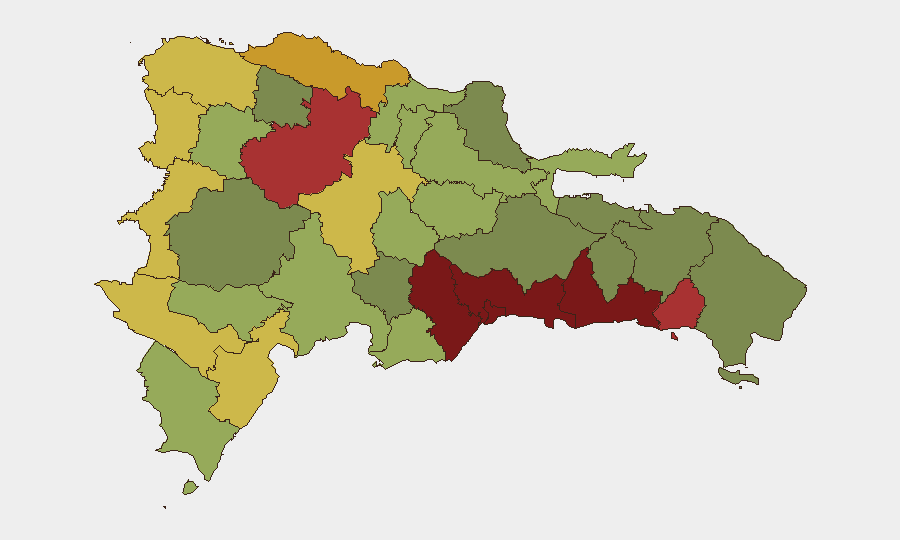
Santo Domingo, Nacional District, and San Cristóbal dominate the sub-national risk ranking (scores 92, 88, 85 respectively), driven by concentrated urban crime, armed robbery networks, and homicide rates that exceed national averages. San Pedro de Macorís and La Romana (scores 83, 78) reflect continued trafficking and organized-crime presence in their ports and residential districts. Border provinces—Elías Piña, Dajabón, and Independencia—rank moderately high (70, 68, 64), reflecting cross-border smuggling and contraband flows. Corporate teams with personnel or assets in Santo Domingo, Santiago, or Puerto Plata face elevated exposure to armed robbery, carjacking, and localized violence; avoidance of high-crime neighborhoods and nighttime movement restrictions remain essential duty-of-care measures.
How GeoBit Would Assist
Security teams should employ Intel Sweep and multi-language OSINT fusion to track organized-robbery networks, drug-trafficking patterns, and labor-protest organizing in real time across high-risk provinces. AOI Monitoring with persistent alerting on Santo Domingo Este, Santiago, and airport perimeters would enable early detection of protest escalation, gang activity, or infrastructure failures. Network & Actor Analysis would map criminal-group structures and trafficking logistics to inform route planning and personnel-movement protocols.
7-Day Outlook
No significant political, environmental, or security catalysts are forecast for the next 7 days; education-sector protests may generate localized traffic disruptions and demonstration activity around schools through late August. Organized armed robbery, drug interdiction, and low-level homicides will likely persist at current rates. Infrastructure complaints in Santo Domingo Este may trigger community grievances but are unlikely to spark major civil unrest absent acute service collapse.
Highest-Risk Areas — Ranked
| # | State / Region | Risk |
|---|---|---|
| 1 | Santo Domingo | 92 |
| 2 | Nacional District | 88 |
| 3 | San Cristóbal | 85 |
| 4 | San Pedro de Macorís | 83 |
| 5 | La Romana | 78 |
| 6 | Santiago | 76 |
| 7 | Puerto Plata | 72 |
| 8 | Elías Piña | 70 |
| 9 | Dajabón | 68 |
| 10 | Barahona | 65 |
| 11 | Independencia Province | 64 |
| 12 | La Vega | 62 |
Sources
Previous Daily Briefs
A new Dominican Republic brief is written every day — each with its own risk map and downloadable CSV. Here's the last week; use the calendar to go further back.
- August 23, 2026
- August 22, 2026
- August 21, 2026
- August 20, 2026
- August 19, 2026
- August 18, 2026
- August 17, 2026
📅 Browse every day by calendar →
Highlighted days have a brief. Tap a day for that day's map & analysis, or “csv” for that day's dataset ($5).
Atlas — our AI intelligence desk — emails them this snapshot personally. Nothing else, no list.