Situation Summary
Georgia remains a stable but fragmented security environment, with a composite national threat score of 18 (global rank #90) but pronounced regional volatility concentrated in the north and central territories. The country is experiencing sustained political tension—637 consecutive days of anti-government protests in Tbilisi—alongside routine violent crime in urban centers and elevated risks in disputed territories (Abkhazia, South Ossetia). No major security incidents have been recorded in the last 24–48 hours, and current threat trajectory appears stable absent new political escalation or border-region incidents.
Key Developments
- Nationwide drug enforcement (26–27 Aug): Georgia's Interior Ministry conducted a coordinated narcotics operation resulting in 26 arrests—15 for trafficking—and seizure of ~33 kg hashish, cocaine, heroin, and cultivation equipment valued at ~6 million GEL. Operation included foreign nationals in Rustavi and signals sustained police focus on organized drug crime.
- Tbilisi protest activism (26 Aug): A 69-year-old protest participant, Shota Odishvili, was sentenced to 15 days' administrative arrest for alleged insulting of police officers during the ongoing anti-government demonstration campaign (day 637). No mass clashes reported in the last 48 hours.
- Kutaisi local protest (27 Aug): Relatives of Temo Khaduri (deceased two years prior) held a small demonstration outside the Kutaisi Prosecutor's Office demanding case reopening. No violence or arrests reported.
- Tbilisi violent crime (24–25 Aug, slightly outside 48-hour window): Police arrested two suspects—including a minor—in Old Tbilisi district on charges of group robbery and serious bodily harm. Case carries potential 9-year sentences and reflects ongoing street-crime enforcement.
- Ukraine support protest (24 Aug, slightly outside window): Minor verbal confrontation between police and Ukraine solidarity protesters near the Ukrainian Embassy in Tbilisi over use of roadway; no physical clashes. Police presence increased but protest continued on sidewalk.
- Domestic abuse and child exploitation (25 Aug): Tbilisi law-enforcement detained a father for coercing underage children to beg and confiscating collected money. Case highlights social-welfare risks in urban areas.
Highest-Risk Areas
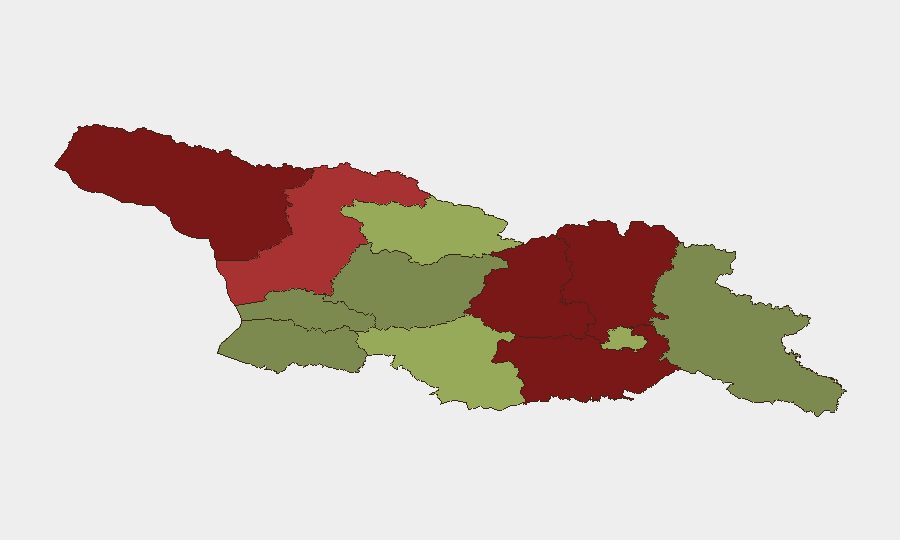
North-central and occupied territories dominate the risk profile: Abkhazia (risk 95) and Shida Kartli (88) remain acutely unstable due to unresolved territorial disputes, Russian military presence, and historical conflict legacies. Lower Kartli (85) and Mtskheta-Mtianeti (82) show elevated risk from border volatility and proximity to South Ossetia. Samegrelo-Upper Svaneti (78) faces criminality and organized-crime pressure. By contrast, Tbilisi (45)—despite visible protest activity—ranks well below the most dangerous regions, suggesting political unrest is managed and localized violent crime remains the primary urban threat.
How GeoBit Would Assist
Security teams should deploy Intel Sweep and multi-language OSINT fusion to monitor Tbilisi protest messaging (Telegram, social media) for escalation signals and cross-reference with law-enforcement press releases to anticipate administrative arrests or tactical shifts. AOI Monitoring & Early Warning on Abkhazia, South Ossetia border zones, and key government/infrastructure sites (Parliament, power plants, embassies) will detect armed movements, political violence, or credible threats before mass-media reporting. Network & Actor Analysis applied to Georgian drug-trafficking and organized-crime networks will contextualize enforcement operations and flag emerging trafficking routes affecting corporate travel or logistics.
7-Day Outlook
Near-term stability is likely absent new political developments or border provocations. Tbilisi protests will continue at current low-intensity levels barring significant government policy announcements or opposition escalation. Violent crime and drug enforcement will remain routine; watch for any incidents at critical infrastructure (power plants, ports, transportation) or escalation of police tactics against activists.
Highest-Risk Areas — Ranked
| # | State / Region | Risk |
|---|---|---|
| 1 | Autonomous Republic of Abkhazia | 95 |
| 2 | Shida Kartli | 88 |
| 3 | Lower Kartli | 85 |
| 4 | Mtskheta-Mtianeti | 82 |
| 5 | Samegrelo-Upper Svaneti | 78 |
| 6 | Samtskhe-Javakheti | 48 |
| 7 | Tbilisi | 45 |
| 8 | Racha-Lechkhumi and Kvemo Svaneti | 42 |
| 9 | Kakheti | 38 |
| 10 | Autonomous Republic of Adjara | 35 |
| 11 | Imereti | 32 |
| 12 | Guria | 28 |
Sources
Previous Daily Briefs
A new Georgia brief is written every day — each with its own risk map and downloadable CSV. Here's the last week; use the calendar to go further back.
- August 27, 2026
- August 26, 2026
- August 25, 2026
- August 24, 2026
- August 23, 2026
- August 22, 2026
- August 21, 2026
📅 Browse every day by calendar →
Highlighted days have a brief. Tap a day for that day's map & analysis, or “csv” for that day's dataset ($5).
Atlas — our AI intelligence desk — emails them this snapshot personally. Nothing else, no list.