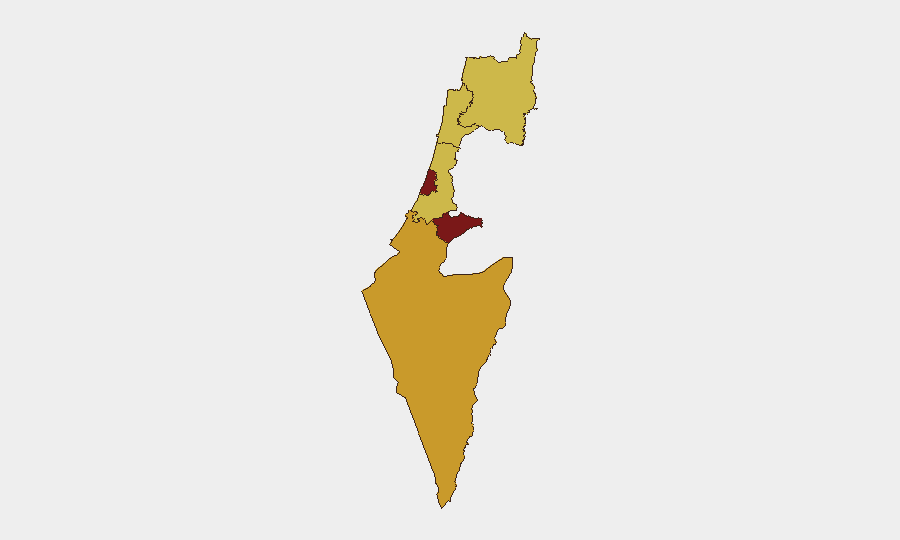
Situation Summary
Israel remains at composite threat rank #10 globally with 355 tracked security events, driven by elevated tensions with Iran (explicit threats logged 2026-07-24), ongoing northern border dynamics involving Lebanon, and heightened media/diplomatic friction. Tel-Aviv and Jerusalem districts are bearing the highest concurrent risk loads (96.5 and 80.7 respectively), suggesting concentration of sensitive activity, infrastructure, or civil unrest in urban centers. The threat environment is active but not yet escalating into sustained kinetic operations; however, the density of rhetorical and administrative actions in the past 72 hours indicates elevated baseline volatility.
Key Developments
- 2026-07-24 · Iran threat against Israel – Ministry-level threat statement recorded; specific targeting or timing unconfirmed. Assess as part of ongoing rhetorical escalation cycle but flag for elevated embassy/diplomatic compound vigilance.
- 2026-07-23 · Beirut territory occupation vs. Israel – Cross-border tension event recorded from northern frontier. Exact location and scale not yet triangulated; North District risk (68.2) reflects this sustained concern.
- 2026-07-24 · Israeli administrative action vs. Al Jazeera – Sanctions/closure action taken; may indicate government media control tightening or response to coverage. Monitor for secondary media or civil-society pushback.
- 2026-07-24 · Israeli expulsion/deportation action – Personnel action recorded; context (journalists, activists, or foreign nationals) requires clarification to assess scope and downstream political reaction.
- 2026-07-23 · Military-grade event signal (Artillery/Tanks) – Originating from NYC signal reference (likely media/statement); assess for confirmation of active weapons movement or posture change. Requires corroboration.
- 2026-07-24 onwards · Religious/civil disapproval signals – Multiple disapproval and public-statement events tied to Muslim and Islamic community voices; typical of domestic tension cycles following high-profile state actions or regional escalation rhetoric.
Note: Precise incident locations, casualty counts, and operational details for the above remain incomplete pending corroboration and live-news verification. Recommend duty-of-care teams treat these as *indicators of concern* rather than confirmed kinetic events.
Highest-Risk Areas
Tel-Aviv District (96.5) and Jerusalem District (80.7) are significantly outpacing other regions, likely due to concentration of government, diplomatic, media, and foreign-national presence in both cities—making them focal points for both direct targeting and secondary civil/political unrest. South District (72.7) remains elevated, consistent with historical proximity to Gaza and rocket-threat exposure. North District (68.2) reflects cross-border Lebanon/Syria dynamics and ongoing border-stability concerns. Urban centers are driving national risk; peripheral and rural areas show lower composite scores.
How GeoBit Would Assist
Security and duty-of-care teams should deploy Intel Sweep and multi-language OSINT fusion to capture emerging threats across Hebrew, Arabic, English, and Iranian-language media simultaneously, supplemented by X/Telegram OSINT and sentiment analysis to detect civil unrest precursors and rhetorical escalation in real time. AOI (Area-of-Interest) Monitoring with persistent alerting on Tel-Aviv and Jerusalem districts, combined with network and actor analysis, enables rapid identification of protest mobilization, security-force positioning, and transnational actor involvement before incidents reach operational scale.
7-Day Outlook
The next 7 days are likely to remain in the current elevated-baseline state, with rhetorical and administrative action continuing faster than kinetic escalation. Risk of a localized civil or diplomatic incident in Tel-Aviv or Jerusalem is materially higher than baseline; spillover into North District cannot be ruled out if Iranian or Lebanese actors respond to the 2026-07-24 threat cycle. Teams should assume operational tempo will increase if media coverage of Israeli state actions amplifies further.
Highest-Risk Areas — Ranked
| # | State / Region | Risk |
|---|---|---|
| 1 | Tel-Aviv District | 96.5 |
| 2 | Jerusalem District | 80.7 |
| 3 | South District | 72.7 |
| 4 | North District | 68.2 |
| 5 | Center District | 67.4 |
| 6 | Haifa District | 66.5 |
Sources
Previous Daily Briefs
A new Israel brief is written every day — each with its own risk map and downloadable CSV. Here's the last week; use the calendar to go further back.
📅 Browse every day by calendar →
Highlighted days have a brief. Tap a day for that day's map & analysis, or “csv” for that day's dataset ($5).
Atlas — our AI intelligence desk — emails them this snapshot personally. Nothing else, no list.