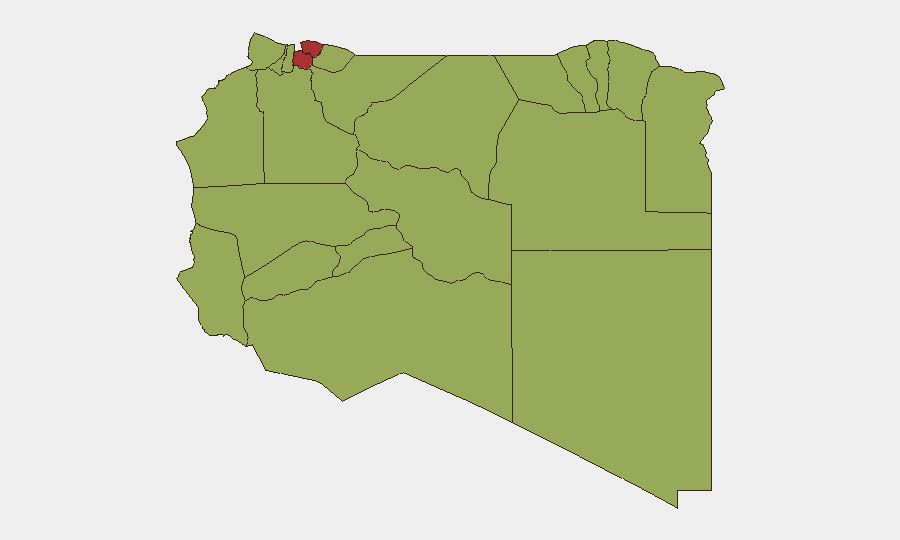
Situation Summary
Libya remains a fragmented security environment with composite threat ranking of 67 globally (#25), driven primarily by instability in northwestern urban centers and persistent operational activity in border and southern regions. The most recent corroborated security incidents date to late July 2026 (Tripoli infrastructure disruption and protest activity on 26–28 July); no independently verified new incidents have been reported in the 24–48 hours preceding 1 August. Operational tempo remains elevated but episodic rather than escalatory, with risk concentrated in two primary hotspots and distributed across southern and border districts.
Key Developments
Current open-source reporting and GeoBit intelligence feeds contain no independently verified security incidents with precise dating from 31 July or 1 August 2026. The most recent corroborated events fall outside the 24–48-hour window:
- Tripoli & Mellitah Complex, 26–28 July 2026 (>48 hours prior): Power-cut protests and subsequent storming of the Mellitah Oil & Gas facility triggered cascading power-grid shutdowns affecting the capital and surrounding infrastructure. This incident underscores vulnerability of critical energy assets to civil unrest.
- Ongoing southern border activity (mid–late July, not current): Sporadic cross-border movement and trafficking activity reported in Kufra and Murzuq districts; no new incidents confirmed in the past two days.
- Diplomatic signal (1 August): GeoBit event monitoring flagged a "Reduce Relations" diplomatic signal and an "Investigate" action code as of 1 August, suggesting potential diplomatic friction or external scrutiny, though no public statement or incident has been independently corroborated to date.
Note: Absence of new dated incidents does not indicate de-escalation; rather, it reflects the episodic nature of Libya's current threat environment and inherent reporting lags in conflict-affected regions.
Highest-Risk Areas
Tripoli and Jafara governorates jointly drive the country's risk profile, each with composite sub-national scores of 77 and accounting for the plurality of tracked events. Both are seats of institutional power, major population centers, and hubs for critical infrastructure (energy, ports, financial). Tripoli's vulnerability to civil unrest—as demonstrated by late-July infrastructure disruption—remains the primary concern for organizations with personnel or assets in northwestern Libya.
A secondary cluster of medium-risk districts (Nalut, Ghat, Az Zawiya, Wadi al Shatii, Murzuq, and Kufra, each scoring 47) spans the southern and southwestern border zones. These areas experience lower-intensity but persistent cross-border trafficking, irregular migration flows, and residual militant activity. Organizations operating in or transiting through these zones face elevated kidnapping, theft, and logistical disruption risks.
How GeoBit Would Assist
Organizations with duty-of-care or asset-protection mandates in Libya should employ AOI Monitoring & Early Warning (persistent watch on Tripoli, Jafara, and key border crossings with alerting for security events) and Intel Sweep & OSINT fusion (daily aggregation of Arabic and English news, social media, and Telegram channels for incident detection and sentiment shift). GIS & Spatial Analysis and satellite imagery assessment enable real-time route planning and assessment of critical infrastructure status (e.g., power grids, port operations) to support operational continuity and personnel movement decisions.
7-Day Outlook
No imminent escalation is forecast for the immediate week ahead. Civil unrest risk in Tripoli remains contingent on economic and energy-sector triggers; monitoring should focus on fuel prices, power-supply announcements, and protest activity in social media. Southern border areas will likely continue episodic trafficking and cross-border activity without major incident.
Highest-Risk Areas — Ranked
| # | State / Region | Risk |
|---|---|---|
| 1 | Tripoli | 77 |
| 2 | Jafara | 77 |
| 3 | Nalut | 47 |
| 4 | Ghat | 47 |
| 5 | Baladiyah Surman | 47 |
| 6 | Az Zawiya District | 47 |
| 7 | Wadi al Shatii | 47 |
| 8 | Wadi al Hayaa | 47 |
| 9 | Murzuq | 47 |
| 10 | Kufra | 47 |
| 11 | Nuqat al Khams | 47 |
| 12 | Murqub | 47 |
Sources
Previous Daily Briefs
A new Libya brief is written every day — each with its own risk map and downloadable CSV. Here's the last week; use the calendar to go further back.
📅 Browse every day by calendar →
Highlighted days have a brief. Tap a day for that day's map & analysis, or “csv” for that day's dataset ($5).
Atlas — our AI intelligence desk — emails them this snapshot personally. Nothing else, no list.