Situation Summary
Mexico's security environment remains volatile, with composite threat ranking at #6 globally and 806 tracked events. The past 24–48 hours have seen sustained violent crime across multiple states, coordinated security operations, and high-profile arrests linking municipal officials to journalist murder—signaling both operational pressure on organized crime and concerning state-level complicity. Northern and central border regions, along with Puebla and San Luis Potosí, remain acute flashpoints; trajectory suggests continued localized violence and criminal fragmentation rather than systemic de-escalation.
Key Developments
- Puebla State, July 18 – Municipal official Javier N. arrested in connection with threats against and murder of journalist Josué Martínez (killed July 16 in Texmelucan), indicating documented state-criminal nexus and elevated risk to media and civil society actors.
- La Piedad, Michoacán, July 18 – Federal and state forces detained 11 suspects, seizing firearms, narcotics, and a grenade launcher under "Buen Vecino" inter-state operation; checkpoint density and police presence increased across local corridors.
- Multi-State Operations, July 18 – Coordinated military and police sweeps across 15 states yielded dozens of arrests and weapons seizures, including dismantling of three synthetic drug labs in Cosalá (Sinaloa), Barrett rifle recovery in Matamoros (Tamaulipas), and armed incident response in Guadalupe y Calvo (Chihuahua).
- Zapopan, Jalisco, July 18 – Fatal gun attack on a man in public; victim shot in abdomen, adding to pattern of targeted killings in Guadalajara metropolitan area and raising community threat perception.
- Torreón, Coahuila, July 18 – Two men hospitalized following separate violent assaults in different neighborhoods; local reporting cites escalating direct attacks in both public and private spaces, prompting reinforced police patrols.
- Calvillo, Aguascalecientes, July 18 – Armed attack resulted in one fatality after victim was pursued into rural area; police operations and rural zone patrols initiated.
- Tamaulipas, July 18 – Vehicle-carrier trailer fire and total destruction on Victoria–Zaragoza highway; temporary traffic disruption and emergency response, with potential supply-chain impact.
- Chiapas, July 18 – Earthquake near Ciudad Hidalgo recorded; civil protection monitoring active for infrastructure and travel disruption, particularly in coastal and border areas.
Highest-Risk Areas
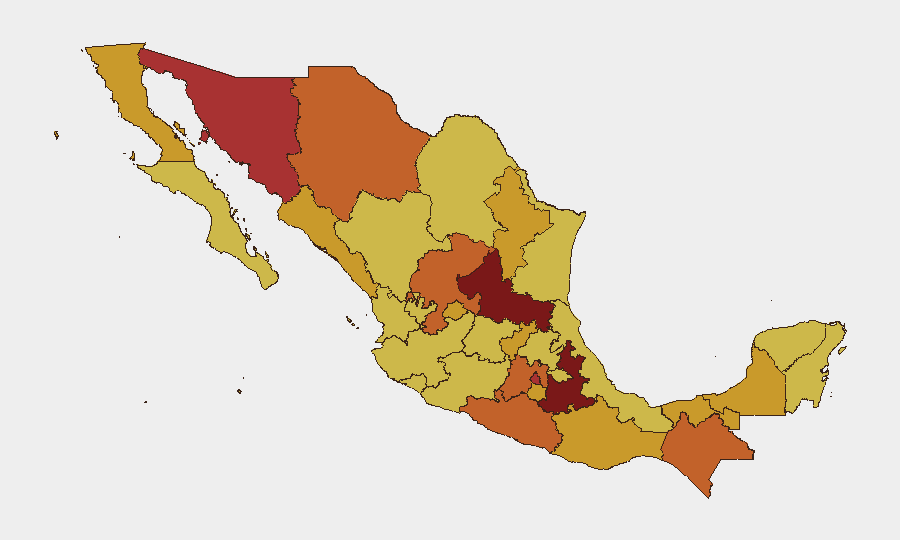
San Luis Potosí (risk 100), Puebla (80.5), and Sonora (77.1) anchor the top tier, driven by cartel territorial contestation, state-institutional fragility, and strategic smuggling corridors. Mexico City (76.3), State of Mexico, and Chiapas round out the critical band, reflecting both metropolitan organized-crime presence and rural trafficking vulnerability. The past 48 hours confirm this ranking: Puebla's arrest of a municipal official complicit in journalist murder exemplifies institutional penetration; northern operations in Sinaloa, Tamaulipas, and Chihuahua reflect ongoing cartel fragmentation and supply-chain disruption; and metropolitan zones (Jalisco, Coahuila) show sustained interpersonal violence.
How GeoBit Would Assist
Security teams would deploy AOI Monitoring & Early Warning on highest-risk municipalities (La Piedad, Puebla City, Torreón, Zapopan, Ciudad Hidalgo) to track incident clustering and tactical shifts in real time. Network & Actor Analysis linked to Intel Sweep (X/Twitter OSINT, mainstream media corroboration, entity extraction) would identify emerging state-criminal collusion patterns—as in the Puebla case—enabling duty-of-care escalation for at-risk personnel. Routing & Network Analysis would support alternative journey planning for supply chains and staff movement through volatility zones, while Conflict & Military mapping of coordinated operations helps anticipate secondary enforcement sweeps and checkpoint density shifts.
7-Day Outlook
Security operations are likely to maintain intensity, with federal forces sustaining multi-state sweeps and checkpoint networks; this may temporarily reduce street-level violence in targeted corridors but risks displacement to adjacent municipalities. State-level institutional compromise (evidenced by Puebla arrests) suggests that corporate and NGO safety relies increasingly on local threat intelligence and hardened protocols rather than official assurances. Risk trajectory remains flat to slightly elevated in Puebla, San Luis Potosí, and border zones.
Highest-Risk Areas — Ranked
| # | State / Region | Risk |
|---|---|---|
| 1 | San Luis Potosí | 100 |
| 2 | Puebla | 80.5 |
| 3 | Sonora | 77.1 |
| 4 | Mexico City | 76.3 |
| 5 | Chiapas | 75.3 |
| 6 | State of Mexico | 74.4 |
| 7 | Chihuahua | 73.8 |
| 8 | Guerrero | 73.6 |
| 9 | Zacatecas | 73.3 |
| 10 | Baja California | 72.9 |
| 11 | Sinaloa | 72.5 |
| 12 | Tabasco | 71.3 |
Sources
Previous Daily Briefs
A new Mexico brief is written every day — each with its own risk map and downloadable CSV. Here's the last week; use the calendar to go further back.
📅 Browse every day by calendar →
Highlighted days have a brief. Tap a day for that day's map & analysis, or “csv” for that day's dataset ($5).
Atlas — our AI intelligence desk — emails them this snapshot personally. Nothing else, no list.