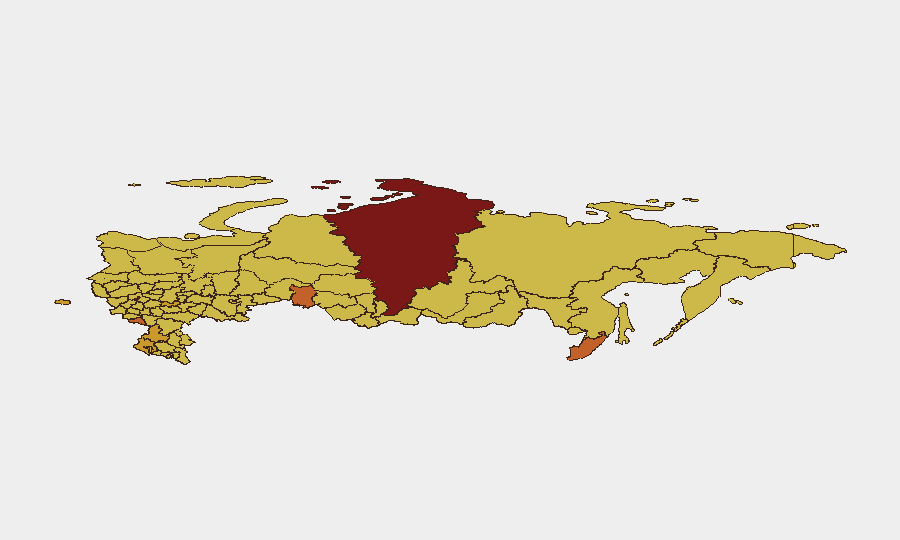
Situation Summary
Russia remains at composite threat level 4 globally, driven by active kinetic operations and infrastructure targeting. Over the past 24–48 hours, Ukrainian drone operations have achieved significant strikes on Russian air defense capacity, energy infrastructure in occupied Crimea, and shadow-fleet logistics in the Sea of Azov. Moscow's civilian centers and critical infrastructure remain under sustained pressure, with no indication of de-escalation.
Key Developments
- Yaroslavl, Yaroslavl Oblast – July 7: Ukrainian drone attack on the city wounded two civilians. Regional governor reported air defenses downed over 70 drones; Russian Defense Ministry claimed 519 drones intercepted across multiple regions overnight, suggesting a coordinated large-scale UAV operation.
- Crimea (Sevastopol) – July 7, early morning: Widespread power blackout reported across the peninsula following Ukrainian strikes on energy infrastructure. Moscow-appointed authorities attributed outages to "external impact"; partial restoration occurred via backup systems.
- Crimea energy grid – July 7: Ukrainian drone/missile strikes disrupted electricity supply infrastructure across occupied territory, causing grid instability before partial recovery. Repeated targeting of this sector indicates sustained focus on logistics and civilian comfort.
- Sea of Azov – July 7: Ukraine's military reported strikes on eight tankers from Russia's shadow fleet supplying fuel to occupied Crimea, with video evidence showing multiple vessels burning. This represents continuation of a campaign dating to at least June targeting maritime fuel logistics.
- Russian air defense saturation – July 7–8: The scale of overnight drone interceptions (519 claimed) and the successful penetration of some attacks suggests potential degradation of air defense capacity or saturation of response capability, particularly outside Moscow and major western cities.
Highest-Risk Areas
Moscow (100) and Krasnoyarsk Krai (88.9) lead the sub-national ranking; proximity to Ukrainian territory, critical infrastructure concentration, and sustained drone/missile operations drive Moscow's top-tier risk. Belgorod Oblast (74), Rostov Oblast (71.1), and Voronezh Oblast (70.6) remain elevated due to conventional military contact and cross-border targeting. Saint Petersburg (72.4) and Kaliningrad (71.5) face secondary but significant risk from maritime interdiction, energy-grid attacks, and long-range drone/missile operations. Regional capitals and transport/energy chokepoints remain prioritized targets.
How GeoBit Would Assist
Intel Sweep & OSINT fusion (Telegram, X, multi-language sources, YouTube/video intelligence) enables real-time corroboration of strike claims and casualty/damage validation across distributed Russian claims and Ukrainian counter-reporting. AOI Monitoring & Early Warning with persistent satellite and open-source feeds on critical infrastructure (Crimea energy grid, Sea of Azov ports, regional air-defense nodes) can provide 24–48-hour advance signal of operational tempo shifts before broad announcements. Conflict & Military mapping (force structure, weapons-capability tracking) combined with Network & Actor Analysis (shadow-fleet entity mapping, supply-chain visualization) allows corporate teams to model logistics disruption, maritime risk, and regional supply continuity for operations and personnel.
7-Day Outlook
Ukrainian air operations are sustaining high tempo against Russian infrastructure and logistics; expect continued drone saturation attacks on energy systems, shadow-fleet tankers, and air-defense nodes. Russian claims of large-scale interceptions should be independently verified, as successful Ukrainian penetrations suggest either degraded air defense capacity or incomplete coverage outside major metropolitan areas. Corporate operations in Moscow, Crimea, and southern/central regions should assume continued disruption to power, fuel logistics, and transportation networks over the next 7 days.
Highest-Risk Areas — Ranked
| # | State / Region | Risk |
|---|---|---|
| 1 | Moscow | 100 |
| 2 | Krasnoyarsk Krai | 88.9 |
| 3 | Omsk Oblast | 74.6 |
| 4 | Belgorod Oblast | 74 |
| 5 | Primorsky Krai | 73.9 |
| 6 | Saint Petersburg | 72.4 |
| 7 | Kaliningrad | 71.5 |
| 8 | Republic of Mordovia | 71.3 |
| 9 | Krasnodar Krai | 71.3 |
| 10 | Rostov Oblast | 71.1 |
| 11 | Leningrad Oblast | 70.8 |
| 12 | Voronezh Oblast | 70.6 |
Sources
Previous Daily Briefs
A new Russia brief is written every day — each with its own risk map and downloadable CSV. Here's the last week; use the calendar to go further back.
📅 Browse every day by calendar →
Highlighted days have a brief. Tap a day for that day's map & analysis, or “csv” for that day's dataset ($5).
Atlas — our AI intelligence desk — emails them this snapshot personally. Nothing else, no list.