Situation Summary
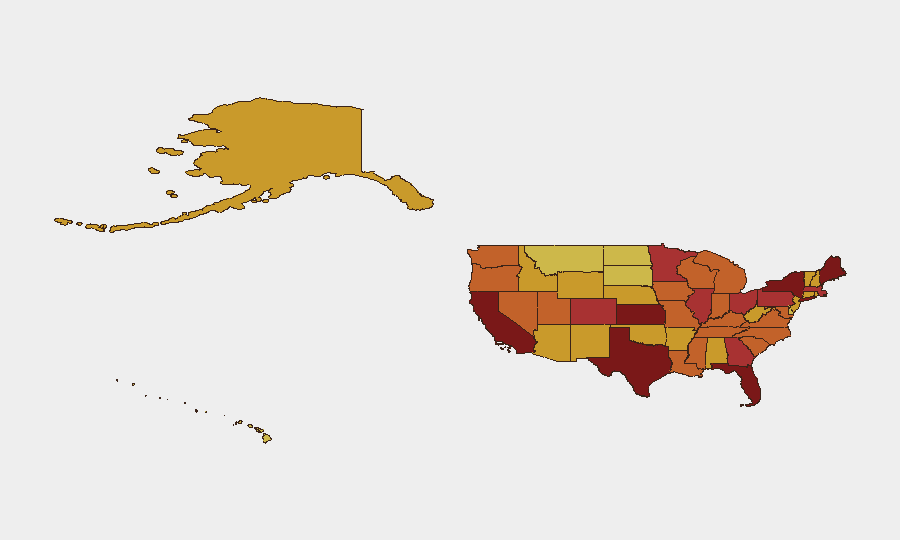
The United States remains at threat rank #2 globally with 8,921 tracked security events, reflecting a complex backdrop of civil-rights and detention-facility controversies, legislative volatility around foreign aid, vehicle-automation liability disputes, and active cyber-exploitation of legacy infrastructure. Texas leads all states in composite threat score (100), followed by California (96.9) and Maine (90.5), driven by a combination of ongoing detention-facility allegations, critical infrastructure vulnerabilities, and emerging AI-facilitation of criminal activity. Near-term risk trajectory remains elevated across multiple vectors—institutional accountability disputes, regulatory gaps in emerging technologies, and cybercriminal infrastructure disruption—with no sharp de-escalation signals evident.
Key Developments
- Katy, Texas – 15 July 2026: The National Transportation Safety Board released preliminary findings that a Tesla Model 3 driver manually overrode the vehicle's driver-assistance system before fatally striking a home, escalating liability and safety concerns around autonomous-vehicle accountability and operator override protocols.
- Conroe, Texas – 15 July 2026: Rights organizations published allegations of physical abuse, medical neglect, and legal-access obstruction at a U.S. Immigration and Customs Enforcement detention facility, prompting civil-rights investigation calls and potential institutional-accountability proceedings.
- Washington, D.C. – 15 July 2026: The U.S. House of Representatives rejected an amendment to restrict Israel aid, with nearly half of Democratic members supporting the measure, signaling internal political fracture over foreign-security assistance and sustained legislative unpredictability on defense/foreign-policy votes.
- Philadelphia, Pennsylvania – 15 July 2026: Following federal court ruling, the Trump administration installed new slavery-history panels at George Washington's historic home, reflecting ongoing public-space interpretation disputes with potential for localized civil-society mobilization or protest activity.
- Multi-jurisdictional – 15 July 2026: The FBI seized hundreds of domains operated by NetNut, a major residential proxy service, disrupting cybercriminal infrastructure used to mask malicious traffic and potentially hampering ongoing fraud and intrusion campaigns.
- Federal Cyber Advisory – 15–16 July 2026: CISA designated CVE-2008-4128, a legacy network-infrastructure vulnerability, as actively exploited in the wild and added it to the Known Exploited Vulnerabilities catalog, signaling urgent patching requirements across U.S. organizational networks.
- Multi-jurisdictional – 15 July 2026: xAI filed suit against a South Carolina defendant charged with sexual exploitation of minors, alleging misuse of the Grok AI system to generate child-sexual-abuse material, highlighting regulatory and criminal-justice gaps in generative-AI safeguards.
Highest-Risk Areas
Texas ranks as the single highest-risk state (score 100), driven by detention-facility civil-rights allegations, vehicle-automation liability incidents, and critical infrastructure exposure. California (96.9) and Maine (90.5) follow, with California's risk anchored in ongoing institutional and political volatility and Maine's elevated score reflecting emerging threat-event density. The concentration of risk in Texas and California—combined with secondary elevation in New York, Kansas, and Florida—suggests that operational security teams should prioritize monitoring of federal detention facilities, critical transportation infrastructure, and legacy network systems across these jurisdictions.
How GeoBit Would Assist
Security teams would deploy AOI Monitoring & Early Warning with persistent watch on detention facilities, critical infrastructure, and cyber-vulnerability hotspots to receive real-time alerting on institutional incidents or exploitation activity. Intel Sweep and OSINT fusion (social media, news feeds, institutional disclosures) would track emerging civil-rights disputes, regulatory violations, and policy shifts affecting operations or personnel. Network & Actor Analysis combined with Cyber intelligence would map evolving threats around proxy-service disruption, legacy-system exploitation, and AI-facilitation of crime.
7-Day Outlook
Detention-facility accountability proceedings and civil-rights litigation are likely to escalate, with media focus intensifying scrutiny of institutional practices across Texas and other high-risk states. Cyber-threat activity may temporarily shift as threat actors adapt to NetNut infrastructure loss, and legacy-system patching urgency will sustain elevated IT-security demand. Legislative foreign-policy volatility should persist, with corresponding uncertainty around security-assistance funding and regulatory priorities through early August.
Highest-Risk Areas — Ranked
| # | State / Region | Risk |
|---|---|---|
| 1 | Texas | 100 |
| 2 | California | 96.9 |
| 3 | Maine | 90.5 |
| 4 | New York | 87.7 |
| 5 | Kansas | 87.4 |
| 6 | Florida | 84.7 |
| 7 | Minnesota | 79.9 |
| 8 | Illinois | 78.5 |
| 9 | Pennsylvania | 77.5 |
| 10 | Ohio | 77.4 |
| 11 | Massachusetts | 77.2 |
| 12 | Colorado | 76.9 |
Sources
Previous Daily Briefs
A new United States brief is written every day — each with its own risk map and downloadable CSV. Here's the last week; use the calendar to go further back.
📅 Browse every day by calendar →
Highlighted days have a brief. Tap a day for that day's map & analysis, or “csv” for that day's dataset ($5).
Atlas — our AI intelligence desk — emails them this snapshot personally. Nothing else, no list.