Situation Summary
Uruguay maintains a stable, low-threat security environment with no acute incidents—terrorism, civil unrest, infrastructure disruption, or major crime spikes—reported in the past 48 hours. Baseline homicide rates remain elevated relative to prior-year comparisons (6.6% increase in Jan–Jun 2026 versus 2025), but this reflects structural crime trends rather than emergent destabilization. Security posture in high-risk urban areas continues under reinforced police and military presence announced in recent weeks. The overall risk trajectory remains consistent with Uruguay's regional standing as one of South America's more stable jurisdictions.
Key Developments
- No acute security incidents verified in the last 24–48 hours across national and regional monitoring sources; this absence is explicitly confirmed by dedicated daily threat intelligence and situational reporting for 25–26 July 2026.
- Baseline homicide concern (national, ongoing since Jan 2026): Interior Ministry data released 2026-07-21 reports 195 homicides in Jan–Jun 2026, a 6.6% increase year-on-year, with increased firearm use; this is structural context, not a new incident, but remains the primary security driver informing regional risk scores.
- No civil unrest, political instability, or travel disruptions reported for the past 48 hours; Uruguay did not feature in latest regional news coverage for acute developments.
- Organized crime and robbery/theft baseline: Robberies and thefts declined in the Jan–Jun 2026 period, while organized-crime pressure in Montevideo and Canelones continues under reinforced police/military operations (announced separately, not a new development within the last 24–48h).
Highest-Risk Areas
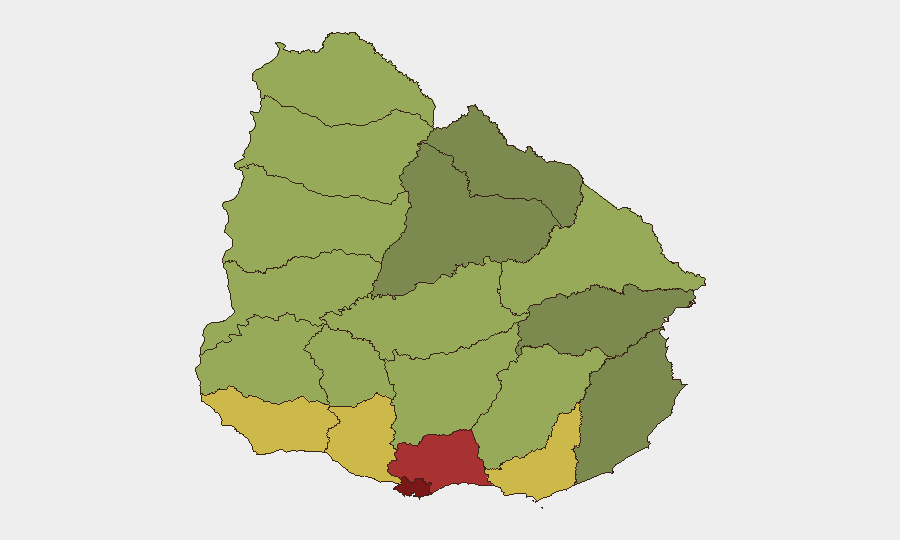
Montevideo (risk 92) and Canelones (risk 78) dominate the sub-national ranking, driven primarily by homicide density, organized-crime activity, and street crime concentration in urban and suburban sprawl zones. Maldonado (68), San José (64), and Colonia (62) follow, reflecting secondary urban centers and tourist corridors where transient populations and property crime present elevated baseline risk. Risk scores reflect structural crime patterns and gang presence rather than acute incident spikes; no single event in the last 48 hours has altered these rankings. Northern and western departments (Salto, Artigas, Paysandú, Soriano) show lower composite risk but remain areas of concern for organized-crime transit and contraband activity related to Brazil and Argentina border dynamics.
How GeoBit Would Assist
Corporate security teams with personnel or assets in Uruguay should employ AOI Monitoring & Early Warning focused on Montevideo and Canelones neighborhoods to detect shifts in crime patterns or gang activity; Intel Sweep and multi-language OSINT (X/Twitter, Telegram, local news) to track organized-crime announcements or police operations; and Network & Actor Analysis to map criminal and trafficking networks affecting supply chains or site security. Routing & Network Analysis capabilities enable alternative journey planning for personnel transiting high-risk zones, while Risk & Threat Assessment provides real-time hazard updates tied to specific geographic coordinates and operational windows.
7-Day Outlook
No acute incidents are forecast for the next seven days; the security environment is expected to remain stable at baseline homicide and property-crime levels. Continued police and military reinforcement in Montevideo may yield temporary crime-pattern disruptions but is unlikely to alter the overall risk trajectory. Monitor for organized-crime-related violence in Montevideo and Canelones should rival gangs compete for territory or respond to law-enforcement operations.
Highest-Risk Areas — Ranked
| # | State / Region | Risk |
|---|---|---|
| 1 | Montevideo | 92 |
| 2 | Canelones | 78 |
| 3 | Maldonado | 68 |
| 4 | San José | 64 |
| 5 | Colonia | 62 |
| 6 | Soriano | 58 |
| 7 | Río Negro | 56 |
| 8 | Salto | 54 |
| 9 | Artigas | 52 |
| 10 | Paysandú | 50 |
| 11 | Florida | 48 |
| 12 | Flores | 46 |
Sources
Previous Daily Briefs
A new Uruguay brief is written every day — each with its own risk map and downloadable CSV. Here's the last week; use the calendar to go further back.
📅 Browse every day by calendar →
Highlighted days have a brief. Tap a day for that day's map & analysis, or “csv” for that day's dataset ($5).
Atlas — our AI intelligence desk — emails them this snapshot personally. Nothing else, no list.