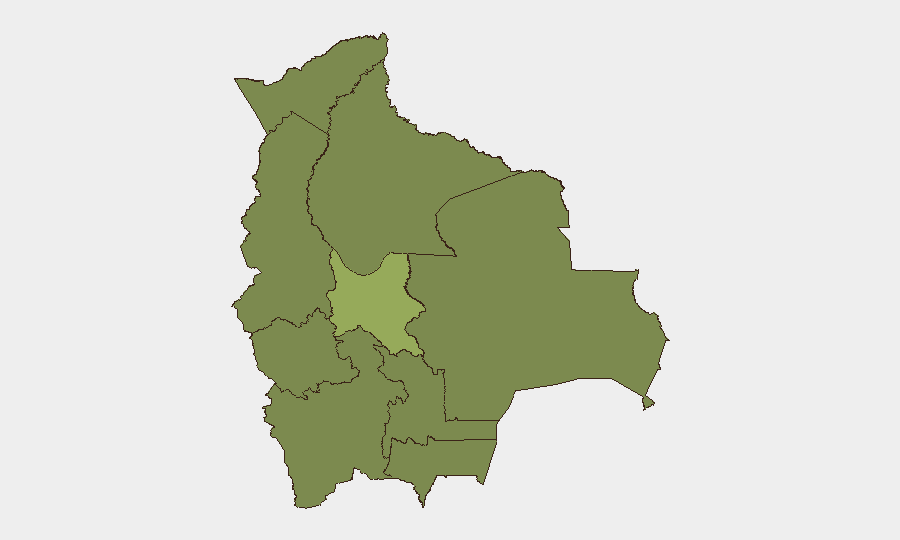
Situation Summary
Bolivia remains under a nationwide state of emergency following weeks of social unrest, with police and military actively deployed across major urban centers to suppress protests and clear roadblocks. As of 13–14 July, La Paz and El Alto continue to experience episodic confrontations between security forces and demonstrators, though authorities characterize the unrest as "largely contained." Supply-chain fragility, renewed blockade risk, and volatile protest dynamics pose ongoing threats to movement and commerce. The country's composite threat score of 38 places it at global rank #47, with Cochabamba significantly elevated above all other departments.
Key Developments
- La Paz & El Alto – Active security deployments (13–14 July). Police and military units remain positioned in central La Paz and El Alto to confront protesters and maintain order; sporadic clashes and crowd-control measures reported as of the latest security brief, with intensity expected to persist over the coming week.
- Nationwide roadblock and transport disruption (ongoing through 14 July). Protest-related barricades continue to affect national highways, airport access, and supply routes; travel advisories warn that new blockades may appear suddenly, creating unpredictable disruptions to fuel and food distribution.
- Travel advisory updates (refreshed within 48 hours). Foreign ministries have updated guidance emphasizing heightened vigilance for non-essential travel, citing renewed mobilization risk and the potential for rapid re-emergence of roadblocks on key intercity corridors.
- Supply-chain fragility (current through mid-July). Fuel shortages and distribution constraints persist following earlier blockades; analytical reporting confirms that renewed road blockages remain a credible near-term risk, creating ongoing infrastructure and logistics exposure.
- Border-region crime and smuggling activity (current). Security advisories flag enduring threats from armed drug-trafficking and smuggling groups operating in frontier zones, with authorities treating the situation as actively high-risk for travelers and security personnel.
- Urban crime in major cities (ongoing). Petty theft and occasional armed robbery continue in La Paz, El Alto, Santa Cruz, and remote tourist areas; no spike in incidents reported in the last 48 hours, but baseline risk remains elevated in crowded and peripheral neighborhoods.
Highest-Risk Areas
Cochabamba's risk score of 56.4 is more than 80% higher than any other department, reflecting concentrated political mobilization and protest activity. La Paz (31.1) remains the administrative and symbolic center of unrest, with El Alto as a critical flashpoint for confrontation between security forces and demonstrators. The remaining seven departments cluster at 26.4, indicating a more uniform baseline of civil tension but no localized spike comparable to Cochabamba or La Paz. Organizations with personnel or assets in Cochabamba should treat it as the primary constraint on normal operations; La Paz-based teams face the highest immediate risk of disrupted access and supply lines.
How GeoBit Would Assist
AOI Monitoring & Early Warning enables real-time alerts on protest mobilizations, roadblock emergence, and security deployments in Cochabamba and La Paz. Intel Sweep and OSINT fusion (X/Twitter, Telegram, local media) provide early detection of renewed blockade calls and legislative/presidential statements signaling policy shifts. Routing & Network Analysis allows security teams to pre-calculate alternative transport corridors and identify safe passage windows as conditions evolve hour-to-hour.
7-Day Outlook
Volatile conditions in La Paz and El Alto will likely persist through late July, with episodic clashes at protest sites and intermittent roadblock re-emergence. No major security escalation is forecast in the absence of new government action or legislative deadlock, but fragile supply chains and hair-trigger protest dynamics create sustained uncertainty. Organizations should maintain heightened vigilance, pre-positioned contingency plans, and real-time monitoring of security-force deployments and protest activity.
Highest-Risk Areas — Ranked
| # | State / Region | Risk |
|---|---|---|
| 1 | Cochabamba | 56.4 |
| 2 | La Paz | 31.1 |
| 3 | Santa Cruz | 26.8 |
| 4 | Potosí | 26.4 |
| 5 | Tarija | 26.4 |
| 6 | Pando | 26.4 |
| 7 | Beni | 26.4 |
| 8 | Oruro | 26.4 |
| 9 | Chuquisaca | 26.4 |
Sources
Previous Daily Briefs
A new Bolivia brief is written every day — each with its own risk map and downloadable CSV. Here's the last week; use the calendar to go further back.
📅 Browse every day by calendar →
Highlighted days have a brief. Tap a day for that day's map & analysis, or “csv” for that day's dataset ($5).
Atlas — our AI intelligence desk — emails them this snapshot personally. Nothing else, no list.