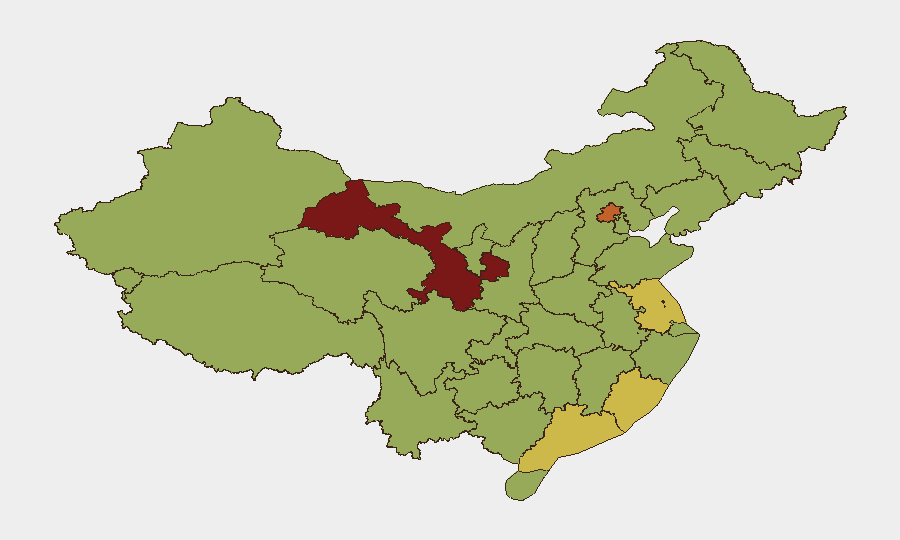
Situation Summary
China's overall security posture remains stable with a composite threat score of 80 (rank #18 globally), but two significant developments in the past 48 hours have elevated near-term operational risk: Typhoon Bavi's landfall in eastern coastal provinces and newly disclosed missing-person cases involving Taiwanese nationals on mainland China. Infrastructure and travel disruptions from the typhoon affect major port, rail, and air corridors in economically critical regions (Zhejiang, Fujian). The cross-strait disappearance issue carries political sensitivity that could influence travel safety and detention risk for Taiwan-affiliated personnel.
Key Developments
- Typhoon Bavi landfall – eastern China (Zhejiang, Fujian provinces) | 11 July 2026
Authorities evacuated 1.7+ million people and issued top-level alerts; severe coastal flooding, strong winds, and storm surge expected to persist 24–72 hours.
- Port and transport suspension – coastal/maritime corridors | 11 July 2026
Ferry services suspended; port closures and flight cancellations warned; coastal highways and rail corridors at risk; logistics and supply-chain delays likely through mid-week.
- Missing Taiwanese nationals – mainland China (locations unspecified) | 11 July 2026
Taiwan's Mainland Affairs Council reported 10 additional Taiwanese citizens missing on mainland China; case linked to concerns of arbitrary detention and incommunicado custody, raising political tension and personal-security risk for cross-strait travelers.
- Conventional military activity signals (Taiwan area) | 10 July 2026
Tracked event signal indicates military-force activity in Taiwan-related context; specifics unconfirmed but consistent with routine operational posture.
- Public statement activity (China–DPRK context) | 11 July 2026
Official statements between Beijing and Pyongyang tracked; no imminent escalation signaled, but reflects active diplomatic messaging.
- Labour/workforce statement activity | 11 July 2026
Company–worker public statement tracked; isolated, no systemic labour unrest flagged, but monitored for sentiment shift.
Highest-Risk Areas
Gansu, Beijing, and Guangdong drive China's composite risk ranking (85.7, 73.5, 65.3 respectively), though Gansu's elevation reflects longer-running geopolitical and infrastructure factors rather than acute recent events. Fujian and Zhejiang—currently bearing typhoon impact—rank within the top 6 by underlying risk score but are experiencing acute, time-limited environmental hazard rather than sustained civil or security instability. Coastal provinces (Fujian, Guangdong, Shanghai, Zhejiang, Jiangsu) show persistent mid-to-high risk; corporate and expatriate personnel in these zones should expect 3–7 day travel and logistics friction from weather recovery. Beijing's elevated score reflects ongoing political-sensitivity and enforcement activity typical of the capital.
How GeoBit Would Assist
Security teams should deploy AOI Monitoring & Early Warning on typhoon-affected corridors (ports, rail hubs, airports in Zhejiang/Fujian/Shanghai) to track real-time transport recovery and logistics bottlenecks. Intel Sweep and multi-language OSINT (X/Telegram, official statements, regional news) will surface emerging labour, detention, or cross-strait incidents that may affect personnel safety and duty-of-care exposure. Routing & Network Analysis can generate alternative supply and personnel-movement paths while coastal infrastructure recovers.
7-Day Outlook
Typhoon Bavi's impacts are expected to peak within 24–48 hours and gradually clear by mid-week (14–15 July), though port and rail delays may persist through 16 July. The Taiwanese missing-person case is likely to remain diplomatically sensitive and unresolved in the short term, increasing caution for Taiwan-linked business travelers. No systemic civil unrest or kinetic escalation is forecast, but operational friction in eastern China logistics should be factored into supply-chain and personnel-movement planning through mid-July.
Highest-Risk Areas — Ranked
| # | State / Region | Risk |
|---|---|---|
| 1 | Gansu | 85.7 |
| 2 | Beijing | 73.5 |
| 3 | Guangdong Province | 65.3 |
| 4 | Jiangsu | 64.2 |
| 5 | Fujian | 60.4 |
| 6 | Jiangxi | 59.4 |
| 7 | Hubei | 58.7 |
| 8 | Shanghai | 58 |
| 9 | Hainan Province | 56.8 |
| 10 | Jilin | 56.5 |
| 11 | Anhui | 56.4 |
| 12 | Yunnan | 56.3 |
Sources
Previous Daily Briefs
A new China brief is written every day — each with its own risk map and downloadable CSV. Here's the last week; use the calendar to go further back.
📅 Browse every day by calendar →
Highlighted days have a brief. Tap a day for that day's map & analysis, or “csv” for that day's dataset ($5).
Atlas — our AI intelligence desk — emails them this snapshot personally. Nothing else, no list.