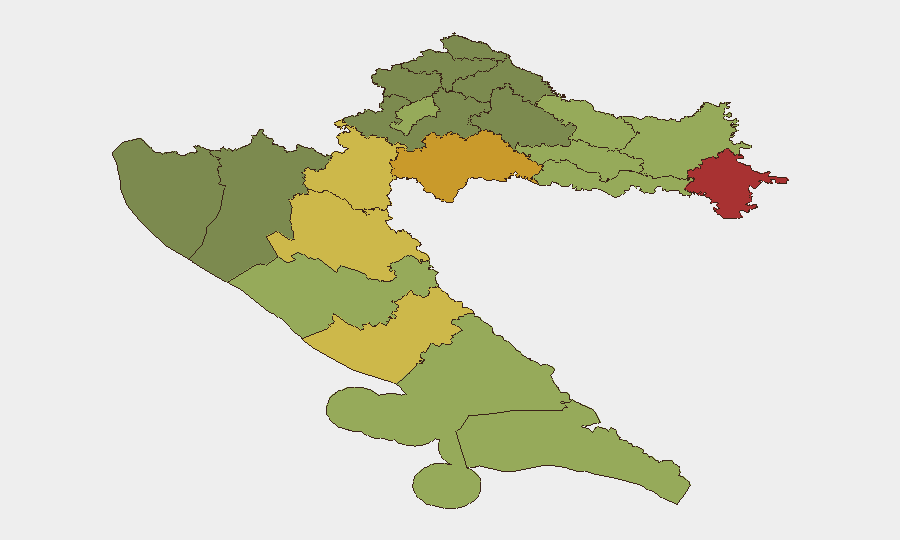
Situation Summary
Croatia's overall threat environment remains low (composite score 7; #146 globally), but acute security pressures have emerged in the last 48 hours centered on deliberately set wildfires in coastal and inland regions. Four suspects—three Croatian nationals of Serbian ethnicity and one foreign national—were arrested on 16–18 August for arson at multiple locations in Zadar County, with prosecutors examining potential terrorism linkages. The convergence of mass-casualty wildfire events, arson arrests, and ethnic-nationalist framing in the information environment has elevated tension and disinformation risk, particularly in the Adriatic coastal belt and eastern border counties.
Key Developments
- Zadar County arson arrests (16–18 Aug): Croatian police arrested four suspects for deliberately igniting fires at 10 locations on 14–15 August. Ethnicity-based social media amplification and USKOK involvement have introduced a terrorism investigation angle and elevated political sensitivity.
- Omiš coastal wildfire (Split-Dalmatia County, 13 Aug; damage assessment 16–17 Aug): A major wildfire near Lokva Rogoznica destroyed approximately 1,000 hectares, dozens of homes, and vehicles, forcing evacuations. Authorities are escalating arson investigation and linking the incident to deliberate ignition.
- Dugi Otok island wildfire (14 Aug; Zadar County area): A second wildfire near Savar village burned scrub and low vegetation, requiring 50 firefighters and indicating sustained fire-ignition activity across the region.
- Gospić hazardous-waste protest (Lika-Senj County, 16 Aug): Hundreds of residents protested an illegal hazardous-waste landfill holding ~37,000 tons, citing public health and water-safety concerns. The action reflects active environmental-governance grievances in high-risk inland regions.
- Information-environment escalation (16–18 Aug): Social media accounts amplified the arson arrests with ethnic and terrorism framings, reaching wider audiences and increasing risk of polarization or copycat incidents.
Highest-Risk Areas
Eastern border and coastal counties drive the elevated sub-national risk profile. Vukovar-Srijem, Sisak-Moslavina, and Karlovac Counties (risk scores 78, 72, 68) reflect legacy post-conflict sensitivities, mixed demographics, and infrastructure vulnerability. Zadar and Šibenik-Knin Counties (scores 55, 62) have emerged as immediate flashpoints due to the current arson cluster, wildfire damage, and the intersection of environmental hazard and deliberate ignition. Zagreb (score 50) and Split-Dalmatia (score 48) remain moderately elevated due to population density and tourism exposure.
How GeoBit Would Assist
Security teams managing personnel or assets in Croatia should deploy AOI Monitoring & Early Warning on Zadar, Šibenik-Knin, and Split-Dalmatia Counties to track fire-incident clustering and arson investigation updates in near real-time. Intel Sweep and X/Telegram OSINT would enable continuous tracking of ethnic-nationalist and disinformation narratives that could accelerate tensions or trigger further incidents. Satellite & Imagery analysis paired with GIS & Spatial Analysis would allow facility-risk teams to assess wildfire proximity to corporate or personnel locations and model alternative routing during evacuation scenarios.
7-Day Outlook
Wildfire season in the Adriatic region typically peaks through August–September, and the documented arson cluster suggests deliberate ignition campaigns may persist. Investigation outcomes and public messaging on the terrorism angle will influence community tension and copycat risk. Duty-of-care teams should maintain heightened situational awareness in Zadar, Šibenik-Knin, and coastal Split-Dalmatia through early September and establish evacuation protocols for high-heat periods.
Highest-Risk Areas — Ranked
| # | State / Region | Risk |
|---|---|---|
| 1 | Vukovar-Srijem County | 78 |
| 2 | Sisak-Moslavina County | 72 |
| 3 | Karlovac County | 68 |
| 4 | Lika-Senj County | 65 |
| 5 | Šibenik-Knin County | 62 |
| 6 | Brod-Posavina County | 58 |
| 7 | Zadar County | 55 |
| 8 | Osijek-Baranja County | 52 |
| 9 | City of Zagreb | 50 |
| 10 | Split-Dalmatia County | 48 |
| 11 | Požega-Slavonia County | 45 |
| 12 | Virovitica-Podravina County | 42 |
Sources
Previous Daily Briefs
A new Croatia brief is written every day — each with its own risk map and downloadable CSV. Here's the last week; use the calendar to go further back.
- August 16, 2026
- August 14, 2026
- August 12, 2026
- August 10, 2026
- August 8, 2026
- August 6, 2026
- August 5, 2026
📅 Browse every day by calendar →
Highlighted days have a brief. Tap a day for that day's map & analysis, or “csv” for that day's dataset ($5).
Atlas — our AI intelligence desk — emails them this snapshot personally. Nothing else, no list.