Situation Summary
The Dominican Republic remains a mid-tier global security concern (rank #101) driven principally by organized crime and gang violence, with no tracked active security events at national scale as of 25 August 2026. Homicide levels remain elevated—817 recorded January–August 2026, with August tracking as the lowest month year-to-date—indicating sustained but not acutely escalating lethal violence. Current activity centers on localized criminal incidents, sectoral labor protests in education, and community demonstrations over utilities; no indicators of imminent systemic instability or large-scale civil unrest.
Key Developments
- 24 August, Villa Jaragua (Bahoruco Province): A 27-year-old man (Oscar Alfredo Pérez) was fatally shot in La Cuesta sector in what police characterized as a "confuso incidente"; National Police arrested the alleged shooter (Xavier Vidal Féliz Ferreras, 31) the same morning, with the body transferred to INACIF in Azua for autopsy.
- 24 August, Santo Domingo (Escuela Espejo La Milagrosa, Don Bosco sector): Members of Colectivo Ciudadano por la Educación held a protest outside the school during the national 2026–2027 school-year opening ceremony, attended by President Luis Abinader; demonstrators demanded improved teacher pay, working conditions, and school infrastructure without reported disorder or confrontation.
- 24 August, countrywide: Dominican National Police released homicide statistics showing 77 deaths recorded in August 2026 (to date), the lowest monthly count in 2026; cumulative January–August total stands at 817 homicides.
- 24–25 August, multiple localities: Dispersed community protests against prolonged power outages and high electricity bills continued in various neighborhoods; demonstrations remained small-scale but created localized road disruptions and heightened tensions with utility providers.
- 24 August, countrywide (education sector): Asociación Dominicana de Profesores (ADP) continued coordinated mobilizations across district education offices, with teachers in blue demanding salary adjustments and facility repairs; union confirmed classes would commence as scheduled despite pressure actions.
Highest-Risk Areas
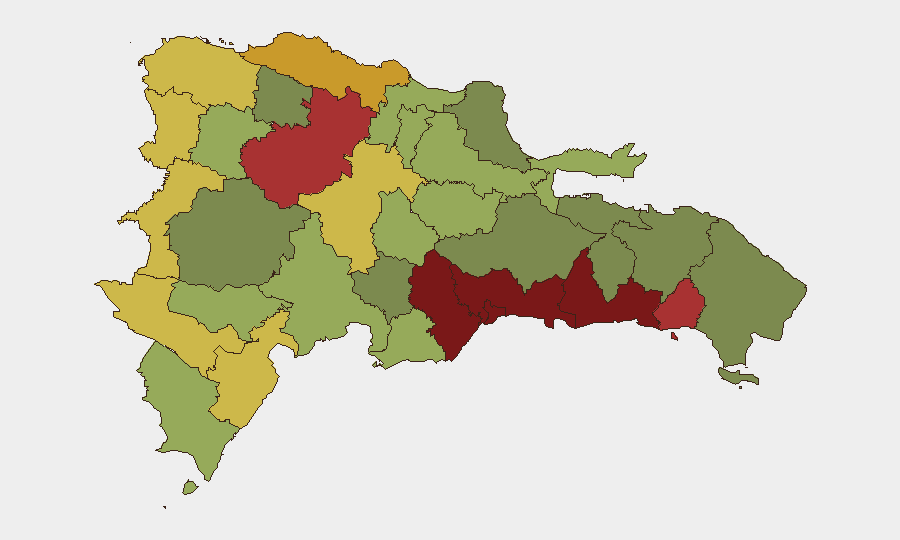
Santo Domingo (risk 92) and the Nacional District (88) anchor the country's threat landscape, driven by concentrated gang activity, armed robbery networks (including the Villa Faro gang), and persistent urban violent crime. San Cristóbal, San Pedro de Macorís, and La Romana provinces follow, reflecting smaller but significant crime concentration in the south and southeast. Northern and border provinces (Santiago, Puerto Plata, Elías Piña, Dajabón) present moderate-to-elevated risk tied to narcotics trafficking corridors and associated gang presence; the recent 21 August DNCD maritime interdiction of a South American narcotics fast boat underscores ongoing transnational drug movement. Risk in lower-ranked provinces (La Vega, Independencia, Barahona) remains material but secondary to the urban crime centers.
How GeoBit Would Assist
Teams with personnel or assets in the Dominican Republic should leverage GeoBit's Intel Sweep and OSINT fusion to monitor emerging gang activity, robbery networks, and trafficking operations in real time across the 12 highest-risk provinces. AOI Monitoring & Early Warning on Santo Domingo, Nacional District, and San Cristóbal—coupled with Network & Actor Analysis of criminal organizations—enables persistent detection of localized threats before they scale. Routing & Network Analysis provides alternative-route planning for staff transiting high-crime zones and can flag infrastructure disruptions (power outages, school closures, protest gatherings) affecting operational continuity.
7-Day Outlook
Homicide trends suggest stabilization rather than acute deterioration, but localized armed robberies and gang activity will remain consistent, particularly in Santo Domingo and provincial urban centers. Teacher and utility-sector protests may persist through early September but are unlikely to escalate to strikes or major blockades; monitor education facilities and utility-dependent operations for access delays. No indicators of destabilizing political or security shock; routine crime vigilance and labor-sector awareness remain the primary focus.
Highest-Risk Areas — Ranked
| # | State / Region | Risk |
|---|---|---|
| 1 | Santo Domingo | 92 |
| 2 | Nacional District | 88 |
| 3 | San Cristóbal | 85 |
| 4 | San Pedro de Macorís | 83 |
| 5 | La Romana | 78 |
| 6 | Santiago | 76 |
| 7 | Puerto Plata | 72 |
| 8 | Elías Piña | 70 |
| 9 | Dajabón | 68 |
| 10 | Barahona | 65 |
| 11 | Independencia Province | 64 |
| 12 | La Vega | 62 |
Sources
Previous Daily Briefs
A new Dominican Republic brief is written every day — each with its own risk map and downloadable CSV. Here's the last week; use the calendar to go further back.
- August 24, 2026
- August 23, 2026
- August 22, 2026
- August 21, 2026
- August 20, 2026
- August 19, 2026
- August 18, 2026
📅 Browse every day by calendar →
Highlighted days have a brief. Tap a day for that day's map & analysis, or “csv” for that day's dataset ($5).
Atlas — our AI intelligence desk — emails them this snapshot personally. Nothing else, no list.